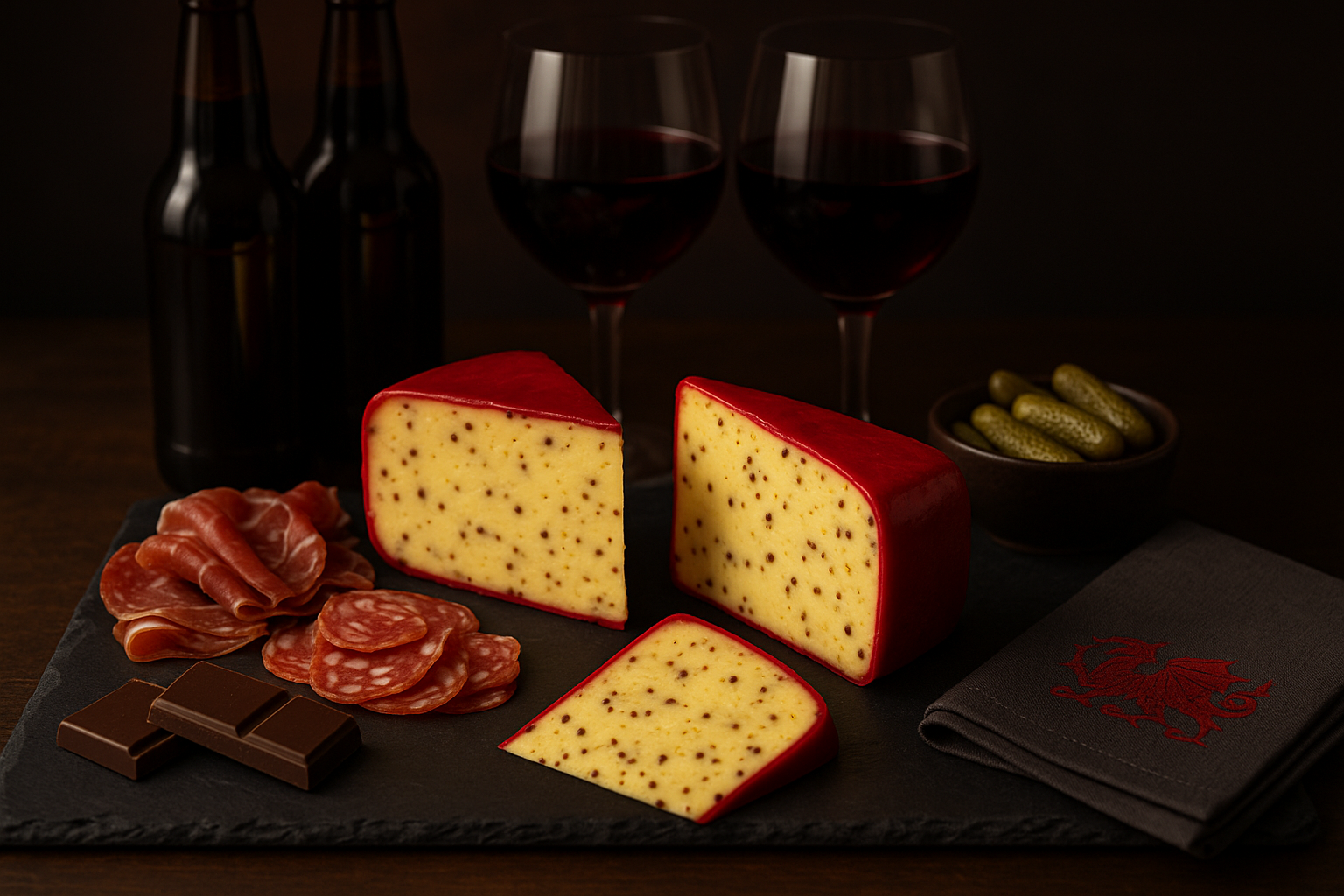
Red Dragon: The Welsh Cheese That Conquered the World
This fiery red-waxed cheddar packed with mustard seeds and ale brings the spirit of Wales to your cheese board.
Estimated Reading Time: 6 min
You've probably spotted it in the cheese case: that distinctive red-waxed wheel dotted with dark mustard seeds. Red Dragon cheese looks like something from a medieval feast, and in many ways, it is. This isn't just another flavored cheddar. It's a modern interpretation of Welsh culinary tradition that has become one of Britain's most successful cheese exports. Whether you know it as Red Dragon or its Welsh name Y Fenni (pronounced "uh-VEN-ee"), this cheese tells a story of cultural pride, industrial innovation, and the power of bold flavors.

The Welsh Soul in an English Body
Red Dragon's story begins in 1981 in Abergavenny, Wales, where Thelma and Gwynfor Adams created what they called Y Fenni. Named after the Welsh word for their market town, this cheese was part of a "Welsh Cheese Renaissance" that sought to reclaim local food identity after decades of industrial standardization.
The original concept was brilliant in its simplicity: take quality cheddar curds and blend them with two ingredients that defined Welsh pub culture: ale and mustard. The result was essentially solidified Welsh Rarebit, the traditional dish of cheese sauce made with ale and mustard served over toast.
Today, the cheese is manufactured by Joseph Heler Cheese in Cheshire, England, under license from Somerdale International. While purists might lament the move from Wales to England, the recipe remains unchanged. The cheese still captures that distinctly Welsh character, even if it's now made across the border.
What Makes Red Dragon Special
Red Dragon starts with pasteurized cow's milk from local Cheshire farms, coagulated using vegetarian rennet. The base is a three-month-aged cheddar that provides a firm yet creamy foundation. But the magic happens during the blending process.
After the cheddar is made using traditional methods, the curds are milled and mixed with wholegrain mustard (about 9% of the total) and brown ale (about 2%). The mixture is then re-pressed and aged for three months before being coated in that signature red wax.
Ingredients: Pasteurized cow's milk, wholegrain mustard (containing mustard seeds, water, white wine vinegar, salt), brown ale, mustard bran, mustard flour, salt, vegetarian rennet, honey, sugar, malt vinegar
Allergens: Contains milk, mustard
The Flavor Experience
Red Dragon delivers a sophisticated balance of four primary taste elements. The cheddar base provides rich, buttery notes with a pleasant saltiness. The wholegrain mustard seeds offer a sharp, pungent heat that travels up your nasal passage, but it's tempered by the cheese's fat content, so it's "spicy but not too hot." The brown ale contributes deep, malty, yeasty notes that add umami depth, while the vinegar in the mustard preparation brightens the entire profile.
The texture is equally compelling. The cheese itself is smooth and creamy, but every bite includes the satisfying crunch and pop of whole mustard seeds. It's like eating a perfectly balanced cheese and mustard sandwich in solid form.
Pro Pairing Tip: The Bridge Strategy
Since brown ale is literally an ingredient in Red Dragon, pairing it with the same style of beer creates what sommeliers call a "flavor bridge." The roasted malt, caramel, and nut flavors in the beer amplify the same notes that the ale contributed during manufacturing. Try it with Samuel Smith's Nut Brown Ale or Newcastle Brown Ale for the ultimate harmony.
Wine Partnerships That Work
For wine lovers, Red Dragon's bold flavors demand equally robust partners. Shiraz or Syrah tops the list because their peppery finish mirrors the mustard spice while their full body matches the cheese's density. California Zinfandel works beautifully too, its jammy fruit sweetness contrasting the saltiness while the alcohol cuts through the rich fat.
Cabernet Sauvignon offers a classic pairing, with its tannins binding to the cheese proteins and fats, softening the wine while cleansing your palate. For something different, try a traditional Rioja, whose savory, leathery notes resonate with the ale component.
Avoid delicate whites like Pinot Grigio or unoaked Sauvignon Blanc. The pungent mustard and vinegar will overwhelm their subtle flavors.
Terroir Tales: From Y Fenni to Red Dragon
The name change from Y Fenni to Red Dragon wasn't arbitrary. When Somerdale International began exporting the cheese globally, they realized "Y Fenni" would be linguistically opaque to international consumers. "Red Dragon," however, immediately evokes the Welsh flag's iconic symbol, Y Ddraig Goch. The bright red wax coating reinforces this visual connection, making the product instantly "Welsh" to anyone worldwide.
Interestingly, both versions still exist. Y Fenni, typically coated in yellow wax, is sold primarily in the UK domestic market, while Red Dragon, in its red wax coat, dominates export markets.
Cooking with Red Dragon
Red Dragon excels in melting applications. Since it's essentially solidified Welsh Rarebit, melting slices over toast recreates this traditional dish instantly, without needing to make a béchamel sauce. It's also exceptional on burgers, where the mustard seeds provide the condiment while the cheese provides the melt.
For charcuterie boards, pair Red Dragon with fatty cured meats like prosciutto or salami. The mustard acts as the acidity needed to cut through the meat's richness. Add cornichons or pickles to echo the vinegar notes, and consider dark chocolate as an unexpected but delicious companion that shares roasted flavor compounds with the ale.
Storage and Spoilage
The red wax coating is functional, not just decorative. It creates an impermeable seal that locks in moisture from the ale and mustard, giving Red Dragon its characteristic creamy texture. Once you cut into the cheese, wrap it immediately in cheese paper or vacuum seal it to prevent the texture from turning hard and translucent.
Don't panic if you see dark specks in your cheese. Those are the mustard seeds, not mold. True spoilage signs include fuzzy surface growth (blue, green, or gray), slimy texture, watery residue in packaging, or strong ammonia odors.
Pro Pairing Tip: The Instant Rarebit
For a quick appetizer that showcases Red Dragon's heritage, simply melt thick slices over toasted bread. The cheese contains all the traditional Welsh Rarebit ingredients, so you get the classic dish without any sauce-making. Finish with a sprinkle of paprika and serve with a pint of brown ale.
Finding Red Dragon in Pagosa Springs
You can find Red Dragon cheese at Murray's Cheese inside City Market, where their knowledgeable staff can help you select the perfect wedge and suggest complementary items for your cheese board.
The Dragon Family Legacy
Red Dragon isn't alone in the Welsh dragon cheese family. Other producers have created variations like Dragon's Breath (Anadl y Ddraig), which adds chili peppers for extreme heat. But Red Dragon remains the original and most widely available, a testament to the power of balancing tradition with innovation.
This cheese represents something larger than its ingredients. It's a survivor of industrial consolidation, a bridge between Welsh tradition and global markets, and proof that bold flavors can find their audience anywhere in the world. When you bite into Red Dragon, you're tasting not just mustard and ale, but the determination of Welsh cheesemakers to keep their culinary heritage alive.
Whether you're building a cheese board for friends or looking for the perfect burger topping, Red Dragon delivers complexity, tradition, and pure deliciousness in every speckled bite. It's a cheese that honors its past while embracing its future, one mustard seed at a time.
Sources and Further Reading
- Somerdale International - Leading British cheese exporter
- Joseph Heler Cheese - Third-generation family dairy in Cheshire
- Abergavenny Fine Foods - Original creators of Y Fenni
- The Cheese Report - Specialty cheese industry publication
- Welsh Food and Drink Association - Traditional Welsh food heritage
