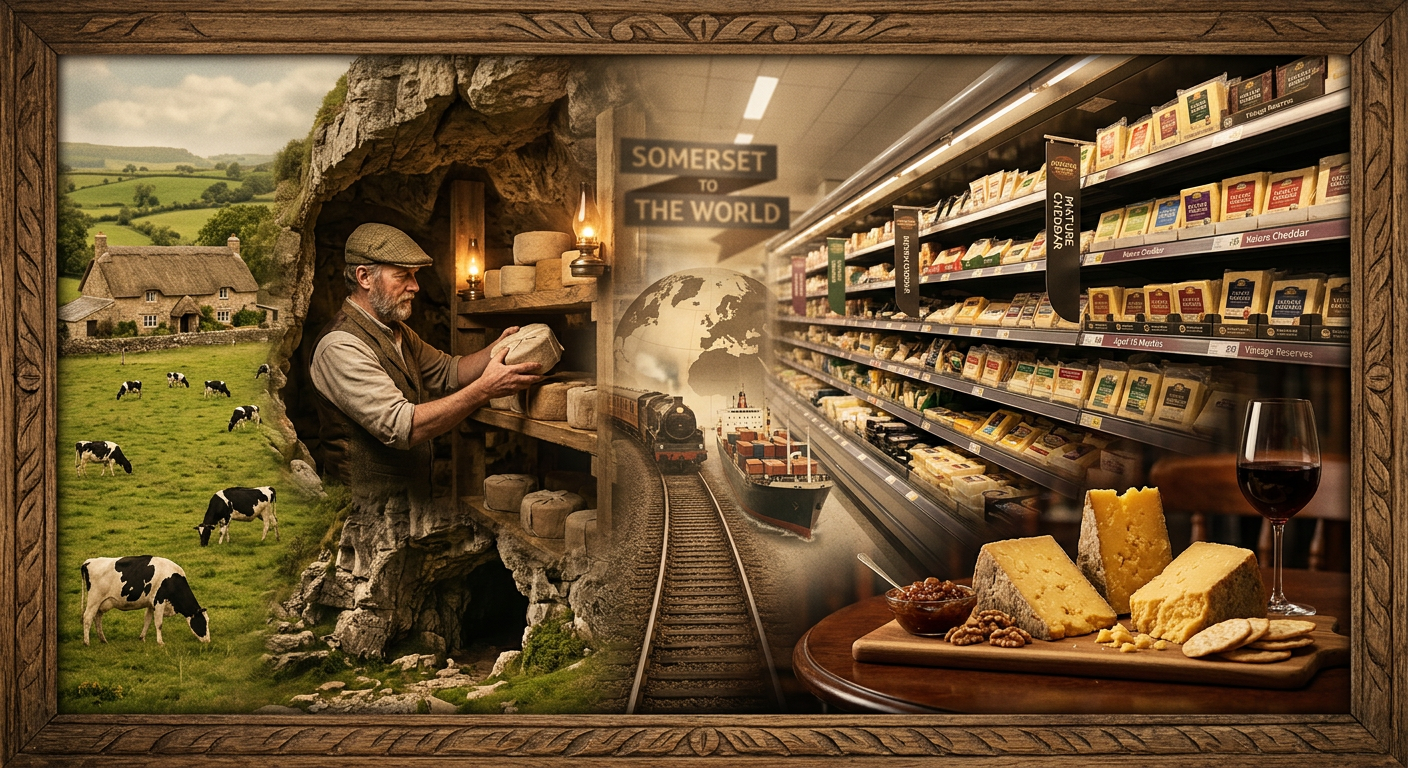
The Timeless Tale of Cheddar: From Somerset Caves to Global Phenomenon
Discover how a humble Somerset cheese became the world's most beloved dairy product through royal patronage, scientific innovation, and a unique process called "cheddaring."
Estimated Reading Time: 8 min
When you bite into a piece of sharp cheddar, you're tasting more than 800 years of history. What started as a way for Somerset farmers to preserve surplus milk has evolved into the world's most popular cheese, found in everything from grilled cheese sandwiches to gourmet cheese boards. But true cheddar isn't just any hard cheese, it's defined by a specific process that transforms ordinary curds into the complex, tangy blocks we know and love.

The story of cheddar begins in the dramatic limestone caves of Somerset's Cheddar Gorge, where constant cool temperatures and high humidity created the perfect natural aging environment long before refrigeration existed. Today, whether you're picking up a block at Murray's Cheese inside City Market or sampling artisanal varieties, you're participating in a tradition that once captivated kings and revolutionized dairy science.
The Royal Cheese That Started It All
Cheddar's rise to fame began with royal endorsement. In 1170, King Henry II purchased over 10,000 pounds of Somerset cheddar, declaring it the finest cheese in Britain. This wasn't just royal preference, it was smart economics. The king paid a farthing per pound, recognizing that this particular cheese could last for months without spoiling, making it invaluable for feeding armies and court.
By the 17th century, demand had grown so intense that authentic cheddar cost three to four times more than other premium British cheeses. During Charles I's reign, the cheese was effectively nationalized for the royal court, with buyers required to pre-pay for wheels that hadn't even been made yet.
The most spectacular example of cheddar's prestige came in 1840, when Somerset farmers combined milk from over 750 cows to create a wedding gift for Queen Victoria. The resulting wheel weighed 1,232 pounds, nearly as much as a small car. However, this mammoth cheese became the subject of a legal dispute over ownership and exhibition rights, leading locals to joke that it was "eaten up in legal fees" before the monarchy could finish it.

Pro Pairing Tip: Traditional Somerset cheddar pairs beautifully with local cider or a crisp Sauvignon Blanc. The acidity in both beverages cuts through the cheese's richness while complementing its sharp, nutty notes.
The Science Revolution: Joseph Harding's Game-Changing Methods
The transformation from artisanal guesswork to scientific precision came through Joseph Harding, often called the "Father of Cheddar Cheese." In the 1850s, Harding revolutionized cheesemaking with his famous declaration: "Cheese is not made in the field, nor in the byre, nor even in the cow, it is made in the dairy."
Harding's innovations were comprehensive:
- Mechanical precision: He introduced the "revolving breaker" for cutting curds, ensuring uniform size for even moisture removal
- Hygiene standards: Milkers had to pour milk into external receivers to keep farmyard dirt out of the clean dairy
- Scientific monitoring: Thermometers and acidity testing replaced the "rule of thumb" approach
- Knowledge sharing: Unlike competitors who guarded secrets, Harding published articles and welcomed international visitors
This open-source approach allowed cheddar techniques to spread globally. Harding's sons introduced the method to Australia and New Zealand, while he personally trained American cheesemakers who would later dominate industrial production.
Terroir Tales: Rachel Harding, Joseph's wife, traveled to Scotland to demonstrate these new techniques, proving that high-quality cheddar could be made outside Somerset. Her work helped establish Scotland's dairy industry and showed that terroir was about technique, not just geography.
The Secret of "Cheddaring": What Makes Cheddar Unique
What distinguishes cheddar from other cheeses isn't just aging, it's a specific post-coagulation process called "cheddaring." This technique creates the characteristic texture and flavor that defines authentic cheddar.
Here's how the cheddaring process works:
Step 1: Coagulation and Cutting
Milk is treated with starter cultures (Lactococcus lactis and Streptococcus thermophilus) to convert lactose to lactic acid, then rennet is added to form a firm gel. The curd is cut into small cubes to release whey.
Step 2: Scalding
Curds are gradually heated to 100-104°F while being gently stirred. This process expels more whey and firms up the curds until they feel springy to the touch.
Step 3: The Cheddaring Stage
This is where the magic happens. After draining the whey, the matted curd is cut into large rectangular blocks. These blocks are repeatedly stacked, turned, and re-stacked for 1.5 to 2 hours. The pressure forces out remaining whey while warmth allows bacteria to continue producing acid.
As the pH drops to 5.1-5.3, calcium phosphate leaches from the protein matrix. This transforms the texture from granular to smooth and fibrous, often described as resembling cooked chicken breast. This "foliated" structure is the hallmark of authentic cheddar.
Step 4: Milling and Salting
The large slabs are fed through a mill, breaking them into small chips. Salt is added (about 2% by weight) to stop bacterial activity, enhance flavor, and remove final moisture.
Step 5: Pressing
Salted curds are placed in molds and pressed under increasing pressure, from 10-20 psi initially to 40-50 psi over 12-24 hours, creating a solid, homogeneous block.
Ingredients: Traditional cheddar contains only cow's milk, salt, starter cultures, and rennet. Some varieties may contain natural coloring (annatto) for the characteristic orange hue. Contains milk; not suitable for those with dairy allergies.
The Chemistry of Aging: How Cheddar Develops Its Bite
Fresh cheddar is bland and rubbery. The complex flavors we associate with aged cheddar develop through biochemical processes during maturation:
Proteolysis: Breaking Down Proteins
This two-stage process is the primary driver of cheddar's flavor and texture:
- Primary proteolysis: Residual rennet breaks down large casein molecules into smaller peptides, softening the texture
- Secondary proteolysis: As starter bacteria die, they release enzymes that create free amino acids
Amino acids like glutamate contribute savory, umami notes, while others create the characteristic "nutty" and "earthy" aromas of aged cheddar. However, if certain peptides accumulate too rapidly, the cheese can develop unpleasant bitterness.
Lipolysis: Fat Breakdown
The breakdown of milk fats creates free fatty acids, contributing sharp, pungent notes through compounds like butyric acid.
Crystal Formation
Those white, crunchy specks in extra-aged cheddar aren't salt, they're calcium lactate crystals. These form when bacteria convert L-lactate into D-lactate, which has lower solubility and precipitates as white crystals.
Pro Pairing Tip: Young cheddars (3-6 months) pair well with light beers and white wines. Aged cheddars (2+ years) can stand up to bold red wines, porters, and even whiskey.
Cheddar Goes Global: The Colonial Cheese
Cheddar's durability made it the perfect "colonial cheese," traveling with British emigrants worldwide.
Canada: From Wheat Crisis to Cheese Empire
Cheddar's Canadian success story began with British Loyalists after the American Revolution, but truly took off during a wheat midge outbreak in Ontario. Farmers converted grain fields to dairy pastures, making cheddar their primary export. By 1900, Ontario had over 1,200 cheese factories, and cheddar was Canada's second-largest export after timber.
Canadian cheddars are known for extreme aging, often exceeding four years, resulting in intensely sharp, earthy flavors stronger than their English counterparts.
United States: The Kraft Revolution
Jesse Williams opened America's first industrial cheese factory in 1851, but James L. Kraft truly revolutionized the industry. Observing waste in retail cheese trade, Kraft patented a method in 1916 for creating shelf-stable "processed cheese." This innovation brought cheddar flavors to millions through products like Kraft Singles, providing reliable protein during both World Wars.
Australia and New Zealand: Harding's Legacy
The Harding sons directly established Southern Hemisphere production. In Australia, cheddar accounts for 55% of the cheese market, characterized by strength-based marketing (mild, tasty, sharp) and unique regional styles like "club cheese", cheddar blended with herbs or peppercorns.
The Dark Ages: Government Cheddar and Recovery
World War II nearly destroyed cheddar's diversity. The British government took control of milk production, diverting most to a single, standardized "Government Cheddar." This period reduced Britain's cheesemakers from over 3,500 before WWI to fewer than 100 by war's end.
This homogenization created a generation knowing only "one-note" acidic blocks. Recovery began in the 1970s-80s as entrepreneurs sought to reclaim traditional "nutty, crumbly, savory" versions, leading to today's artisanal renaissance.
Protecting Tradition: Modern Standards and Classifications
Today, various certifications distinguish traditional cheddar from mass-produced versions:
West Country Farmhouse Cheddar (PDO)
Registered in 2007, this Protected Designation of Origin requires milk from Somerset, Dorset, Devon, or Cornwall. The cheese must use traditional manual cheddaring and age at least nine months on the farm where milk was produced.
Quality Indicators
When shopping for quality cheddar, look for:
- Texture: Should be firm but not rubbery, with possible calcium lactate crystals in aged varieties
- Color: Natural cheddar ranges from pale yellow to deep gold; orange color comes from annatto
- Aroma: Should smell clean and slightly tangy, with nutty notes in aged varieties
- Taste: Balance of sharp, salty, and nutty flavors without excessive bitterness
Pro Pairing Tip: Store cheddar wrapped in wax paper or cheese paper, not plastic wrap, which can cause moisture buildup and off-flavors. Let it come to room temperature before serving for optimal flavor development.
The Future of Cheddar
From Somerset caves to global supermarkets, cheddar's journey reflects humanity's relationship with food preservation, scientific innovation, and cultural identity. Whether you prefer a mild, creamy young cheddar or an intensely sharp aged variety, you're participating in a tradition that spans centuries and continents.
Next time you're at Murray's Cheese in City Market, take a moment to appreciate the complexity behind that seemingly simple block of cheddar. Each bite contains the legacy of medieval farmers, royal patronage, scientific revolution, and the dedicated artisans who continue perfecting this timeless cheese.
Sources and Further Reading
- Royal Agricultural Society of England - Historical cheese production records
- International Dairy Federation - Technical standards and production methods
- Somerset County Council - West Country Farmhouse Cheddar PDO documentation
- Journal of Dairy Science - Biochemical analysis of cheese maturation
- Kraft Foods Historical Archives - Industrial cheese development
