The Holey Grail: Why Swiss Emmental Is the King of Cheeses
From ancient alpine traditions to modern scientific breakthroughs, discover how tiny hay particles create the world's most iconic cheese holes.
Estimated Reading Time: 6 min
Picture this: you're standing in front of a 200-pound wheel of cheese that's taller than a toddler and wider than a coffee table. This isn't just any cheese, it's Emmentaler AOP, the "King of Cheeses," and those famous holes aren't just for show. They're the result of a fascinating dance between bacteria, physics, and a pinch of hay dust that scientists only recently figured out. Whether you're planning your next fondue night or simply curious about what makes Swiss cheese so special, the story of Emmental will change how you see every slice.

The Valley That Started It All
Emmental cheese takes its name from the Emme River valley in Switzerland's Bern canton, where "Emmental" literally means "Emme valley" in German. This isn't just geographic trivia, the location was crucial to the cheese's development. Unlike the high alpine peaks where many Swiss cheeses originated, the Emme valley's lower altitude meant longer summers and extended grazing periods for cattle.
Historical records show cheese production in this region dating back to 1293, but the cheese we know today didn't emerge until much later. The first recorded use of "Emmentaler" appeared in 1542, and by 1557, it had already become a luxury item. That year, a Bernese councillor presented a "beautiful Emmenthaler cheese" as a prestigious wedding gift to a physician in Basel.
The real game-changer came in 1815 when Rudolf Emanuel Effinger established the first valley cheese dairy in Kiesen. This marked the transition from seasonal mountain production to year-round, industrial-scale manufacturing. Suddenly, cheesemakers could centralize milk from multiple farms and standardize their product.
Pro Pairing Tip
Emmental's nutty, slightly sweet flavor pairs beautifully with crisp white wines like Riesling or light reds like Pinot Noir. For a local touch, try it with Colorado's own Riesling from the Grand Valley AVA.

The Science Behind the Holes
For over a century, scientists thought they understood why Swiss cheese had holes. The accepted theory, proposed by American researcher William Clark in 1917, attributed the "eyes" solely to carbon dioxide gas produced by bacteria during fermentation. But this theory couldn't explain a growing crisis: the disappearing holes in modern Swiss cheese.
As dairies became increasingly sterile and traditional open milk buckets were replaced by modern milking machines, the holes became smaller or vanished entirely, a condition cheesemakers called "blind" cheese. The culprit? Cleanliness.
In 2015, researchers at Switzerland's Agroscope Institute made a breakthrough discovery using X-ray computed tomography to track cheese wheels during their 130-day ripening period. They found that carbon dioxide alone isn't enough to create holes, it needs microscopic nucleation sites to get started.
Those nucleation sites? Tiny flecks of hay dust that historically settled into milk buckets in traditional barns. These hay particles contain microscopic capillaries that trap air bubbles. When Propionibacterium freudenreichii subspecies shermanii bacteria produce carbon dioxide during fermentation, the gas migrates to these pre-existing air pockets and expands them into the characteristic holes.
Terroir Tales: The Hay Dust Solution Today's cheesemakers can control hole formation with surgical precision by adding just 5 to 10 milligrams of hay dust per 1,000 kilograms of milk. It's a perfect example of how traditional "contamination" was actually essential to the process.
Why Emmental Wheels Are Massive
A standard wheel of Emmentaler AOP weighs between 75 and 120 kilograms (165 to 265 pounds), with most averaging around 90 kilograms. These wheels measure 80 to 100 centimeters in diameter and stand 16 to 27 centimeters tall. But why so big?
The answer lies in 19th-century tax avoidance. Swiss authorities and international customs bureaus often levied duties based on the number of wheels exported, not their total weight. Cheesemakers responded by creating the largest possible wheels to maximize the amount of cheese shipped per taxable unit.
What started as a financial strategy became a defining characteristic. The massive size also served practical purposes: round wheels could be rolled across storage floors and onto transport carriages, while the lack of corners prevented cracks and mold penetration during the long aging process.
Ingredients:
- Raw cow's milk (unpasteurized)
- Natural rennet
- Salt
- Propionibacterium freudenreichii cultures
- Microscopic hay particles (for nucleation)
- Contains: Milk
The Swiss Cheese Union: A Century of Control
From 1914 to 1999, one organization controlled nearly every aspect of Swiss cheese production: the Swiss Cheese Union. This government-backed cartel was initially created to stabilize the dairy industry during World War I, but it evolved into one of the most powerful food monopolies in history.
The Union drastically simplified Swiss cheese production. Before its influence, Switzerland boasted over 1,000 regional cheese varieties. The Union restricted legal production to just three types: Emmentaler, Gruyère, and Sbrinz. Cheesemakers were forbidden from experimenting with new recipes or reviving heritage styles.
One of the Union's most lasting legacies is fondue. Facing massive cheese surpluses in the 1930s, the cartel launched an aggressive marketing campaign to transform a regional peasant dish into a symbol of Swiss national unity. They distributed fondue sets to the Swiss military and used imagery from the Heidi stories to promote "Alpine living." The campaign was so successful that fondue became globally recognized as the quintessential Swiss meal.
The Collapse and Renaissance
The Union finally collapsed in 1999 amid corruption scandals, ending 85 years of dairy hegemony. This allowed local cheesemakers to innovate once again, leading to the revival of heritage varieties and the development of new styles like the organic "Gotthelf Emmentaler," named after 19th-century novelist Jeremias Gotthelf.
Emmental vs. Its Rivals
Understanding Emmental requires comparing it to its closest relatives. While both Emmental and Gruyère are Swiss hard cheeses, they represent different branches of Alpine cheesemaking.
Emmental undergoes "warm aging" at 12°C to 20°C to stimulate the propionic acid bacteria that create holes. Gruyère, by contrast, is kept in cooler temperatures to prevent eye formation, resulting in a dense, "blind" paste. Emmental cheesemakers also add water to the vat during cooking, reducing acidity and creating the sweetness and elasticity necessary for gas bubbles to expand without fracturing the curd.
Jarlsberg, developed in Norway in 1956, represents a modern evolution. This "goutaler" (a hybrid of Gouda and Emmental techniques) uses pasteurized, micro-filtered milk and proprietary bacterial cultures, resulting in a softer, creamier cheese with more consistent flavor.
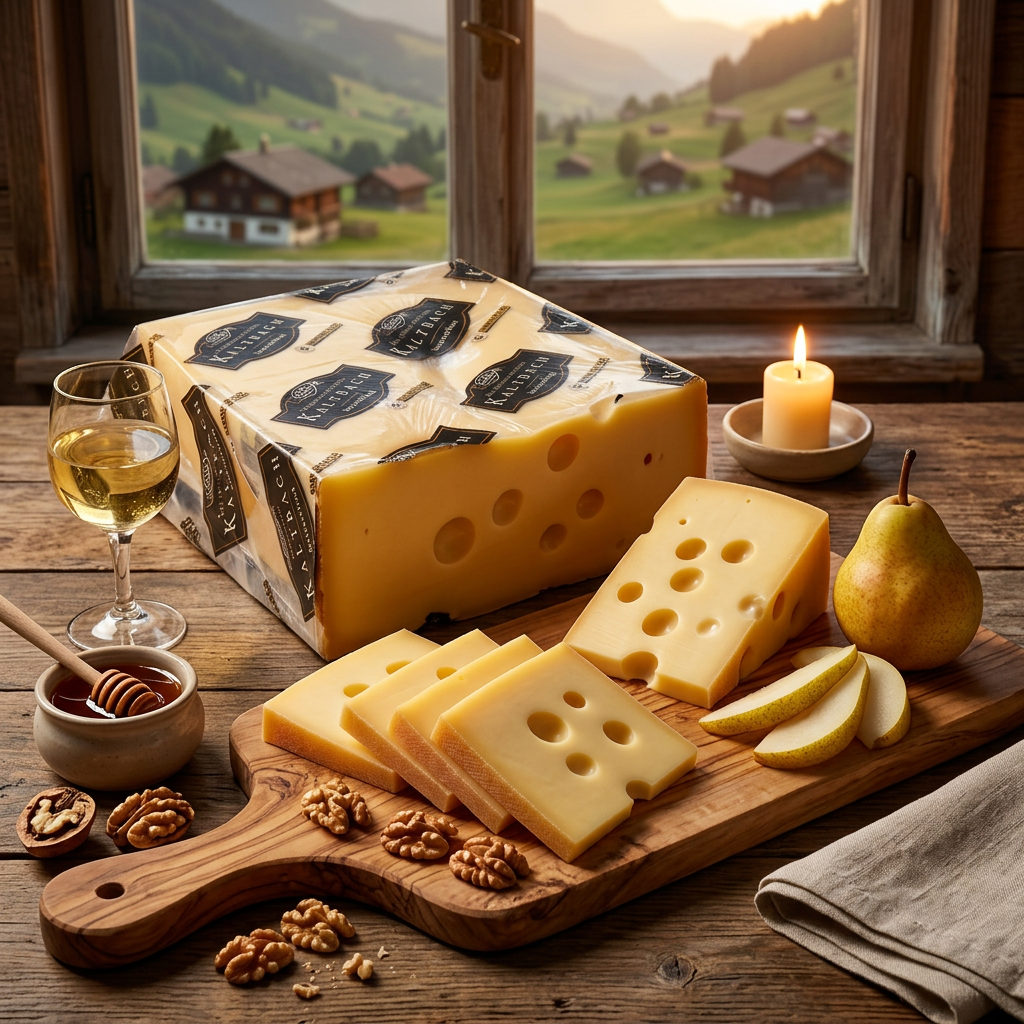
Pro Pairing Tip For the ultimate cheese board, pair aged Emmental with local Colorado honey, toasted walnuts, and fresh pears. The cheese's nutty complexity complements the honey's floral notes beautifully.
The Folklore and Philosophy of Holes
Swiss cheese has inspired its share of folklore and humor. The persistent myth that mice create the holes by nibbling through wheels has entertained children for generations, despite being biologically impossible given the cheese's density.
Swiss folklore tells of a young alpine dairyman who won his beloved's heart with a "holey" cheese recipe given to him by a mountain gnome. More philosophically, Swiss cheese inspired the "Swiss Cheese Paradox", a logic puzzle stating that the more cheese you have, the more holes you have, and therefore the less cheese you have.
When modern production methods caused holes to disappear in the early 2000s, it sparked its own wave of humor. Reddit users joked about supply chain crises in "bags of holes" or suggested the holes were diverted to provide bubbles for carpenter's levels.
American Swiss Heritage
Swiss immigrants brought Emmental traditions to America in the mid-1800s. Nicholas Gerber opened the first Green County cheese factory in Wisconsin in 1868, using traditional copper kettles and 180-pound wheel recipes. However, the labor-intensive nature of large wheels led to the development of "Baby Swiss" in the 1960s, smaller, 5-pound wheels with milder flavor and smaller eyes that better suited American tastes.
Terroir Tales: Quality Control The USDA maintains strict grading standards for Swiss cheese. To earn "Grade A" classification, eyes must be uniform, perfectly sized (between a dime and a quarter), and free from defects described as "overset," "collapsed," "dead," or "frog-mouthed."
Where to Find Authentic Emmental
For Pagosa Springs residents and visitors seeking authentic Emmentaler AOP, Murray's Cheese inside City Market offers carefully selected wheels that meet strict Swiss production standards. Look for the AOP designation, which guarantees the cheese was made in the traditional Emme valley using time-honored methods.
When shopping, examine the eyes, they should be round, glossy, and about the size of a cherry. The paste should be pale yellow with a slightly elastic texture, and the flavor should be nutty and sweet with herbal undertones that reflect the alpine meadows where the cows graze.
The Enduring Legacy
Emmental represents more than just a culinary achievement, it's a testament to human ingenuity and cultural persistence. From its origins as survival food in the Emme valley to its status as a global icon, the cheese has survived religious persecution, economic consolidation, and even the threat of "hole extinction" due to modern hygiene practices.
The Agroscope discovery that hay dust creates perfect holes is a profound irony: the very "contaminant" that modern technology sought to eliminate was essential to the cheese's most iconic feature. As traditional copper vats continue to produce these massive wheels in humid stone cellars, Emmental remains a perfect synthesis of nature's bacteria, human tradition, and just a pinch of hay.
Whether you're melting it into fondue, layering it in a sandwich, or savoring it on a cheese board with a glass of wine, remember that each hole tells a story of centuries-old traditions meeting cutting-edge science. In a world of mass production and artificial flavors, Emmental stands as a delicious reminder that sometimes the old ways, perfected over time, create something truly extraordinary.
Sources and Further Reading
- Agroscope Institute for Food Sciences - Swiss Federal Department of Economic Affairs
- Falstaff Magazine - International food and wine publication
- Swiss Cheese Marketing - Official Swiss cheese promotion organization
- Wisconsin Cheese - American dairy industry association
- Smithsonian Magazine - Science and culture publication