America's Crown Jewel: Why SarVecchio Parmesan Is Redefining What American Cheese Can Be
From Wisconsin's glacial soils to your cheese board, discover how one family's 85-year journey created America's most decorated Parmesan.
Estimated Reading Time: 6 min
Forget everything you think you know about American cheese. In the rolling hills of northern Wisconsin, something extraordinary is happening in the aging caves of Antigo. Here, wheels of SarVecchio Parmesan are quietly developing the kind of complexity that has made Italian cheese masters take notice. This isn't just another domestic attempt at European tradition, it's an American original that has won over 380 international awards and even exports back to Italy itself.

The story begins with Paolo Sartori, who arrived in Wisconsin aboard the steamship Finlandia in search of "la dolce vita", the sweet life. What he found in the Midwest's unique terroir would eventually challenge the very notion of what American cheese could achieve.
The Wisconsin Advantage: Where Glaciers Meet Gastronomy
SarVecchio's excellence starts with geography. The cheese is crafted in Wisconsin's Antigo Flats, where 10,000-year-old glacial deposits created the perfect foundation for exceptional dairy farming. The Antigo silt loam, a fertile, mineral-rich soil formed during the Wisconsin Glaciation, provides the ideal growing medium for high-protein forages that directly influence the milk's flavor profile.
"The relationship between soil and cheese is often overlooked," explains dairy science research. "The mineral content of Wisconsin's glacial soils contributes to specific enzymatic precursors in the milk, which later manifest as the fruity and savory notes characteristic of SarVecchio."
This terroir advantage is amplified by Wisconsin's unique regulatory environment. It's the only state requiring professional licenses for cheesemakers, ensuring a baseline of technical expertise that shows in every wheel. The Sartori Company employs several Master Cheesemakers who have completed the state's rigorous, multi-year certification process.

Pro Pairing Tip
When serving SarVecchio, let it come to room temperature for 30 minutes before cutting. This allows the crystalline structure to soften slightly, releasing maximum flavor while maintaining that signature crunch.
From Farm to Cave: The 20-Month Journey
SarVecchio begins its life as milk from approximately 100-120 family farms within a 70-mile radius of the production facility. These patron farms average just 75 cows each, allowing for individual animal care that larger operations can't match. The cows graze on 90% farm-grown forage, and importantly, they're never treated with synthetic growth hormones (rBST-free).
Unlike traditional Italian Parmigiano-Reggiano, which uses raw milk, SarVecchio is made with pasteurized milk. This choice allows Sartori's cheesemakers to precisely control the microbial environment, ensuring consistency while meeting strict U.S. food safety standards.
The production process follows grana-style techniques, where curds are cut to rice-grain size, the "grana" that gives this cheese family its name. But the real magic happens during the minimum 20-month aging process.
The Three Phases of Transformation
Months 1-6: Foundation Building Residual lactose converts to lactic acid, dropping the pH and expelling whey. The cheese firms and develops its basic structure.
Months 6-12: Character Development Enzymes break down large casein proteins into smaller peptides. The cheese loses its squeaky, curd-like texture and becomes dense and firm.
Months 12-20+: The Grand Finale This is where SarVecchio truly shines. Peptides break down into free amino acids, including glutamic acid (responsible for that savory umami punch) and tyrosine. Simultaneously, milk fats transform into free fatty acids, creating the cheese's signature fruity and buttery notes.
The Crystalline Crown: Understanding SarVecchio's Signature Crunch
What sets 20-month SarVecchio apart is its spectacular texture. As moisture evaporates during aging, tyrosine, an amino acid, becomes insoluble and forms hard, white crystals throughout the paste. These "prized crunchy tyrosine crystals" provide a delightful snap that indicates proper, long-term ripening.
You'll also find calcium lactate crystals, formed from the reaction of lactic acid and calcium, adding a sandy, crystalline texture. The result? A cheese that doesn't bend, it shatters into irregular shards, perfect for breaking off chunks with a traditional almond-shaped Parmesan knife.
Ingredients: Pasteurized cow's milk, salt, cheese cultures, microbial rennet Allergens: Contains milk
Terroir Tales: The Antigo Plant's Remarkable Story
The facility where SarVecchio is made has its own dramatic history. Originally a Kraft factory, the plant was slated for closure when local employees and cheesemakers, so confident in their "special" milk and process, fought to keep it running. Their determination led to a partnership with Sartori and the creation of what many now consider America's finest Parmesan.
Flavor Profile: A Symphony in Aged Milk
SarVecchio's flavor profile reads like a sommelier's tasting notes. The primary characteristic is a distinct fruitiness, think pineapple, green apple, or dried apricot, resulting from esterification during the long aging process. This is balanced by deep caramel and toffee notes, the product of slow Maillard-like reactions and amino acid concentration.
The base notes are nutty and toasted, walnut, almond, and hazelnut, while high levels of naturally occurring glutamates create that coveted umami sensation. Despite significant salt content (2-4%), the cheese maintains a beautiful sweet-salty balance, finishing with a lingering sensation of melted butter.
Pro Pairing Tip
For wine pairings, try sparkling wines like Prosecco or Champagne. The effervescence cuts through the dense proteins and fats, while the bubbles highlight the cheese's fruity notes. For beer lovers, IPAs provide a hoppy counterpoint that accentuates those tropical fruit esters.
Beyond the Cheese Board: Culinary Applications
SarVecchio's superior "meltability" makes it exceptional for cooking. Shave it over Caesar salads, grate it into risotto, or use it to create smooth, savory sauces. Its crystalline structure holds up beautifully to heat, making it ideal for everything from roasted vegetables to eggplant Parmesan.
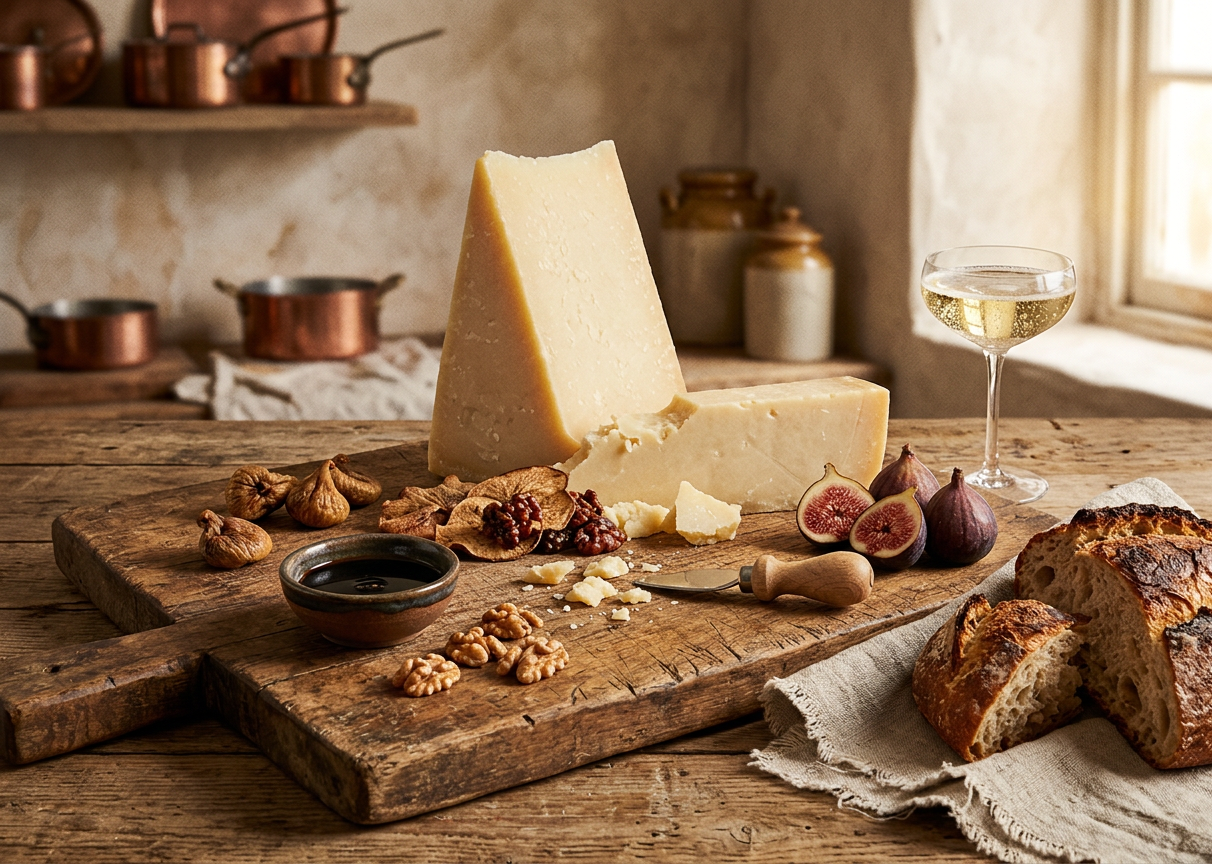
For the cheese board, pair SarVecchio with:
- Sweet elements: Red grapes, fresh figs, dried pineapple, dark chocolate
- Savory companions: Crusty artisan bread, walnuts, black olives
- Refreshing contrasts: Fennel slices, celery sticks
- Gourmet touches: Aged balsamic vinegar, wildflower honey
Quality Indicators vs. Spoilage: What to Look For
Those white specks you see? They're likely tyrosine or calcium lactate crystals, signs of quality, not spoilage. If the spots are hard and gritty (not smearable), you're looking at premium aging indicators.
Actual spoilage signs include fuzzy mold in blue, green, black, or pink shades, slimy surfaces, or off-odors reminiscent of rancid butter. Because SarVecchio is a hard cheese, small surface mold can be safely cut away (remove at least one inch around and below the affected area).
Terroir Tales: Export Success Story
In 1970, Sartori became the first U.S. company to export cheese to Japan. Even more remarkably, they were the first to export Parmesan back to Italy, a feat often compared to "selling beer to the Germans." This reverse export speaks volumes about SarVecchio's quality and the respect it has earned in international markets.
The American Original
SarVecchio represents more than just excellent cheese, it's proof that American artisans can honor tradition while creating something uniquely their own. The use of microbial rennet makes it suitable for vegetarians, while the pasteurized milk ensures safety and consistency without sacrificing complexity.
With over 380 international awards, including multiple "Best of Class" wins at the World Championship Cheese Contest, SarVecchio has earned its place among the world's great cheeses. It's currently available at specialty cheese shops and select grocery stores, including Murray's Cheese inside City Market here in Pagosa Springs.
Pronunciation Guide:
- Sartori: sar-TOR-ee
- SarVecchio: sar-VEK-ee-oh
- Parmesan: PAR-muh-zahn
Whether you're building the perfect cheese board, elevating a weeknight pasta, or simply savoring a crystalline shard with a glass of wine, SarVecchio Parmesan offers a taste of American excellence that honors the past while defining the future of domestic cheese.
Sources and Further Reading
- Wisconsin Cheese Marketing Board - Industry standards and production information
- Sartori Cheese Company - Heritage and production details
- U.S. Dairy Export Council - Export achievement recognition
- Cornell Law School - Federal cheese standards (21 CFR 133.165)
- World Championship Cheese Contest - Award documentation
