The Ancient Caves and Modern Magic Behind Murray's Cave Aged Gruyère
From Roman emperors to Queens warehouses, this Swiss cheese carries 2,000 years of history in every nutty, crystalline bite.
Estimated Reading Time: 6 min
You've probably tasted Gruyère before, but have you ever wondered why some wheels develop those satisfying crunchy crystals while others remain smooth? Or why certain varieties carry price tags that make your wallet wince? The answer lies buried 22 million years deep in Swiss sandstone and continues its journey in the unlikely setting of Long Island City, Queens. Murray's Cave Aged Gruyère represents one of the most fascinating intersections of geological accident, medieval tax evasion, and modern urban innovation in the cheese world.

The Emperor's Fatal Feast: A Legend Worth Savoring
Legend has it that Roman Emperor Antoninus Pius met his end in 161 AD not from fever or political intrigue, but from gorging himself on too much Caseus Helveticus, the ancient ancestor of modern Gruyère. While historians debate the truth of this tale, it points to something remarkable: Alpine cheesemakers had already mastered long-term preservation techniques sophisticated enough to transport their product to imperial tables in Italy.
This wasn't just any mountain cheese. The Roman naturalist Pliny the Elder documented the "Caseus Helveticus" in his Naturalis Historia around 77 AD, describing it as a product of sophisticated mountain husbandry. The Roman road system transformed what had been a local survival food into a luxury commodity that could feed legions and emperors alike.
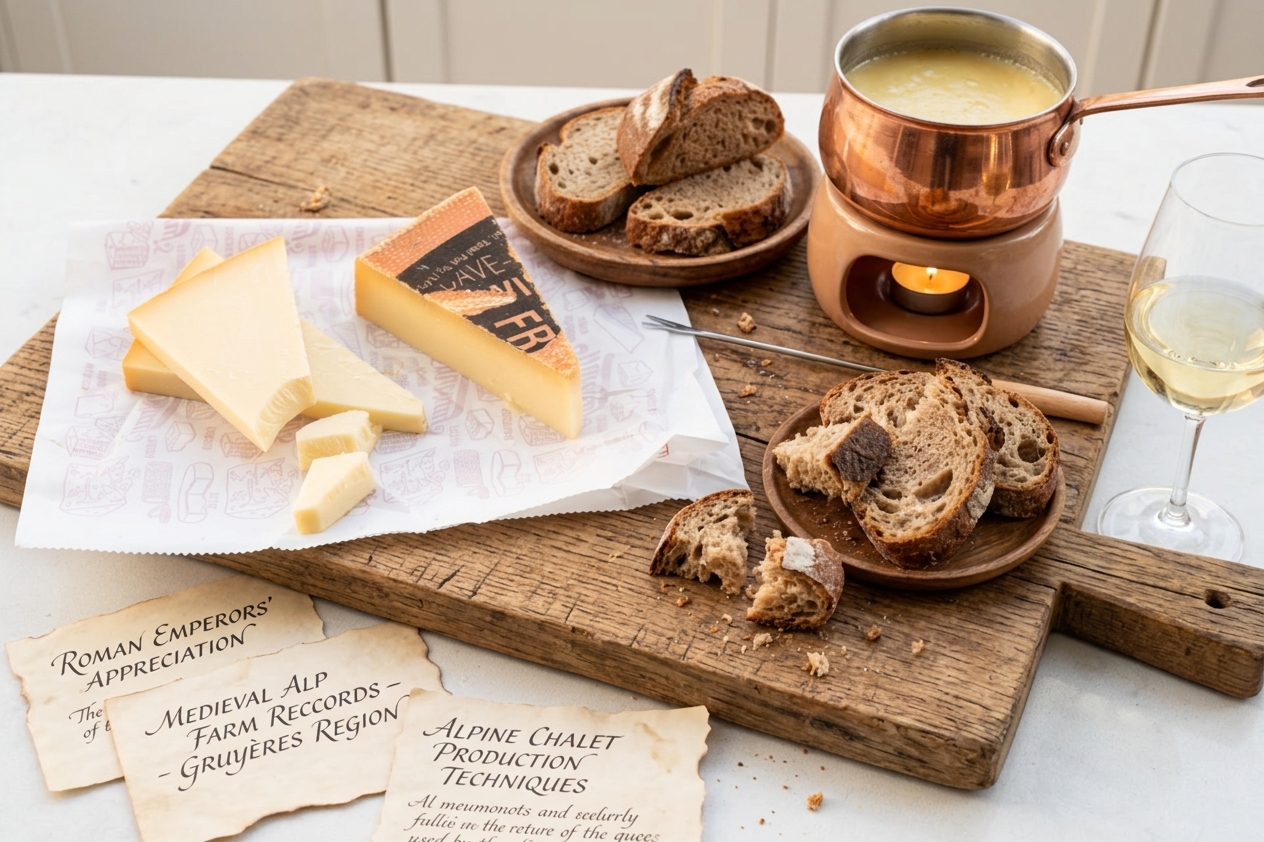
Pro Pairing Tip: Channel your inner emperor with a classic pairing. Murray's Cave Aged Gruyère melts beautifully into fondue, but try it simply with crusty bread and a glass of Swiss Chasselas wine for a more refined approach.
The 80-Pound Tax Dodge That Shaped a Cheese
Why does authentic Gruyère come in massive 80-pound wheels? The answer lies in medieval tax avoidance. In 1115 AD, Guillaume, the first Count of Gruyère, established a "cheese tax" requiring local farmers to pay a tithe to the church. Since taxes were levied per wheel rather than by weight, clever farmers realized they could minimize their burden by consolidating their entire season's milk into one enormous wheel instead of several smaller ones.

This economic pressure led to the development of what we now call "Alpine style" cheesemaking, requiring massive copper vats and high-heat cooking to stabilize large quantities of milk. The church, recognizing the value of these wheels as stable currency, began providing farmers with standardized equipment to ensure consistent quality for resale.
What started as tax evasion became the foundation for modern AOP (Appellation d'Origine Protégée) specifications. That 80-pound format, originally designed to outsmart medieval tax collectors, turned out to be the ideal size for the long, slow maturation process that develops Gruyère's characteristic tyrosine crystals and nutty depth.
The 22-Million-Year-Old Secret Weapon
The unique flavor profile of Murray's Cave Aged Gruyère begins in the Kaltbach Cave, a natural sandstone labyrinth in Switzerland's Santenberg mountain. This isn't just any cave, it's a 22-million-year-old natural incubator formed during the Miocene epoch when sand was deposited in a prehistoric sea.
The sandstone acts like a giant sponge with 20% pore volume, allowing constant water circulation and maintaining a natural humidity of 96%. The "Kaltbach" (Cold Brook) flows through the cave, regulating temperatures at a steady 50-53 degrees Fahrenheit. This environment provides the perfect conditions for preventing large wheels from drying out during their 12-to-18-month maturation.
Terroir Tales: The interaction between mineral-rich sandstone and cheese triggers specific metabolic pathways. As wheels age, they develop their signature rustic brown patina, a result of mineral deposits from the sandstone interacting with the salt-water brine used to wash the wheels. The cave's unique microflora, colonizing the sandstone over millions of years, break down proteins and fats to create those complex "roasted nut" and "caramelized onion" notes.
From Swiss Caves to Queens: The Urban Affinage Revolution
While Cave Aged Gruyère begins its life in Swiss sandstone, it finishes its maturation in a state-of-the-art facility in Long Island City, Queens. In 2004, Murray's constructed four specialized masonry caves modeled after ancient French cellars to "refine" European imports suffering from "travel fatigue."
The facility includes four distinct environments: Washed Rind, Bloomy Rind, Natural Rind, and Alpine caves. Gruyère wheels rest in the Alpine Cave, the largest space designed to handle wheels weighing up to 200 pounds. Visitors must undergo decontamination involving lab coats, hairnets, and solvent-scrubbed rubber boots to maintain the delicate microbial balance.
This "urban affinage" allows Murray's to take "green" (young) cheeses from Switzerland and add a New York twist. By finishing the aging process in Queens, cavemasters ensure the Gruyère reaches consumers at peak ripeness, a degree of control traditional importers cannot replicate.
The Copper Connection: Why Metal Matters
Under strict AOP regulations, Swiss Gruyère milk must be heated in traditional copper vats. While stainless steel dominates modern industrial dairies for ease of cleaning, it lacks the thermal and chemical properties required for authentic Alpine cheese.
Copper's superior heat conduction allows cheesemakers to raise milk temperature to exactly 135 degrees Fahrenheit with extreme precision. More importantly, trace copper ions released during heating act as catalysts for specific enzymes that break down casein proteins, resulting in an elastic, smooth paste. This is why Gruyère excels as "the fondue cheese", its copper-wrought molecular structure melts into silky, homogenous sauce without fat separation.
Pro Pairing Tip: Take advantage of Gruyère's superior melting properties beyond fondue. Try it in a croque monsieur, gratins, or simply melted over roasted vegetables. The copper-influenced protein structure ensures smooth, even melting every time.
The Crunch Factor: Understanding Tyrosine Crystals
Those satisfying crunchy white crystals in well-aged Gruyère aren't salt, they're tyrosine, an amino acid that crystallizes during the year-long proteolysis process. As enzymes from raw milk and starter cultures slowly break down casein protein chains into individual amino acids, tyrosine molecules group together as the cheese loses moisture.
For cheese experts, these crystals serve as visual and textural markers of "slow food." They represent the transformation of liquid milk into a complex, mineralized solid through patient application of time and microbes. Cheeses aged too quickly or made with pasteurized milk often fail to develop these crystals, making them a primary quality indicator for Murray's cavemasters.
The 3 AM Ritual: Labor-Intensive Perfection
Refining Cave Aged Gruyère requires 24-hour attention from cavemasters who flip and brush the 80-pound wheels with brine solution at regular intervals. This isn't merely mechanical work, it's an oral tradition passed down through generations with no written records of specific timing or pressure requirements.
In the Kaltbach cave, specialists evaluate every wheel after four months, using small hammers to tap the cheese and "listen" for internal defects. Only wheels passing this auditory and sensory test continue maturation into the 12-to-18-month Cave Aged category.
At Murray's LIC facility, cavemasters continue this labor with "ritual precision," monitoring humidity and temperature scientifically while relying on instinctual "monger's sense" to determine peak ripeness. This high-touch process justifies the premium price point of Cave Aged varieties.
The "Oniony Funk" Phenomenon
Murray's mongers frequently describe their Cave Aged Gruyère as having a "hint of oniony funk", the olfactory signature of Brevibacterium linens, the "red smear" bacteria thriving in high-humidity, high-pH cave environments.
When wheels are washed with brine, it creates conditions encouraging B. linens to flourish. These bacteria metabolize surface sugars and fats, releasing volatile sulfur compounds chemically similar to those in roasted onions and garlic. This "funk" provides savory counterpoint to the sweet, nutty "brown butter" notes of the interior paste.
Ingredients: Raw cow's milk, salt, traditional rennet, bacterial cultures. Contains milk. Aged on spruce boards in natural caves.
The Legal Meltdown: Generic vs. Protected
In 2023, the U.S. Court of Appeals ruled that "Gruyère" has become a generic term in America, meaning cheese labeled as such no longer must originate in Switzerland or France. This major defeat for Swiss sovereignty was based on the "migration factor", European immigrants brought the name and recipe to Wisconsin and elsewhere in the late 19th century, leading American consumers to perceive "Gruyère" as a style rather than a geographical indication.
For Murray's, this legal reality elevates the importance of "Cave Aged" and "Single Source" branding. While customers can buy "Gruyère" made in Wisconsin at typical grocery stores, Murray's emphasizes its direct link to Swiss Kaltbach cave and NYC secondary maturation as markers of authenticity.
Where to Find the Real Deal
Pagosa Springs residents and visitors can experience authentic Murray's Cave Aged Gruyère at the Murray's Cheese counter inside City Market. The knowledgeable staff can guide you through tasting notes and suggest perfect pairings for your mountain adventures.
Whether you're planning a sophisticated cheese board for après-ski entertaining or seeking the perfect melting cheese for a cozy fondue night, Murray's Cave Aged Gruyère delivers 2,000 years of cheesemaking evolution in every crystalline bite. From Roman emperors to modern cavemasters, this cheese represents the perfect marriage of ancient tradition and contemporary innovation, aged to perfection in caves both Swiss and American.
Sources and Further Reading
- Atlas Obscura: Kaltbach Cave documentation
- Emmi Group: Technical specifications and cave aging processes
- Murray's Cheese: Official product information and aging techniques
- European Union: AOP regulations and geographical protections
- U.S. Court of Appeals: 2023 generic name ruling documentation