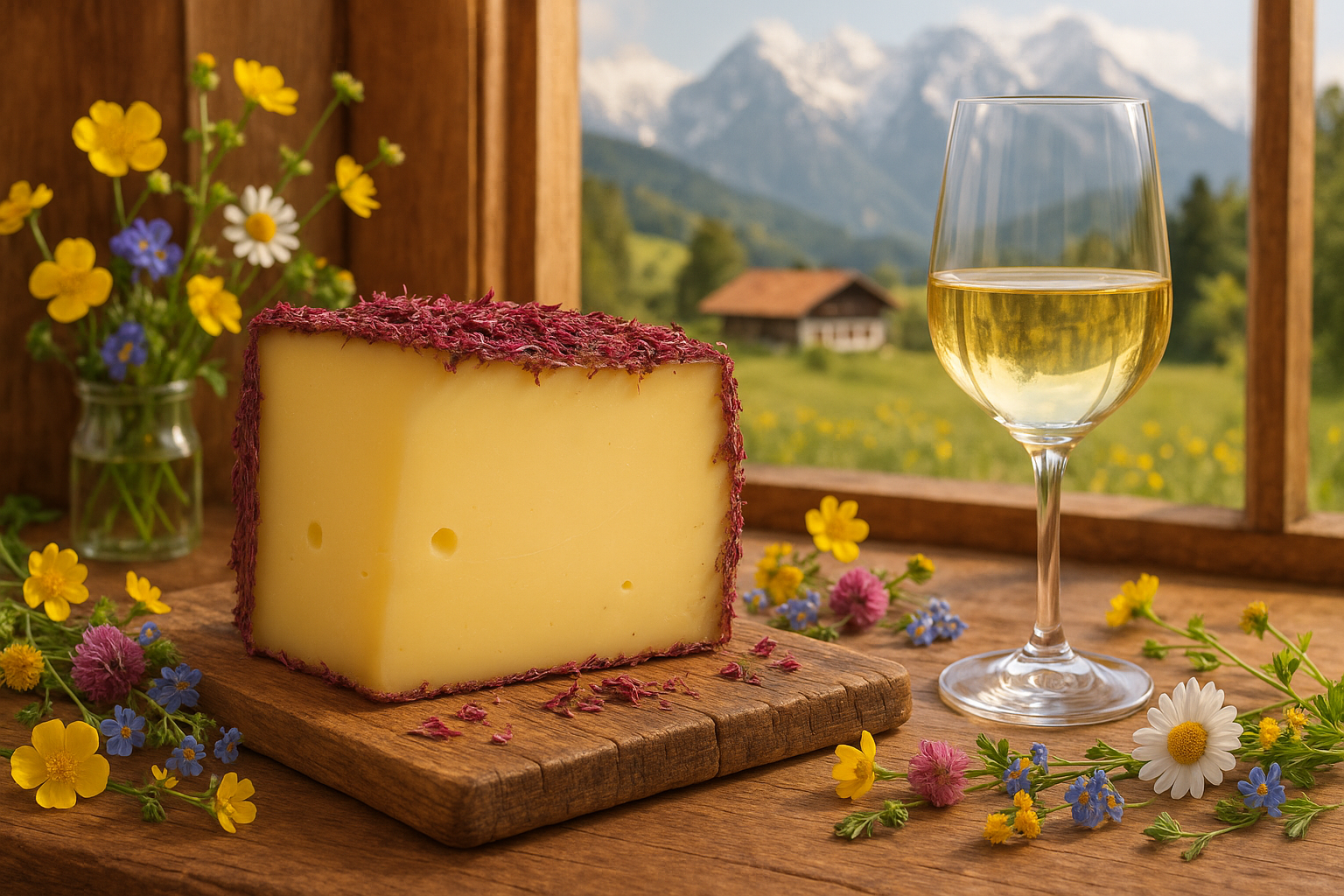
Alp Blossom: The Flower-Crowned Jewel of the Bavarian Alps
This stunning German cheese transforms traditional Alpine cheesemaking into edible art, with a vibrant coating of 13 botanicals that's as delicious as it is Instagram-worthy.
Estimated Reading Time: 6 min
Imagine unwrapping a wheel of cheese that looks like it was plucked straight from a fairy tale meadow. Alp Blossom, with its riot of colorful dried flowers and herbs pressed into a golden rind, might be the most photogenic cheese you'll ever encounter. But don't let its beauty fool you into thinking it's all show and no substance. This Bavarian masterpiece delivers a complex flavor journey that captures the essence of Alpine springtime in every bite.

Created by master cheesemaker Albert Kraus at Hofkäserei Kraus in the village of Ebersbach, this semi-hard cheese represents the perfect marriage of old-world tradition and modern artistry. What started as a simple Alpine cheese has been transformed into something extraordinary through the ancient art of affinage, the careful aging and finishing of cheese.
The Bavarian Terroir: Where Mountains Meet Meadows
Alp Blossom hails from the Allgäu region of Bavaria, Germany, nestled in the lower reaches of the Bavarian Alps at about 2,500 feet above sea level. This isn't just any dairy region, the Allgäu is the only area in Germany permitted to produce the prestigious Allgäuer Bergkäse PDO (Protected Designation of Origin), setting the gold standard for Alpine cheesemaking.
The cheese's story begins with a cross-border romance. Originally developed by the Sennerei Huban cooperative in Austria's Vorarlberg region, production moved to Germany in the late 2010s when Albert Kraus sought greater control over his milk supply and aging process. This transition brought the cheese into the heart of the "Hay Belt" (Heugürtel), a prestigious agricultural corridor stretching from Eastern Switzerland through Southern Germany into Western Austria.
Terroir Tales: The Kraus Family Legacy
Albert Kraus sources his milk from just two farms within five kilometers of his dairy, one run by his brother Xaver, the other by a close neighbor. This hyper-local approach ensures complete transparency and quality control, a rarity even in artisanal cheesemaking circles.

The Brown Swiss Advantage: Premium Milk for Premium Cheese
Every wheel of Alp Blossom begins with 100% Brown Swiss cow's milk, and this breed selection is no accident. Unlike Holstein-Friesian cattle bred for volume, Brown Swiss cows have been genetically selected over centuries for Alpine terrain and superior cheesemaking properties.
The technical superiority lies in the milk's protein and fat composition. Brown Swiss cows possess a high frequency of the β-casein BB gene variant, resulting in curds that are more elastic, provide higher yields, and demonstrate greater stability during the seven-month aging process. The milk also contains small, uniform fat globules that create the smooth, creamy texture that makes Alp Blossom so irresistible.
But here's where it gets really interesting: these cows graze on high-altitude pastures containing over 100 different plant species. This diverse diet directly impacts the milk's chemical signature, increasing concentrations of Omega-3 fatty acids and conjugated linoleic acids (CLA) while contributing to the "grassy" and "nutty" aromatic compounds that define the Alpine style.
The "Hay Milk" Standard
Alp Blossom is produced under strict "Heumilch" (Hay Milk) protocols, meaning the cows are fed absolutely no silage, fermented forage that can introduce unwanted bacteria spores. This silage-free approach ensures clean, stable fermentation and prevents the "late blowing" that can ruin aged cheeses with irregular holes and off-flavors.
Thermized vs. Raw: The Heat Treatment Debate
While many retailers label Alp Blossom as "raw," the milk is actually thermized, heated to 57-68°C (135-155°F) for 15-20 seconds. This sub-pasteurization treatment is scientifically significant because it preserves native enzymes like lipoprotein lipase and alkaline phosphatase, which catalyze the breakdown of lipids and proteins during aging, creating depth of flavor impossible with fully pasteurized milk.
Thermization also reduces spoilage bacteria while allowing beneficial "house" microflora to survive, giving the cheese its unique regional character. In the United States, thermized milk is legally treated as "raw" milk, requiring a minimum 60-day aging period, a standard Alp Blossom exceeds significantly.
The Art of Two-Phase Aging
Alp Blossom's journey from milk to masterpiece spans 4-7 months through a carefully orchestrated two-phase process.
Phase One: Building the Foundation (Months 1-4)
The cheese begins life as "Lisa," the base recipe used by Hofkäserei Kraus. During the first four months, wheels are kept in temperature-controlled cellars and frequently washed with salt brine. This encourages growth of Brevibacterium linens, creating the traditional washed-rind character that adds savory, "beefy," and funky notes to the foundation.
Phase Two: The Floral Transformation (Months 4+)
Here's where magic happens. After four months, each wheel is hand-coated with a vibrant mixture of dried Alpine flowers and herbs. This labor-intensive process involves pressing wheels into a custom blend of over 13 botanicals sourced from surrounding meadows, including cornflower, marigold, rose petals, lavender, parsley, rosemary, garlic, savory, sea salt, onion, oregano, and paprika.
The moisture on the rind acts as a natural binder, allowing the flora to become physically and chemically integrated. As aging continues, volatile aromatic compounds from the herbs, like thymol from oregano and linalool from lavender, permeate the outer layers of the paste, ensuring the floral notes aren't just decoration but are chemically present in the flavor profile.
Pro Pairing Tip: Temperature Matters
Serve Alp Blossom at room temperature for 30-45 minutes before eating. This allows the butterfat to soften and the aromatic compounds to volatilize, creating the full sensory experience.
A Symphony of Flavors
The flavor profile of Alp Blossom is remarkably complex, divided between the robust interior paste and the aromatic influence of the botanical rind.
The Interior: Alpine Comfort
The paste itself delivers deep, umami-rich savory character often compared to buttered roasted chicken or vegetable bouillon, a result of protein breakdown into free amino acids, particularly glutamate. Nutty flavors of toasted almonds and roasted hazelnuts permeate throughout, balanced by gentle pastoral sweetness reminiscent of caramelized milk or Biscoff cookies. A subtle "barnyard" earthiness inherited from the washed-rind phase adds complexity without overwhelming.
The Floral Finish
The botanical coating provides a "tea-like" aromatic finish that lightens the heavier dairy notes. Lavender and rose petals add delicate floral perfume, while savory and oregano contribute peppery, herbal depth. Garlic and onion notes, both from the cows' wild ramp grazing and the rind mixture, provide a piquant, savory finish.
Texture: Supple and Satisfying
Alp Blossom offers a dense, semi-firm paste that's highly sliceable yet maintains a "juicy" and accessible mouthfeel. The cheese is "toothsome" with a creamy, rich bite that yields easily under pressure. Occasional small "eyes" (pea-sized holes) are evenly distributed throughout, a technical indicator of proper gas production during fermentation, typical of mountain cheese styles.
The hand-applied floral coating creates a textured, slightly chewy exterior that's entirely edible, providing rustic, tactile contrast to the silkiness of the paste.
Perfect Pairings: From Wine to Chocolate
Wine Companions
Aromatic white wines are the gold standard. A dry or off-dry Riesling cuts through the 50% fat content while its floral and stone fruit notes mirror the botanical rind. Austrian Grüner Veltliner offers white-pepper snap and herbal complexity that heightens the savory herbs. For red wine lovers, stick to low-tannin varietals like Pinot Noir or Beaujolais, high-tannin reds will clash with the delicate florals.
Beer Harmony
The high carbonation of beer efficiently cleanses the palate of dense fats. Bavarian Hefeweizen provides the classic regional pairing, with clove and banana esters harmonizing beautifully with the floral perfume. Malty lagers like Festbier echo the almond and browned butter notes, while farmhouse ales bridge to the botanical character with their own earthy, peppery profiles.
Creative Combinations
Don't overlook avant-garde pairings: dark chocolate and floral gins interact beautifully with the rose and lavender aromatics. Traditional accompaniments include clover honey, apricot preserves, thinly sliced prosciutto, crusty sourdough, and raw almonds.
Pro Pairing Tip: The Rind Question
The floral coating is completely edible and adds textural interest, but some prefer to remove it for a purer cheese experience. Try both ways to discover your preference.
Storage and Spoilage: Keeping Beauty Beautiful
Proper storage maintains both flavor and visual appeal. Wrap in cheese paper or parchment, then loosely in plastic, and refrigerate. The cheese will keep for 2-3 weeks after cutting.
Natural vs. Problematic Changes
A slight ammonia scent upon unwrapping is normal for washed-rind cheeses, it should dissipate within 15-30 minutes at room temperature. Small white specks are usually harmless calcium lactate or tyrosine crystals. Browning of the flowers over time is natural oxidation, not spoilage.
However, watch for neon pink or soot-black mold, sliminess, persistent bitter or metallic taste, or ammonia so strong it stings your nostrils, these indicate the cheese should be discarded.
Where to Find This Floral Fantasy
In Pagosa Springs, you can find Alp Blossom at Murray's Cheese inside City Market, where the knowledgeable staff can help you select the perfect wheel and suggest complementary items for your cheese board.
Terroir Tales: The "Jasper Hill of Germany"
Importers have dubbed Albert Kraus the "Jasper Hill of Germany," comparing him to the innovative American creamery that revolutionized traditional styles with modern, creative affinage. Like Jasper Hill, Kraus respects rigid traditional requirements while embracing creative freedom in specialty variations.
The Future of Alpine Artistry
Alp Blossom represents more than just a beautiful cheese, it's a masterclass in respecting tradition while embracing innovation. By prioritizing the biochemistry of Brown Swiss "Hay Milk" and the artisanal labor of hand-applied floral affinage, Albert Kraus has created a cheese that's both a literal and figurative embodiment of Alpine meadows.
For cheese lovers, it's a visual and aromatic triumph. For dairy scientists, it's a rigorous example of controlled fermentation and enzymatic preservation. For the rest of us, it's simply one of the most stunning and delicious cheeses you'll ever encounter, a true feast for all the senses that captures the essence of Bavarian springtime in every colorful, flavorful bite.
Sources and Further Reading
- Janet Fletcher, cheese writer and author
- Euro USA specialty food importers
- Hofkäserei Kraus production documentation
- Center for Dairy Research, University of Wisconsin
- European Union PDO documentation
