The Timeless Tale of Gruyère: From Medieval Monasteries to Modern Cheese Boards
Discover how a thousand-year-old Swiss tradition creates one of the world's most beloved cheeses, from Alpine pastures to your table.
Estimated Reading Time: 8 min
Imagine biting into a piece of cheese that carries the essence of Swiss mountain flowers, the skill of medieval monks, and the dedication of farmers who wake at 4 AM every single day. That's Le Gruyère AOP, a cheese so revered that it has survived feudal collapses, legal battles, and the industrialization of food. Whether you're melting it into a perfect fondue or savoring aged crystals on a cheese board, you're tasting nearly a millennium of Swiss tradition.
But what makes this cheese so special? And why are Swiss cheesemakers fighting legal battles in American courts to protect its name? Let's dive into the fascinating world of authentic Gruyère.
A Medieval Beginning: The 1115 Charter
The story of Gruyère begins long before Switzerland as we know it existed. Archaeological evidence suggests that the inhabitants of ancient Helvetia were making cheese as early as the first century B.C. The Roman naturalist Pliny the Elder even mentioned "Caseus Helveticus" in his writings around 77 A.D., describing a durable cheese valued for its shelf life and portability.
However, the formal history of Le Gruyère AOP dates to 1115 A.D., when a foundational charter from the Pays-d'Enhaut documented cheese production in the region's monasteries and Alpine farms. Benedictine monks at places like the monastery of Brouillon played a crucial role in refining cheesemaking techniques, using their literacy to record and preserve specific recipes.
By 1249, cheese from the Gruyère region was being actively marketed in the city of Fribourg, establishing a trade network that would eventually span Europe. The cheese officially adopted the name "Gruyère" in 1655, and by 1762, it was formally included in the French dictionary as a regional specialty.

Terroir Tales: In 1602, the government of Fribourg presented 14 wheels of cheese identified as "Gruyère" to French diplomats, showing how the cheese had already become a symbol of regional pride and diplomatic goodwill.
The Science of Swiss Perfection
What sets authentic Gruyère apart isn't just tradition, it's an uncompromising commitment to quality that starts with the cows themselves.
The No-Silage Rule
At the heart of Gruyère production is a strict prohibition against silage (fermented fodder stored in silos). Instead, cows must graze on fresh pasture grass during summer and natural hay in winter. This isn't just tradition, it's science. Silage can harbor butyric acid bacteria that cause "late blowing" or off-flavors during the long aging process.
In Alpine pastures, these "postcard-happy cows" consume a diverse array of wild flora, including mountain flowers and herbs that contribute delicate aromatic compounds to their milk. Farmers deliver this precious milk twice daily to local dairies within a 20-kilometer radius, ensuring maximum freshness.
Raw Milk: The Foundation of Flavor
Le Gruyère AOP uses only raw, unpasteurized milk, a non-negotiable standard that preserves the natural microbial flora essential for developing the cheese's complex flavor profile. One 35-kilogram wheel requires approximately 400 liters of this premium milk, representing the daily output of nearly 20 cows.
Ingredients:
- Raw cow's milk (from specific Swiss regions)
- Traditional rennet
- Salt
- Natural aging cultures
- Contains: Milk
The Alchemy of the Copper Vat
The cheesemaking process begins at 4 AM when master cheesemakers start their precise, scientific routine in traditional copper vats prized for their superior heat conductivity.
The milk is heated from 13°C to 31°C over 20 minutes, then rennet is added for coagulation. After 35-45 minutes, the curd is cut into rice-sized grains using "cheese harps", large rotating cutters with fine wires.
The defining moment comes during "scalding," when the curds and whey are gradually heated to 57-58°C over 45-55 minutes. This high heat kills undesirable bacteria and causes the curd grains to contract and expel moisture, creating the dense, elastic paste that can age for up to two years.
After cooking, curds are pressed under up to 900 kilograms of force for 20 hours. Each wheel receives a "cheese passport", a casein label displaying the wheel number, dairy license, and production date for complete traceability.
Pro Pairing Tip: The scalding process is what gives Gruyère its exceptional melting properties. Unlike many cheeses that become stringy or greasy when heated, properly made Gruyère melts into a silky, smooth texture perfect for fondue or French onion soup.
The Magic of Affinage: Where Time Creates Flavor
After a 24-hour salt bath, young Gruyère wheels enter ripening cellars where they undergo a remarkable transformation over 5-18 months or more.
The Living Rind
Stored on wooden spruce boards in cellars with 90-96% humidity and temperatures between 13-15°C, the wheels develop a biological "smear" through a fascinating microbial succession:
- Early Phase (0-7 days): Salt-tolerant yeasts colonize the surface
- Secondary Phase (7+ days): As pH rises, coryneform bacteria, notably Brevibacterium linens, proliferate, creating the characteristic reddish-orange rind and pungent aroma
This bacterium breaks down proteins into flavorful peptides and sulfur compounds, developing the cheese's complex taste profile.
Maturation Stages
Le Gruyère AOP Classic (5-9 months): Smooth, pliable texture with mild, buttery flavor, perfect for melting
Le Gruyère AOP Surchoix (12 months): Intensified flavor with notes of stone fruits, boiled ham, and roasted chestnuts, plus the beginning of tyrosine crystals
Le Gruyère AOP Réservé (15+ months): Robust, full-bodied with deep umami notes, brown butter hints, and pronounced crystalline crunch, ideal for cheese boards
The Alpine Elite: Gruyère d'Alpage
A small fraction of Gruyère production occurs in just 61 authorized mountain chalets between mid-May and September, when cattle graze at high altitudes.
This seasonal Alpage Gruyère represents the pinnacle of Swiss cheesemaking:
- Wood-fired vats heated over open fires
- Hand-pressed using traditional hemp or linen cloths
- Exceptional terroir from cows grazing on incredible Alpine flower diversity
The resulting 25-kilogram wheels are complex, aromatic, and deeply floral, representing centuries-old techniques unchanged by time.
Terroir Tales: The diversity of Alpine flora at high altitudes is so rich that Alpage milk contains significantly higher levels of Omega-3 fatty acids and aromatic compounds, creating a cheese that literally tastes like the mountain meadows.
The Battle for a Name: Gruyère vs. "Gruyere"
In 2023, a US Court of Appeals delivered a crushing blow to Swiss cheesemakers, ruling that "gruyere" is a generic term in America, not a protected geographic designation.
The Swiss and French consortiums had sought to register "GRUYERE" as a certification mark, which would have prevented non-European producers from using the name. However, the court found that:
- The FDA has maintained standards for "gruyere" since 1977 based solely on moisture and fat content, not origin
- Substantial quantities have been imported from countries like Egypt and Germany for decades
- US consumers view "gruyere" as describing a flavor profile rather than geographic origin
This means American-made, often pasteurized "gruyere" can legally use the name, despite not meeting AOP standards for raw milk, specific cattle feed, or traditional aging methods.
Cultural Traditions: More Than Just Cheese
Gruyère production is deeply woven into Swiss cultural life through the practice of transhumance, seasonal livestock migration.
The Désalpe Festival
Every autumn, cattle return from Alpine pastures in celebrations called Désalpe. Cows wear elaborate flower headdresses and ceremonial bells, while herdsmen don traditional "bredzon" jackets embroidered with edelweiss. These festivals in villages like Charmey attract thousands, reinforcing Gruyère's status as a national icon.
Poya Paintings
Unique to the region, Poya paintings emerged in the 19th century as visual inventories of farmers' wealth, depicting long lines of cattle processing up mountains. These naive folk art pieces served as "19th-century selfies," showing herds in their finest hour.
The Heart of Swiss Fondue
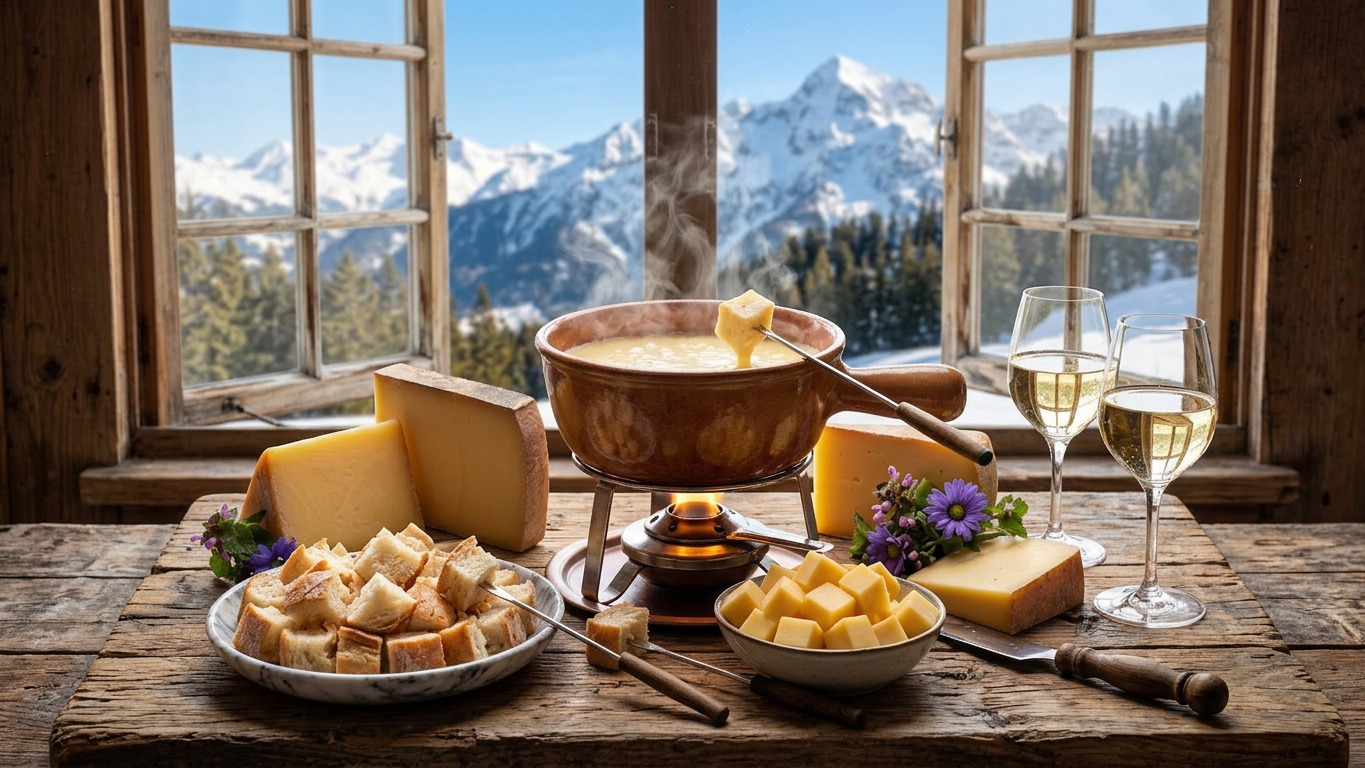
Gruyère gained global recognition as the essential ingredient in Swiss fondue, popularized as a national dish in the 1930s by the Swiss Cheese Union.
The classic moitié-moitié ("half-and-half") fondue blends equal parts Gruyère and Vacherin Fribourgeois. Gruyère provides the fundamental nutty, savory flavor, while Vacherin adds creaminess and prevents separation. The addition of acidic white wine and cornstarch creates the perfect melting chemistry.
Pro Pairing Tip: For the perfect fondue, use a dry white wine like Chasselas or Fendant. The acid helps cheese proteins melt smoothly without clumping, while a touch of cornstarch creates that signature silky texture.
Economic Challenges and Future Outlook
As of 2024, Gruyère production reached 30,311 tonnes, recovering from a 2023 dip but still below the 2022 peak of 31,397 tonnes. The industry faces challenges from inflation and the strong Swiss franc, which have impacted international sales.
Export declines include a 40% drop in Belgium and 25% decrease in the US market. However, the Swiss domestic market remains stable, supported by strong national identity and cultural connection to the cheese.
Sustainability Efforts
The industry is embracing modernization while preserving tradition. Robotic systems now handle wheel turning and salting in larger ripening cellars, operating in natural sandstone caves that regulate humidity and temperature through the rock itself.
Organic Gruyère production emphasizes ultra-local sourcing (within 20 kilometers) and sustainable farming practices, representing the industry's response to modern environmental concerns.
Where to Find Authentic Gruyère in Pagosa Springs
For Pagosa Springs residents and visitors seeking authentic Le Gruyère AOP, Murray's Cheese inside City Market offers carefully selected wheels that meet the strict AOP standards. Look for the casein label that guarantees traceability back to specific Swiss dairies.
The Enduring Legacy
Le Gruyère AOP represents more than a culinary product, it's a sensory representation of the Swiss landscape, carrying "the taste of delicate mountain flowers and wonderful alpine herbs." In a world of mass-produced commodities, this thousand-year-old tradition stands as a beacon of artisanal integrity.
Whether you're enjoying a mild Classic in your morning quiche or savoring the crystalline crunch of an aged Réservé, each bite connects you to medieval monasteries, Alpine meadows, and the unwavering dedication of Swiss cheesemakers who refuse to compromise on quality.
The next time you taste authentic Gruyère, remember: you're not just eating cheese, you're experiencing a millennium of Swiss heritage, one delicious bite at a time.
Sources and Further Reading
- Le Gruyère AOP Official Website (gruyerestories.com)
- Great British Chefs Gruyère History Guide
- Culture Cheese Magazine Battle for Gruyère Analysis
- Academy of Cheese Le Gruyère AOP Guide
- Swiss PDO-PGI Association Documentation