Estimated Reading Time: 7 min
Bread cheese is cheese, not bread
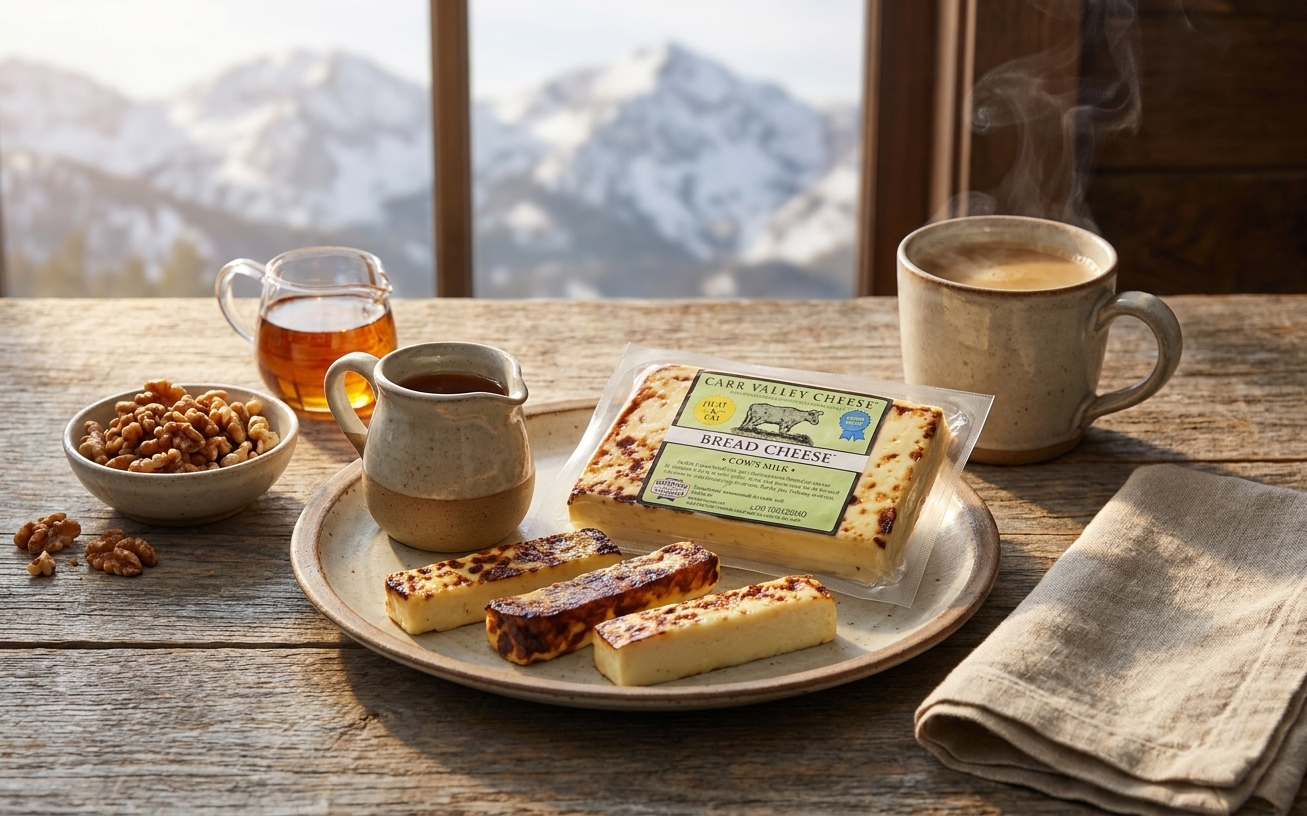
The name makes more sense once you see the golden-brown crust. Carr Valley Bread Cheese is a fresh, unripened cheese that gets baked before it is packaged. That browned surface looks a little like toast and brings some of the same warm, roasted appeal.
Inside, it is mild, buttery and pleasantly salty. There is no bread in the original cheese, and it is not a sandwich waiting for its second slice.

Think of it as a grilling or frying cheese, in the same broad kitchen category as halloumi. It softens when heated but holds its shape instead of becoming a puddle. That makes it useful for everything from a quick skillet snack to vegetable skewers.
My advice: Start with the plain version. Its quiet, sweet-cream flavor gives you room to try both jam and savory toppings without making two separate dishes.
Wisconsin-made, with Nordic roots
Carr Valley makes its Bread Cheese in Wisconsin, where the company has a cheesemaking plant in La Valle. Its inspiration comes from Nordic bread cheeses, especially Finland's juustoleipä and leipäjuusto. Those names translate to “cheese bread” and “bread cheese,” respectively.
This is an American interpretation of that tradition, not a Finnish import.

Historically, Finnish bread cheese was often made with cow's colostrum, the rich first milk produced after calving. Goat and reindeer milk also have a place in the broader Nordic tradition. Carr Valley's original version uses regular pasteurized cow's milk, making the style accessible well beyond its northern roots.
Terroir Tales: A Wisconsin maker with a long view
Carr Valley owner Sid Cook is a fourth-generation cheesemaker and a Wisconsin Master Cheesemaker. The creamery draws on milk from nearby farms, linking its cheeses to Wisconsin's dairy landscape rather than any one required cattle breed.
Bread Cheese has earned recognition in major competitions, including first-place finishes at the American Cheese Society competition in 2007 and 2008. Still, its strongest selling point at your table may be simpler: It gives you browned cheese without a frying-pan rescue operation.
What's in it, and how is it made?
The original Carr Valley Bread Cheese is made with pasteurized cow's milk. Its ingredients include salt, microbial enzymes and calcium chloride. Check the current package for the full ingredient list, especially when buying a flavored version.
Rennet is the milk-setting ingredient that helps form curds. Carr Valley uses microbial enzymes rather than traditional animal rennet in the original cheese, making it suitable for many vegetarians. A bacon-flavored version, of course, is another matter.
Calcium chloride helps milk form a firm curd. It is a common cheesemaking aid, not a flavoring.
The process has two distinct heating stages:
- The milk is pasteurized. Controlled heat reduces harmful microbes before cheesemaking begins.
- The finished curd is baked. After the curds are formed, drained and pressed into blocks, oven heat browns the surface.
That second step creates the cheese's signature crust. Much of its toasted flavor comes from the Maillard reaction, the browning that occurs when sugars and proteins react under heat. It is also part of what makes toast and seared foods smell so good.
Carr Valley also makes Goat Bread Cheese, which offers a different milk flavor and a gently tangy alternative. Other versions include garlic, jalapeño, pizza and bacon.
Allergen note: Both cow's milk and goat's milk versions contain milk. Goat cheese is not a safe substitute for someone with a cow's milk allergy. If you avoid gluten or other ingredients, read the specific package rather than relying on the name.
Fresh, moist and surprisingly sturdy
Bread cheese does not need months in an aging room. It is sold as a fresh, unripened cheese, meaning its character comes from the milk, curd-making process and baking rather than long maturation.
It has a moist interior, despite its firm feel. That moisture helps the warmed cheese stay tender instead of turning dry and brittle. It also means this is a refrigerated food, not something to leave in a backpack all afternoon.
Cold, the texture can seem dense and slightly rubbery. Warmed, it becomes more yielding and glossy, while keeping a satisfying chew.
Why doesn't it melt like mozzarella? Cheese behavior depends partly on acidity and the way calcium helps link milk proteins. Bread cheese retains a sturdy protein network that resists flowing when heated. The result is softening without the stretch you expect from pizza cheese.
Then comes the squeak.
That little sound happens as the resilient protein structure rubs against your teeth. It is a normal feature, much like the squeak of fresh cheese curds. Dairy researchers have studied how storage changes this texture, including how gradual protein breakdown can reduce the squeak. A quieter bite alone is not proof of spoilage, and a loud one is not a safety guarantee.
What it tastes like
Expect a gentle contrast between the center and the surface.
The interior tastes milky and buttery, with modest salt and little of the sharpness associated with aged cheddar. The crust adds toasted, nutty notes, sometimes suggesting brown bread or lightly browned butter.
Warming brings those qualities forward. You might notice a little fat glistening on the surface, along with a softer bite. That is why serving it straight from the refrigerator rarely shows it at its best.
For nutrition planning, a 1-ounce serving typically provides about 100 calories, 7 grams of fat and 6 grams of protein. Use your package's Nutrition Facts for exact amounts, including sodium. It contributes protein, but it is still a rich cheese rather than a lean replacement for every other part of dinner.
How to warm bread cheese in a skillet
A skillet gives you control and a good view of the browning. Handy when dinner happens between wet mittens and the next load of laundry.
- Cut even pieces. Try slabs about 1/2 inch thick or generous bite-size cubes. Similar sizes will warm at a similar rate.
- Heat a nonstick or well-seasoned skillet over medium heat. Start without added fat, or use a very thin film of oil if your pan needs it.
- Add the cheese in one layer. Leave enough room to turn the pieces.
- Warm and turn. Start checking after a minute or two. Turn as the surface becomes golden and the center softens. Thickness and stove output will affect the time.
- Serve promptly. Aim for a warm, tender center and a browned exterior, not a blackened crust.
The cheese is already baked, so this is reheating rather than cooking raw curd. Follow any heating directions on the package. A microwave can work for quick warming, but the skillet gives you more control over the surface.
For grilling, use sturdy slabs, secure skewers or a grill basket. Tiny cubes have an unfortunate talent for finding the gaps.
Sweet, savory or straight into coffee
Bread cheese works best when its accompaniments add contrast. You do not need a crowded board.
For breakfast: Serve warm pieces with a little maple syrup and toasted walnuts, or pair them with eggs and tomatoes. After a cold morning in Pagosa Springs, this is a useful compromise between a snack and a full production.
For a savory plate: Add warm cubes to a tomato-and-bread salad just before serving. Toss them into a quinoa bowl with roasted vegetables, or skewer them with cherry tomatoes and finish with a little balsamic glaze. Garlic and jalapeño versions fit especially well here.
For dessert: Try honey, fig jam or tart berry preserves. Add almonds or walnuts for crunch. A few shavings of dark chocolate can work, but keep the toppings restrained enough to taste the cheese.
For a Nordic-inspired coffee break: Put a few small cubes in hot coffee, then eat the softened cheese with a spoon. Coffee cheese is part of northern Nordic food traditions, and bread cheese is also commonly enjoyed with cloudberry jam. Tart berry preserves make a practical alternative when cloudberries are not on your grocery list.
Pro Pairing Tip: Make a two-bite test
Warm a few plain pieces. Give one a small spoonful of berry jam and another a cherry tomato with cracked pepper. Taste both before dressing the whole batch. Mild cheese leaves plenty of room for your own preference.
Wine, beer and cider that make sense
You do not need an elaborate pairing chart. Start with fruit, freshness or a little sweetness.
Sparkling wine: Brut Cava or Champagne brings acidity and bubbles that feel refreshing beside warm, buttery cheese. Champagne's breadlike notes can also echo the browned crust. Prosecco is another approachable option, especially with fruit accompaniments.
Port: Ruby Port pairs naturally with berry preserves, while tawny Port suits nuts and caramel-like flavors. This is the richer, dessert-minded choice. Pour small glasses.
Fruit beer: A cherry kriek, raspberry framboise or balanced fruited sour can supply the tart contrast you might otherwise get from jam. Avoid assuming every fruit beer is sweet. Some are quite dry or sharply sour.
Dry sparkling cider: Crisp apple flavor makes this an easy match, particularly with plain bread cheese or a light drizzle of honey.
For an alcohol-free option, try coffee or sparkling apple juice with a squeeze of lemon.
Store it like fresh cheese, not pantry food
Keep Bread Cheese refrigerated at 40 F or below, and follow the package's date and storage directions. Once opened, wrap or seal it well and follow any after-opening guidance. Vacuum packaging helps protect quality, but it does not make cheese shelf-stable or eliminate all food-safety risks.
If you are shopping before heading to a cabin or campsite, use a cooler with ice packs. A chilly Pagosa morning does not guarantee a chilly parked car by noon.
Know the difference between normal features and reasons to discard it:
- Normal: The original toasted brown patches and a little melted fat or whey released during warming.
- Not normal: New fuzzy growth, pink or green spots, a persistent slimy film, or a sour, rancid or otherwise unpleasant odor.
- Also concerning: Swollen packaging, leaks or a damaged seal. Return or discard the product rather than taste-testing it.
Discard the whole piece if a fresh cheese develops mold. Do not trim it as you might a hard aged cheese. Harmful bacteria can also be present without visible changes or bad smells, so appearance cannot replace safe storage.
As a general food-safety rule, refrigerate perishables within two hours, or within one hour when temperatures exceed 90 F. Reheating is not a way to rescue cheese that has been mishandled.
A quick pronunciation guide, then dinner
For an English-friendly approximation, say juustoleipä as YOO-stoh-lay-pa and leipäjuusto as LAY-pa-yoo-stoh. The Finnish ä is closer to the vowel in “cat” than the final vowel in “spa.” Put the strongest emphasis on the first syllable.
Or simply ask for bread cheese.
On your next grocery run in Pagosa Springs, check with Murray's Cheese inside City Market about Carr Valley Bread Cheese and the varieties currently in stock. Pick one topping, warm a small batch and eat it while the center is tender. This is a cheese that rewards a hot pan more than a fancy platter.
Sources and Further Reading
- Bread Cheese, Carr Valley Cheese. Product details and serving ideas.
- Bread Cheese (Carr Valley), culture: the word on cheese. Production, texture and flavor overview.
- Why Don't Halloumi and Other Grilling Cheeses Melt?, culture: the word on cheese. An accessible explanation of grilling-cheese structure.
- On the Cutting Wedge, Wisconsin Cheese, Dairy Farmers of Wisconsin. Sid Cook's cheesemaking background.
- Safe Food Handling, U.S. Food and Drug Administration. Refrigeration and safe handling guidance.
