From Accident to Empire: How Ancient Cheese Changed Human Civilization
Discover how a simple mistake with milk in an animal stomach launched one of humanity's most enduring food innovations, and why it might have saved our species.
Estimated Reading Time: 8 min
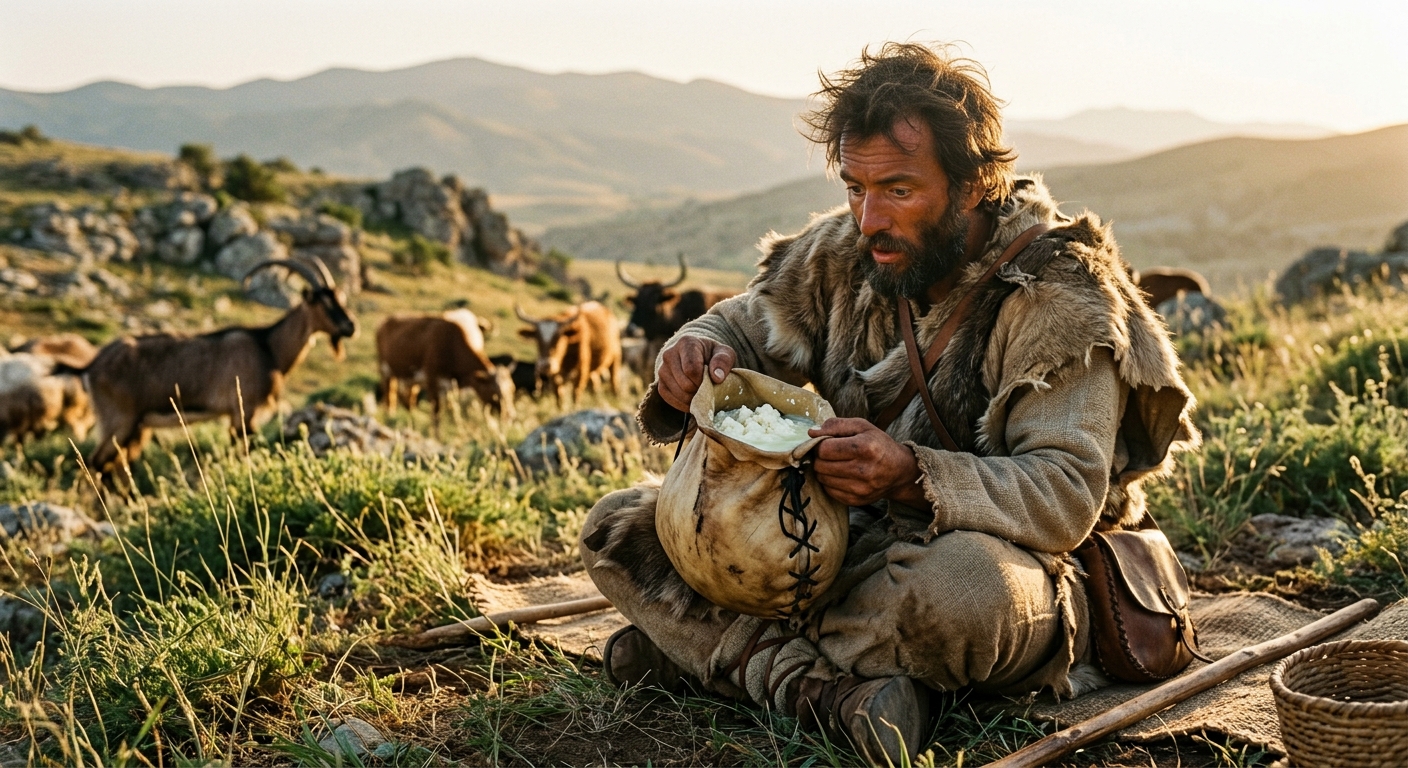
Imagine you're a Neolithic herder 9,000 years ago, carrying fresh milk in a pouch made from a calf's stomach. After a long day's journey, you open the bag expecting liquid refreshment, only to find solid white chunks floating in watery liquid. Most people might have thrown it away in disgust. But someone, somewhere, decided to taste it, and accidentally launched one of the most important food technologies in human history.

That accidental discovery of cheese didn't just give us a delicious snack. It provided a way to preserve highly perishable milk, created a portable protein source for long journeys, and may have literally shaped human evolution. Recent archaeological breakthroughs using cutting-edge protein analysis are revealing that cheese-making predates writing, cities, and even agriculture in some regions.
The Biochemical Accident That Started It All
The first cheese was almost certainly an accident, but it was an accident waiting to happen. Neolithic peoples stored liquids in bags made from animal stomachs, the most waterproof containers available. What they didn't know was that the stomach lining of young, milk-fed animals contains rennet, a powerful enzyme complex that causes milk proteins to coagulate.
When fresh milk sat in these stomach-bags, especially in the warm climates of the Near East, the rennet went to work. The milk separated into solid curds and liquid whey, the fundamental process behind all cheese-making. The warm temperatures also encouraged natural lactic acid bacteria to begin fermentation, creating the tangy flavors we associate with aged cheeses.
Pro Pairing Tip: Understanding rennet helps you appreciate cheese today. Animal rennet (from calf stomach lining) creates the firmest, most age-worthy cheeses. Vegetable rennet from fig sap or thistle produces softer textures with unique flavors. Many artisan cheesemakers still use these traditional plant-based coagulants.

The realization that these solid curds were not only edible but lasted much longer than fresh milk was revolutionary. Unlike liquid milk, which spoils rapidly in hot climates, the removal of whey eliminated most of the lactose and moisture, the primary sites of spoilage. Early cheesemakers could salt, dry, or store these curds underground, creating a reliable food source during lean seasons.
Turkey's Ancient Cheese Laboratory
The "cradle of civilization" in modern-day Turkey also served as humanity's first cheese laboratory. At Çatalhöyük, a massive Neolithic settlement inhabited from 7100 to 5600 BC, researchers have found the earliest definitive evidence of complex dairy processing.
Using breakthrough "shotgun" proteomics technology, scientists can now identify specific proteins trapped in 8,000-year-old pottery. Unlike general fat analysis, proteomics reveals exactly which animals were milked and how their milk was processed. Findings from Çatalhöyük confirm that inhabitants were milking cows, sheep, and goats, and crucially, they were separating whey from curds.
The presence of both whey and curd proteins in the same vessels provides a "smoking gun" for cheese-making. This isn't just evidence of drinking milk; it's proof of secondary processing that created entirely new food products. The multi-species nature of these residues suggests sophisticated herd management, where different milks were likely blended to create varied dairy products.
Terroir Tales: The Çatalhöyük cheesemakers were experimenting with milk blends 8,000 years ago. Modern artisan cheesemakers continue this tradition, try a mixed-milk cheese like Beenleigh Blue (sheep and cow) or Humboldt Fog (goat with vegetable ash) to taste this ancient innovation.
When Cheese Became Currency: Mesopotamian Bureaucracy
As urban centers developed in ancient Mesopotamia, cheese transformed from a local food into a cornerstone of the state economy. During the Sumerian Ur III period (c. 2110–2003 BC), dairy production was subjected to rigorous government oversight that would make modern agricultural departments seem relaxed.
Thousands of cuneiform tablets from cities like Ur and Girsu provide detailed ledgers of dairy distribution. These administrative records document contracts with shepherds responsible for sacred or state-owned flocks, listing specific quotas of butter and cheese expected as tribute to temples.
The Sumerian language developed a rich vocabulary for dairy products, reflecting sophisticated culinary specialization:
- ga-àr-ra: Powdered or finely grated cheese, similar to modern Parmesan
- ga-murx: Cheese "strained in cheesecloth," indicating specialized filtering techniques
- ga-še-a: Sour milk used in barley porridge, resembling yogurt or kefir
- ga-àb-sig7-ga: "Milk from beautiful cows," likely premium-grade milk for religious rituals
Cheese held deep religious significance through the marriage myth of goddess Inanna and shepherd Dumuzi. In ritual texts, Dumuzi courts the goddess by boasting: "My milk is sweet and thick... my cheese is delicious." Citizens of Uruk brought daily offerings of butter and cheese to Inanna's temple, ensuring dairy remained a prestige good and incentivizing reliable preservation methods.
Egyptian Tombs and 3,000-Year-Old Cheese
Ancient Egyptians took cheese preservation to extraordinary lengths, literally preserving it for the afterlife. In 2010, archaeologists excavating a tomb in Saqqara belonging to Ptahmes, mayor of Memphis during the 13th century BC, found a "solidified whitish mass" covered by canvas fabric.
Proteomic analysis revealed this mass was indeed cheese, made from a mixture of cow and sheep/goat milk. The scientific significance lies in what was absent: no evidence of kefir bacteria, indicating this was likely a fresh or brined variety with a significantly more acidic flavor than modern soft cheeses. The canvas fabric suggests the cheese was either aged cloth-bound or strained using textile bags, methods still used in Mediterranean cultures today.
Egyptian tomb murals from 2000 BC explicitly depict milking and curd production processes. Remarkably, many traditional Egyptian cheeses survive today:
- Karish: Soft white cheese made by churning milk in goatskin and straining through reed mats
- Mish: Sharp, salty fermented cheese aged in earthenware jars for up to a year
- Halom: Semi-hard brined cheese, the ancestor of modern Halloumi
Fragments of reed mats used for straining cottage cheese, recovered from ancient sites and displayed in the Museum of Ancient Egyptian Agriculture, look nearly identical to tools used by modern Egyptian peasants. This "technology of the mat" has remained unchanged for over 4,000 years.
Europe's Specialized Cheese Tools
As farming communities moved from the Balkans into Central Europe, they encountered cooler climates that significantly impacted cheese development. Lower temperatures required less salt for preservation, allowing different molds and microbes to flourish and create more complex flavors.
The Linear Pottery culture (LBK) in Central Europe provides the most specialized evidence for early cheese-making through ceramic "sieve vessels", pottery pierced with 2-3mm holes. Found in Poland's Kuyavia region and dating to the 6th millennium BC, these vessels initially puzzled researchers.
Isotopic analysis using advanced mass spectrometry confirmed these sieves contained concentrated dairy fats, not honey or beer residues. The specialized vessels were used specifically to separate curd from whey, allowing LBK farmers to produce reduced-lactose dairy products. This was essential since DNA analysis shows LBK individuals lacked the lactase persistence gene, they couldn't digest fresh milk as adults.
Pro Pairing Tip: The principle behind these ancient sieves lives on in modern cheese-making. When you see "basket-pressed" or "colander-drained" on cheese labels, you're experiencing technology that's over 7,000 years old.
The Green Sahara's Surprising Dairy Culture
Cheese history isn't purely Eurasian. During the Holocene (10,000 to 5,000 years ago), the Sahara was a lush savanna where hunter-gatherers transitioned to pastoralism long before adopting agriculture.
Analysis of pottery from the Takarkori rock shelter in Libya's Tadrart Acacus Mountains provides the first chemical evidence for Saharan dairying. Dating to the 5th millennium BC, fatty acids extracted from earthenware revealed that half the vessels processed dairy fats. This finding is supported by remarkable rock art depicting cattle herding and rare scenes of humans milking cows.
In the Saharan context, dairying represented a "secondary products" economy that allowed humans to utilize domestic animals without slaughtering them, a resilient food security strategy as the region gradually became more arid.
Greek and Roman Industrial Scale
By classical antiquity, cheese-making had evolved from accident to sophisticated industry. Greeks and Romans developed regional specialties, refined rennet use, and integrated cheese into military logistics and international trade.
Greek writers provided the first technical descriptions. Aristotle noted that deer rennet was highly prized, though calf and kid rennet were more common. He described using "first milk" (colostrum) to make fine heat-curdled cheeses, a delicacy still enjoyed in the Aegean.
Greek regional cheeses gained fame across the Mediterranean:
- Kythnios: Made on Kythnos island, where sheep fed on fig and olive leaves for distinctive flavor
- Tromilia: Famous goat cheese imported to Athens from the Peloponnese
- Sicilian: Renowned for blending sheep and goat milk
Romans scaled Greek foundations for empire. Pliny the Elder's Natural History (77 AD) devoted an entire chapter to cheese diversity across the Roman world. Roman soldiers were crucial to disseminating cheese-making knowledge, retired legionnaires often became professional cheesemakers in their provinces, starting lasting industries in regions like Switzerland and France.
Roman innovations included:
- Caseus Formaticus: Cheese made in molds, origin of "cheese" in Romance languages
- Smoking techniques: Using apple wood or stubble to enhance flavor and durability
- Industrial scale: Records mention wheels weighing 1,000 pounds alongside tiny caseolus snacks for soldiers
The Silk Road's Ancient Kefir
The Xiaohe Cemetery in China's Taklamakan Desert yielded the oldest preserved cheese remnants, 3,500-year-old kefir cheese found directly on mummies dating to 1615 BC. These samples represent a distinct Central Asian dairy tradition using kefir grains (symbiotic bacteria and yeast) to ferment milk before draining whey.
Ancient DNA analysis revealed the kefir cheese used Lactobacillus species specifically adapted to the local environment. Goat DNA suggests the Xiaohe population traded with steppe populations, facilitating kefir's spread along an "additional route" into inland East Asia.
Georgia's Living Heritage: 60 Varieties and Counting
The Caucasus region, particularly Georgia, maintains one of the world's most continuous cheese cultures with over 60 unique varieties. Georgian idiom states: "Cheese and bread, a kind heart," reflecting cheese's fundamental cultural importance.
Traditional Georgian varieties showcase ancient preservation methods:
- Sulguni: Stretched-curd cheese from Mingrelia, similar to mozzarella, often sold smoked
- Guda: Named after its sheepskin aging pouch, this pungent sheep's milk cheese ages 60+ days
- Tenili: Complex string cheese boiled, pulled into tendrils, brined, dried, and stored in clay pots with cream
- Dambalkhacho: Mold-ripened cheese from buttermilk cottage cheese, dried over fire and aged in clay pots
These varieties demonstrate how ancient methods, animal skin aging, clay pot storage, have been preserved and refined into modern culinary heritage.
The Evolutionary Connection: Cheese and Human Genetics
Perhaps the most profound insight into cheese history is its role in human evolution. For most of human history, adults couldn't consume fresh milk due to lactose intolerance. A 2022 University of Bristol study mapped milk use over 9,000 years and combined this with ancient DNA data.
The study found milk use was widespread across Europe long before the genetic trait for lactase persistence became common (around 1000 BC). This suggests cheese-making was the "workaround" that allowed adults to utilize dairy without illness, as fermentation and straining significantly reduce lactose content.
The rapid spread of the lactase persistence gene occurred during periods of famine and disease. During these crises, individuals weakened by hunger or infection were more likely to die from lactose intolerance complications if forced to consume fresh milk as a last resort. Those with the genetic mutation to digest lactose had a distinct survival advantage, allowing the gene to spread rapidly through populations.
Terroir Tales: This evolutionary pressure explains why traditional cheese-making regions often have high rates of lactase persistence, while areas with less dairy history show more lactose intolerance. Your ability to enjoy a glass of milk with your cheese reflects thousands of years of evolutionary adaptation.
Modern Connections to Ancient Wisdom
The transition from ancient artisan practices to modern industrial production preserved essential knowledge through medieval monasteries. Monks experimented with aging processes, bacteria cultures, and different milk types to create classic European cheeses like Brie, Camembert, and Munster. Monastic traditions ensured techniques passed down through generations with little alteration, preserving authentic "ancient" recipes.
The 1860s marked mass-produced rennet development, followed by pure microbial cultures at the century's turn. Before these scientific interventions, cheesemakers relied on "back-slopping" (using whey from previous batches) or natural environmental microbes, leading to high variability in flavor and quality.
Bringing Ancient Wisdom to Your Table
When you visit Murray's Cheese inside City Market here in Pagosa Springs, you're participating in a tradition that spans millennia. Every wheel of aged Gouda connects to those first accidental curds in a Neolithic stomach-bag. Every bite of fresh mozzarella echoes the stretched-curd techniques perfected by Roman soldiers.
Look for cheeses that showcase ancient techniques: cloth-bound cheddars aged in caves, raw milk varieties that rely on natural bacteria, or mixed-milk cheeses that blend different animals' contributions. These aren't just foods, they're edible archaeology, connecting us to our ancestors' ingenuity and survival.
The next time you enjoy cheese, remember: you're tasting one of humanity's oldest and most successful food technologies, born from accident but perfected through millennia of human creativity and necessity.
Sources and Further Reading
- Dr. Richard Evershed, University of Bristol - Organic geochemistry and archaeological lipid analysis
- Dr. Jessica Hendy, Max Planck Institute - Ancient protein analysis and proteomics
- Dr. Melanie Roffet-Salque, University of Bristol - Neolithic dairy processing research
- Dr. Mélanie Roffet-Salque, University of York - Prehistoric pottery and dairy residues
- Smithsonian Institution - Ancient Mesopotamian administrative records and cuneiform analysis