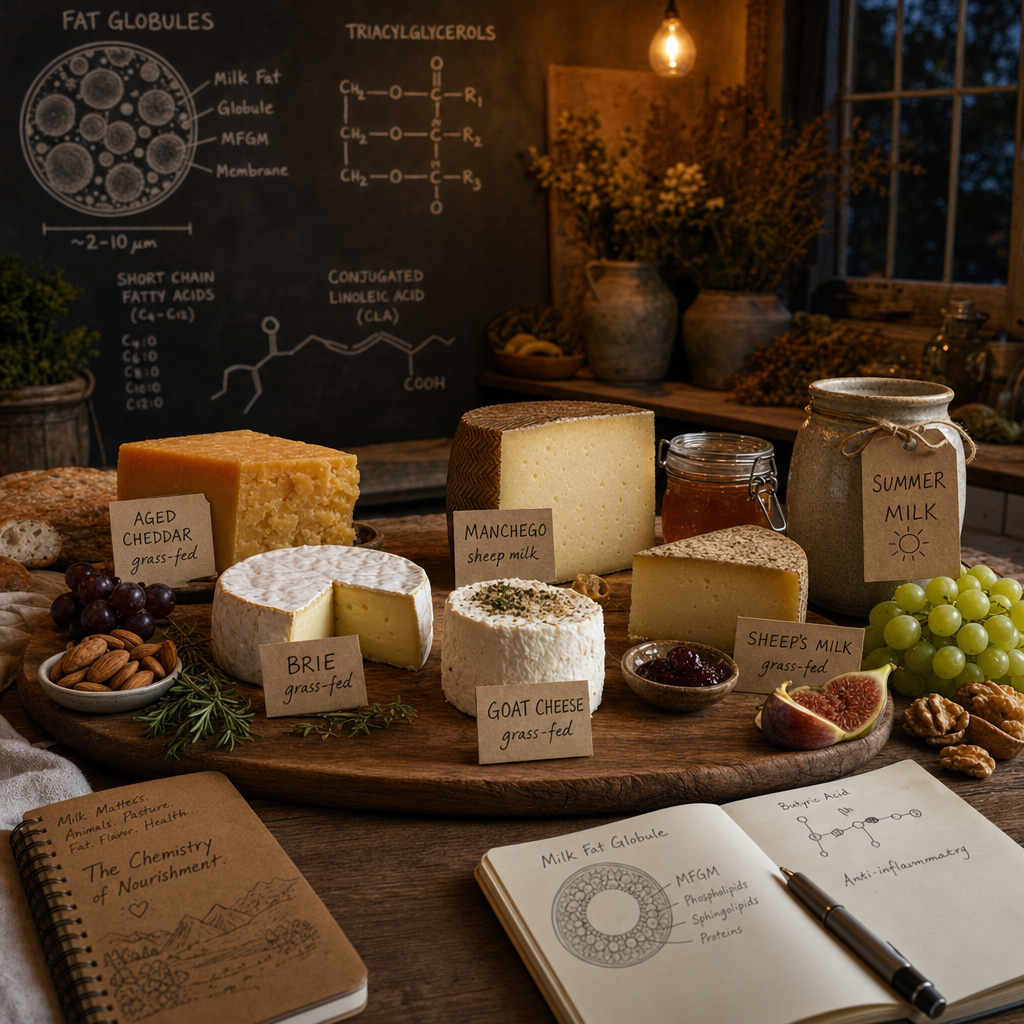
The Hidden Science Behind Your Favorite Cheese: Why Fat Isn't the Villain You Think It Is
Forget everything you thought you knew about dairy fat. The latest research reveals that the type of fat matters far less than the food it comes from.
Estimated Reading Time: 6 min
You've probably heard the warnings about saturated fat in cheese. But here's what might surprise you: a growing body of research suggests that the fat in your favorite aged cheddar or creamy brie isn't the health villain it's been made out to be. In fact, the complex world of dairy lipids tells a story that's far more nuanced than the simple "good fat, bad fat" narrative we've been told for decades.

The difference lies in something scientists call the "matrix effect" – the idea that how nutrients behave in your body depends not just on what they are, but on the structure of the food containing them. And when it comes to cheese, that structure changes everything.
The Biochemical Landscape of Dairy Fats
To understand why cheese might be different, you need to know what you're actually eating when you bite into that slice of Manchego. Dairy fats are among the most complex natural fat systems on Earth, containing over 400 different fatty acids. While that sounds overwhelming, about 15 varieties make up the bulk of what you're consuming.
These fats fall into several categories based on their chemical structure. Saturated fatty acids (SFAs) – the ones traditionally labeled as "bad" – make up about 65-70% of milk fat. They're called saturated because every carbon atom is "saturated" with hydrogen, creating a straight chain that packs tightly together. This is why butter is solid at room temperature.
Monounsaturated fats (MUFAs) account for about 25% of milk fat and include oleic acid, the same heart-healthy fat found in olive oil. Polyunsaturated fats (PUFAs) make up just 2-4% but include essential omega-3 and omega-6 fatty acids that your body can't make on its own.

The Trans Fat Paradox
Here's where things get interesting. Not all trans fats are created equal. While industrial trans fats from partially hydrogenated oils are universally recognized as harmful, dairy contains naturally occurring trans fats that appear to be neutral or even beneficial.
The primary natural trans fat in dairy is vaccenic acid, formed when microbes in a cow's rumen process dietary fats. Your body can actually convert this into conjugated linoleic acid (CLA), a compound that's been studied for its potential anti-cancer and anti-inflammatory properties.
Pro Pairing Tip: When selecting aged cheeses, look for those made from grass-fed milk. Pasture-raised cows produce milk with higher levels of beneficial omega-3 fatty acids and CLA, especially during summer grazing season.
What Makes Milk Fat Special
Bovine milk fat isn't just a random collection of fatty acids. The composition reflects the cow's diet, breed, lactation stage, and even the season. Cows grazing on fresh pasture produce milk with dramatically different fat profiles than those fed grain-based diets.
Short-chain fatty acids like butyric acid (which gives Parmesan its distinctive bite) are synthesized directly in the mammary gland. These compounds contribute to cheese's unique flavor and may play roles in gene regulation and cancer prevention. Medium-chain fatty acids like those found in abundance in goat cheese are rapidly absorbed and have potential antimicrobial properties.
The fat doesn't exist as free-floating oil, either. It's organized into microscopic globules wrapped in a complex membrane called the Milk Fat Globule Membrane (MFGM). This triple-layered structure is rich in phospholipids, proteins, and other bioactive compounds that are crucial for brain development in infants and may help regulate cholesterol in adults.
Terroir Tales: Just like wine grapes, the terroir where cows graze affects their milk. Alpine cheeses from Switzerland often have higher levels of beneficial fatty acids due to the diverse mountain flora the cows consume, including herbs and wildflowers that concentrate unique compounds in their milk.
The Cheese Matrix Effect: Why Structure Trumps Chemistry
Here's the game-changer: multiple studies have shown that eating saturated fat in the form of cheese produces different effects on blood cholesterol than eating the same amount of fat from butter. This isn't just a small difference – it's significant enough that researchers are rethinking how we evaluate the health impact of foods.
A 2025 study from University College Dublin found that women consuming full-fat cheddar cheese had notably lower increases in total and LDL cholesterol compared to those eating a "deconstructed cheese" mixture of butter, protein, and calcium with the same nutrient profile. The cheese eaters also showed better overall lipid profiles.
Several mechanisms might explain this matrix effect:
Calcium Soap Formation
Cheese is exceptionally high in calcium. Researchers theorize that calcium ions bind to fatty acids in your digestive tract, forming insoluble "soaps" that are excreted rather than absorbed. This effectively reduces the amount of saturated fat your body actually takes in.
Protein Scaffolding
The complex casein protein network in cheese may physically protect fat droplets from digestive enzymes, slowing the rate at which fats are broken down and absorbed. This more gradual process appears to blunt the typical cholesterol response.
Fermentation Benefits
The aging process in cheese creates bioactive peptides and short-chain fatty acids that may actively improve lipid metabolism and reduce inflammation.
Pro Pairing Tip: Aged cheeses like Parmigiano-Reggiano and aged Gouda have undergone extensive protein breakdown during aging, potentially enhancing these protective matrix effects. Plus, the aging process concentrates beneficial compounds while reducing lactose content.
Beyond Cow's Milk: Sheep and Goat Alternatives
If you're exploring cheese options at Murray's Cheese in City Market, don't overlook sheep and goat varieties. These offer distinct nutritional advantages that might surprise you.
Sheep milk contains roughly twice the fat content of cow's milk, but it's often easier to digest due to smaller fat globules and different protein structures. Sheep cheeses like Manchego and Roquefort are particularly rich in CLA and omega-3 fatty acids. The smaller fat globules provide more surface area for digestive enzymes, potentially improving nutrient absorption.
Goat milk shines in its concentration of short-chain fatty acids, especially caproic and caprylic acids. These compounds give goat cheese its characteristic tangy flavor and may offer antimicrobial benefits. Goat cheese is also naturally lower in lactose and contains different casein proteins that some people find easier to digest.
Terroir Tales: Traditional sheep cheeses from mountainous regions often have the highest concentrations of beneficial fatty acids. The diverse alpine vegetation that sheep graze on – including herbs, grasses, and wildflowers – translates directly into more complex and potentially healthier milk fat profiles.
The Seasonal Factor
Here in Pagosa Springs, where we experience distinct seasons, it's worth noting that the time of year affects the nutritional quality of dairy products. Cheeses made from spring and summer milk – when cows are grazing on fresh, diverse pastures – typically contain higher levels of beneficial compounds.
Saturated fat levels in milk naturally peak during winter indoor feeding and decrease during summer grazing. Meanwhile, unsaturated fats, CLA, and omega-3 levels follow the opposite pattern. This means that artisanal cheeses made during peak grazing season may offer the best nutritional profiles.
Bioactive Compounds: The Hidden Players
Beyond the basic fat categories, dairy contains several bioactive lipids that are gaining scientific attention. Conjugated linoleic acid (CLA) is produced through two pathways: partial biohydrogenation in the cow's rumen and conversion from trans-vaccenic acid in the mammary gland.
Animal studies have shown CLA to have anti-cancer, anti-inflammatory, and immune-modulating properties. While human data is more complex, related compounds like trans-palmitoleic acid – found exclusively in dairy and ruminant fats – are strongly associated with reduced diabetes risk and improved insulin sensitivity.
The phospholipids in the MFGM deserve special mention. These compounds are crucial for brain development in infants, but recent research suggests they may help regulate cholesterol levels in adults too. Meta-analyses of clinical trials show that MFGM supplementation can significantly reduce total and LDL cholesterol.
Ingredients: When shopping for cheese, look for varieties made from whole milk rather than reduced-fat versions. The beneficial compounds are concentrated in the fat portion, and removing fat often means removing the very components that make cheese potentially health-neutral or beneficial.
Practical Implications for Cheese Lovers
What does all this science mean for your cheese board? First, it suggests that moderate consumption of full-fat cheese as part of a balanced diet isn't the health risk it was once thought to be. The matrix effect appears to buffer many of the negative effects traditionally associated with saturated fat.
Second, quality matters. Cheeses made from grass-fed milk, particularly those produced during grazing season, offer superior nutritional profiles. Aged cheeses may provide additional benefits through their complex protein structures and fermentation-derived compounds.
Finally, variety is valuable. Different cheese types – cow, goat, sheep – offer distinct nutritional advantages. Rotating between different varieties ensures you're getting a broad spectrum of beneficial compounds.
Pro Pairing Tip: Consider pairing aged cheeses with foods rich in fiber and antioxidants. The combination may further enhance the beneficial matrix effects while providing complementary nutrients. Think aged cheddar with apple slices or Manchego with walnuts.
The Future of Fat Research
The emerging understanding of the matrix effect represents a fundamental shift in nutritional science. Rather than focusing solely on individual nutrients, researchers are increasingly looking at whole foods and how their structures influence biological responses.
This doesn't mean cheese is a health food, but it does suggest that the relationship between dairy fat and health is far more complex than previously understood. For those of us who appreciate good cheese, that's welcome news indeed.
As you explore the cheese selection at Murray's, remember that you're not just choosing flavors – you're selecting complex food matrices with potentially very different health implications. The science suggests that when it comes to cheese, the whole truly is greater than the sum of its parts.
Sources and Further Reading
- Dr. Emma Feeney, University College Dublin School of Agriculture and Food Science
- Dr. Ronald Mensink, Maastricht University Department of Human Biology
- Dr. Arne Astrup, University of Copenhagen Department of Nutrition
- International Dairy Foods Association Research Division
- Journal of Nutritional Biochemistry Dairy Lipids Special Issues
