America's Cheese Revolution: How 14.66 Billion Pounds Changed Everything
The United States just shattered cheese production records, but what does this historic milestone mean for your local cheese counter and the artisans crafting tomorrow's favorites?
Estimated Reading Time: 6 min
Walk into any grocery store in Pagosa Springs today, and you'll witness the fruits of an extraordinary achievement. In 2025, American cheesemakers produced a staggering 14.66 billion pounds of cheese, a record that represents far more than impressive numbers. This 2.9% jump from the previous year signals a fundamental shift in how America makes, sells, and thinks about cheese. From the massive industrial operations dominating the Midwest to the passionate artisans crafting small-batch treasures, everyone in the cheese world is navigating this new landscape. The question isn't just how we got here, but where this unprecedented production boom takes us next.

The Perfect Storm Behind Record Production
Three powerful forces converged to create 2025's cheese production milestone. First, American dairy cows became remarkably more productive, with each cow producing an average of 24,390 pounds of milk annually, nearly 220 pounds more than the previous year. This wasn't just about having more cows (though the national herd did grow by 153,000 head), but about extracting maximum value from each animal through precision genetics and advanced nutrition.
Second, the industry underwent massive infrastructure expansion. New state-of-the-art facilities opened across South Dakota, Kansas, Texas, and New York, equipped with ultrafiltration and reverse osmosis technologies that can process millions of pounds of milk daily with minimal labor. These facilities don't just make cheese faster, they make it more consistently and efficiently than ever before.
Third, an unexpected revenue stream emerged: renewable natural gas projects. Dairy farms increasingly contract their manure to generate methane, creating a financial safety net that encourages maintaining larger herds even when milk prices drop. This "manure-first" economic model generates surplus raw milk that must go somewhere, and cheese, being storable and valuable, becomes the natural outlet.
Pro Pairing Tip
When shopping for cheese at Murray's Cheese inside City Market, look for varieties that showcase this production diversity. Wisconsin cheddars represent the traditional heartland, while California mozzarellas demonstrate the West Coast's industrial efficiency.

Where All This Cheese Goes: The Consumption Reality
Here's the fascinating paradox: while production soared by 2.9%, American cheese consumption has essentially plateaued. We're eating about 42 pounds of cheese per person annually, a massive increase from the 20 pounds we consumed in the 1970s, but a figure that's remained stable for the past few years.
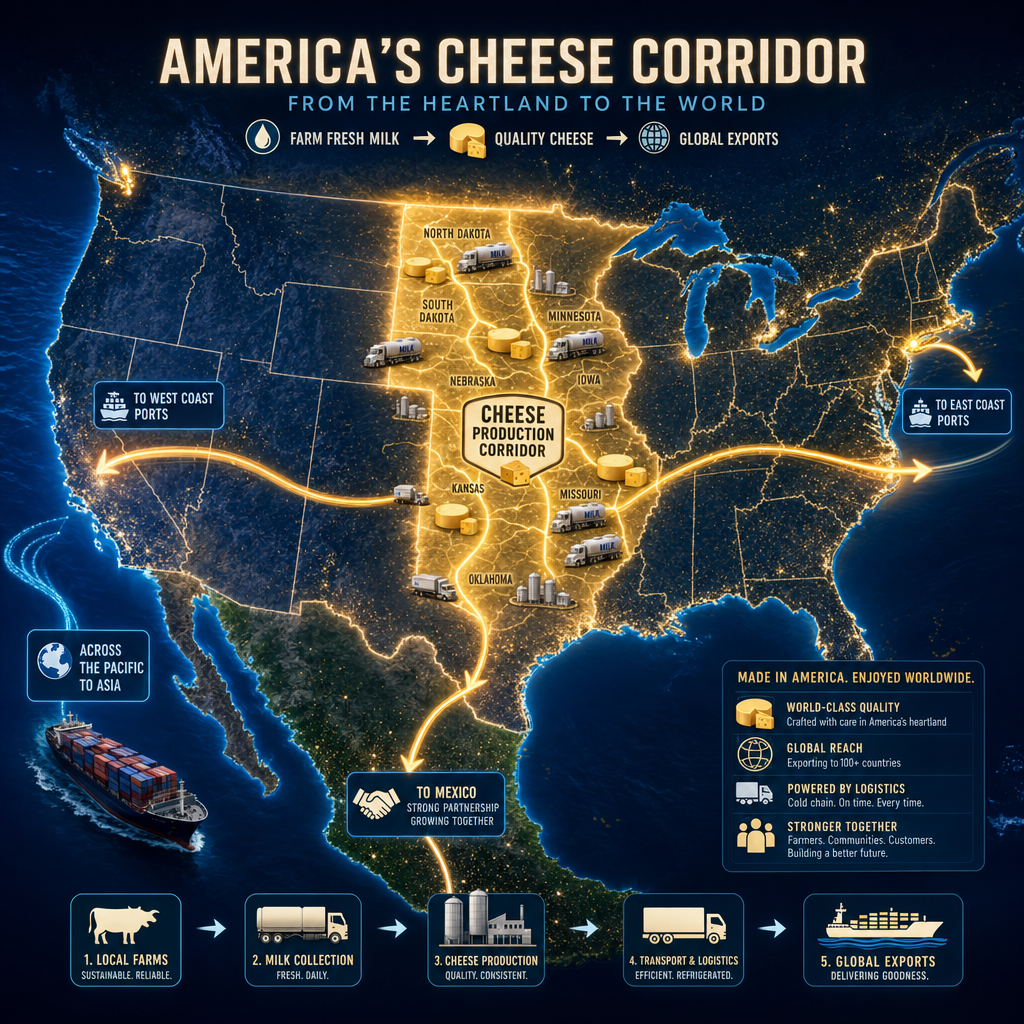
So where does all that extra cheese go? The answer lies in exports and evolving eating habits. In 2025, the U.S. exported more than 1.35 billion pounds of cheese, a 20% increase over 2024. Mexico alone purchased 446.4 million pounds, while significant gains were made in Central America, Japan, and South Korea.
Domestically, the story is about premiumization rather than volume. While total consumption stays flat, Americans are increasingly choosing higher-value varieties. Burrata sales volume surged 19.4% in 2025, while Hispanic varieties like queso panela and queso cotija saw increases of 25.7% and 19.1%, respectively. We're not eating more cheese, we're eating better cheese.
Terroir Tales: The Digital Cheese Revolution
Approximately 12% of all natural cheese sales now happen online, a sector that grew 19% in 2025. This digital expansion allows cheese lovers in places like Pagosa Springs to access varieties that would never make it to local shelves, from Vermont farmstead cheddars to Oregon blue cheeses.
Regional Powerhouses: Where America Makes Its Cheese
The geography of American cheesemaking is shifting dramatically. The Central U.S. outpaced the nation with a 10.8% increase in cheese production, while the traditional Western powerhouses grew at a more measured 1.6%. This represents a fundamental migration toward regions with better logistics, lower costs, and more aggressive expansion policies.
The Central Surge
The "I-29 Corridor" and High Plains have become the new epicenter of growth. South Dakota's dairy herd increased by 22% in 2025, while Wisconsin, despite losing 145 farms, added 4,000 cows and increased output. The region benefits from critical logistical hubs in Chicago, St. Louis, and Memphis that serve as interchange points for cheese destined for both coasts and export markets.
Western Maturity
California remains the single largest milk-producing state at 40.95 billion pounds, but faces constraints from water availability, labor costs, and environmental regulations. The average Western herd size of 1,050 cows (more than ten times Pennsylvania's average) allows these operations to dominate commodity markets, particularly mozzarella for pizza chains and cheddar for industrial food processing.
The Top Five Cheese States
Wisconsin continues leading with an estimated 3.51 billion pounds annually, maintaining its "America's Dairyland" status through specialty Italian and Hispanic varieties alongside traditional American types.
California ranks second at approximately 2.46 billion pounds, focusing heavily on mozzarella and Monterey Jack for both domestic and export markets.
Idaho has solidified third place through large-scale, automated manufacturing. The state added 42,000 cows in 2025, the largest increase nationally, and produced 18.258 billion pounds of milk.
New York claims fourth with a resurgent industry driven by state support for dairy processing. The state added 12,000 cows and saw production rise 2.8% to 16.59 billion pounds.
New Mexico rounds out the top five, though facing increasing competition from Texas. The state focuses on large-scale block cheese production for industrial food sectors.
What This Means for Artisan Cheesemakers
The record 14.66 billion pound production environment creates a complex but ultimately favorable landscape for small-scale artisanal producers. Rather than being squeezed out, these makers are riding a wave of "premiumization" and protein consciousness.
While mass-produced commodity cheese operates on margins as thin as two cents per pound, the specialty market allows for significantly higher premiums. About 60% of American adults reported increasing protein intake in 2025, and these consumers increasingly seek "fancier," diverse, and specialty cheeses that offer unique culinary experiences.
The artisanal sector is undergoing intense professionalization through programs like Wisconsin's Master Cheesemaker Program and the Academy of Cheese. This has attracted younger artisans who enter the field not to scale into industrial giants, but to maintain high-margin, small-batch operations emphasizing "American representation" on the global stage.
The specialty cheese market was valued at $15 billion in 2025 and is projected to reach $23 billion by 2033, with a 5% compound annual growth rate. This growth is fueled by rising disposable incomes and an expanding foodservice sector using specialty cheeses as primary menu differentiators.
Pro Pairing Tip
Seek out American artisan cheeses that showcase unique terroir. A Vermont farmstead cheddar aged in caves will taste dramatically different from a Wisconsin bandage-wrapped version, even when made from similar recipes.
Looking Ahead: The 2026-2027 Forecast
The implications of 2025's record production will continue rippling through the cheese world. Market positioning will be defined by pricing volatility, technological integration, and the "functional dairy" trend.
Pricing and Premiumization
Class III milk prices (used primarily for cheese) are projected to average $17.00 per hundredweight in the second quarter of 2026, potentially dipping to $16.60 in early 2027. While lower input costs might seem beneficial, they often coincide with lower wholesale prices that can erode margins for small producers lacking corporate hedging tools.
Artisan producers will likely lean further into premiumization. As consumers continue splurging on high-quality ingredients for home cooking, the price gap between commodity and specialty varieties is expected to widen. Makers who can document sustainability practices, animal welfare standards, and grass-fed certifications will be better positioned to justify these premiums.
Technological Disruption
The 2026-2027 period will see increased influence from food-tech startups leveraging precision fermentation to produce plant-based alternatives that emulate traditional cheese properties. While currently occupying a small niche, their focus on "sustainable protein" directly targets the same health-conscious demographic supporting artisan cheese.
Blockchain technology is being explored for traceability in the specialty market. By providing transparent records of a cheese's journey from farm to table, producers can satisfy growing consumer demand for supply chain transparency. This "tech-enabled authenticity" will become critical for high-end brand positioning.
The Functional Dairy Revolution
A significant trend shaping 2026 is the intersection of cheese and holistic wellness. Research increasingly focuses on how aged and cultured dairy products support digestion, cognitive function, and even sleep. Wisconsin's 2026 Cheese Trends Report suggests the "future of cheese is being shaped by a blend of curiosity, craftsmanship, and care," emphasizing low-sodium, high-protein, and probiotic-rich formulations.
The New Cheese Reality
The achievement of 14.66 billion pounds of cheese production in 2025 represents more than industrial prowess, it's a testament to American agriculture's ability to adapt and thrive. This volume record has fundamentally changed the stakes for all market players.
For industrial processors, the path forward involves relentless focus on export expansion and logistical efficiency. With domestic consumption stabilizing, moving massive quantities of cheddar and mozzarella to international markets is no longer optional but essential for survival.
For artisan and specialty sectors, the strategy must be the polar opposite. Rather than competing on volume, these makers must double down on uniqueness and local provenance. The record production of commodity cheese actually creates a "foil" against which artisanal products can shine. As the market becomes saturated with standard varieties, consumer desire for globally inspired and ethically sourced cheeses will only grow.
The regional shift toward the Central U.S. and High Plains will likely accelerate, as these regions offer the infrastructure and space necessary for both industrial scale and professionalized artisan clusters. The 2025 production record isn't just a peak but a plateau, a new baseline for an industry that has mastered biological efficiency and is now turning attention to the complex demands of a global, protein-hungry, and increasingly sophisticated consumer base.
Whether you're selecting cheese at Murray's inside City Market or exploring artisan options online, you're participating in this remarkable transformation. The 14.66 billion pound milestone represents not just what American cheesemakers accomplished in 2025, but what they're building toward in the years ahead.
Sources and Further Reading
- Ambrook Research - The New American Cheesemongers
- USDA Agricultural Marketing Service - Dairy Market Reports
- Wisconsin Cheese Makers Association - Industry Growth Analysis
- Progressive Publishing - 2025 Dairy Statistics
- Grand View Research - Cheese Market Analysis
