Why Drunken Goat Is the Perfect Gateway to Spanish Cheese
This wine-soaked goat cheese from Murcia combines creamy sweetness with a stunning purple rind that makes it as beautiful as it is delicious.
Estimated Reading Time: 4 min
If you've ever hesitated to try goat cheese because of its reputation for being "too goaty," Drunken Goat might just change your mind. This Spanish cheese, officially known as Queso de Murcia al Vino, offers all the creamy richness you'd expect from a quality cheese without any of the aggressive barnyard flavors that can put people off. Instead, you get a mild, sweet cheese with a striking purple rind that tells the story of its unique wine bath. Whether you're building a cheese board for guests or looking to expand your own palate, this cheese delivers both visual drama and approachable flavors that work for everyone from cheese novices to seasoned aficionados.

The Murcia Terroir: Where Desert Meets Dairy Excellence
Drunken Goat comes from the autonomous community of Murcia in southeastern Spain, a region that might seem unlikely for cheese production at first glance. The landscape is semi-arid, with scarce rainfall and predominantly saline soils that would challenge most dairy operations. But this harsh environment is exactly what makes the cheese special.
The local Murciana-Granadina goats have adapted to thrive on the hardy scrub vegetation that dots the landscape, including aromatic plants from the mint and rockrose families. These wild herbs, rich in essential oils, influence the flavor of the milk in subtle but important ways. The goats produce exceptionally sweet milk with high fat content, despite being milked only once daily and grazing on sparse forage.
The Protected Designation of Origin (PDO) status ensures that every step of production, from the goats' diet to the final aging, happens within this specific Mediterranean zone. This regulatory oversight preserves the authentic connection between the cheese and its unique terroir.
Pro Pairing Tip: The aromatic compounds from the goats' wild herb diet make Drunken Goat particularly compatible with Spanish wines that share similar terroir characteristics.

The Murciana-Granadina Breed: Efficiency Meets Flavor
At the heart of Drunken Goat's exceptional quality is the Murciana-Granadina goat breed. These animals represent centuries of selective breeding for high-yield dairy production in challenging environments. A single goat can produce over 600 kilograms of milk per lactation period, remarkable considering the sparse forage available in their natural habitat.
The milk from these goats is notably "rich and sweet," lacking the aggressive caproic or "hircine" odors often associated with other goat breeds. This sweetness comes from the breed's specific metabolic pathways and their diet of aromatic wild plants. The milk typically contains a minimum of 4.7% fat and approximately 3.4% protein, creating the ideal foundation for a creamy, well-structured cheese.
For the Mitica brand of Drunken Goat, the milk is pasteurized to ensure microbiological stability and a standardized flavor profile that appeals to international markets. The pasteurization process involves heating the milk to 60°C for approximately 15 seconds, eliminating potential pathogens while preserving the proteins necessary for proper curd formation.
The Wine Bath: Creating That Signature Purple Rind
What sets Drunken Goat apart from other Spanish goat cheeses is its distinctive wine treatment. The cheese is immersed in local Monastrell red wine for 48 to 72 hours during the maturation process. This isn't just any wine – it's often "Doble Pasta" wine, fermented with twice the usual amount of grape skins and pulp, resulting in exceptionally high coloring power and tannin content.
This wine bath creates the cheese's stunning deep violet rind while infusing it with subtle notes of dark berries, plum, and floral bouquet. The timing of this treatment is crucial – it typically occurs toward the end of the initial aging period to prevent the wine's acidity from compromising the curd's structure.
Recent dairy science studies suggest this wine soaking may have historical roots as a preservation method. The phenolic compounds and ethanol in the wine help inhibit the growth of certain foodborne pathogens on the rind, effectively acting as a natural antimicrobial barrier.
Terroir Tales: The name "Drunken Goat" was created in 1996 by Michele Buster, co-founder of Forever Cheese, to make the traditional Spanish cheese more approachable for American consumers. Her efforts in promoting the region were so significant that she received an official award from the government of Murcia.
Production Process: From Curd to Cellar
The cheesemaking process begins with animal rennet, prized for its precise proteolytic activity that targets the α-casein protein in goat's milk. The coagulation occurs at controlled temperatures between 35°C and 40°C for 40 to 60 minutes, creating a curd with ideal elasticity for pressing.
The curds are cut into grains of 6-8 millimeters and pressed in molds for 2 to 4 hours to expel whey and achieve the proper moisture content. The cheese is then salted through immersion in brine at a maximum concentration of 20° Baumé, which aids in moisture expulsion and regulates the final water activity.
The standard Drunken Goat is aged for 60 days, though PDO regulations require different minimum aging periods based on wheel size: 30 days for wheels under 500 grams and 45 days for wheels over 1 kilogram. For those seeking a more intense experience, the Drunken Goat Reserva is aged for a minimum of 10 months, resulting in a significantly firmer paste and more concentrated flavors.
Flavor and Texture: Mild Meets Sophisticated
Drunken Goat strikes an elegant balance between the inherent sweetness of Murciana goat milk and the fruity, floral acidity of Monastrell wine. The initial palate is exceptionally mild, displaying notes of fresh cream, cultured yogurt, and a subtle lactic tang. Unlike many caprine cheeses, it lacks aggressive "goatiness," making it an ideal gateway cheese for those new to goat milk products.
The wine immersion contributes a secondary layer of complexity. You'll detect notes of dark berries, plum, and a hint of floral bouquet from the rind, followed by a delicate vinous finish that complements the mild acidity of the paste. The salt levels are well-integrated, providing a savory foundation without overpowering the delicate milk sugars.
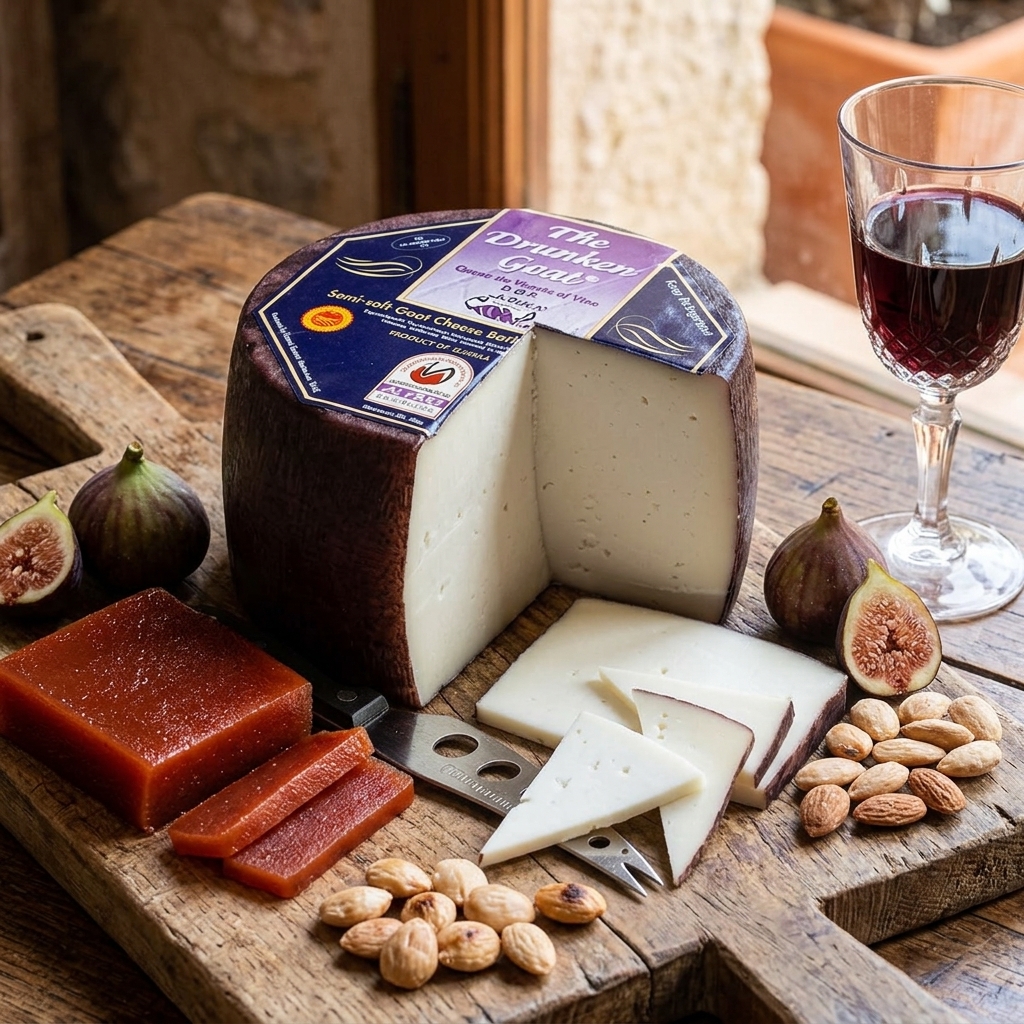
Texturally, the cheese is supple, elastic, and unctuous. The paste is dense and compact, presenting a startlingly white color that provides vivid contrast to the deep violet rind. When cut, it offers a smooth, uniform surface with occasionally small, unevenly distributed mechanical holes. The cheese is easily sliceable and pliable, maintaining its integrity on a cheese board while remaining soft enough to melt effortlessly.
Ingredients: Pasteurized goat's milk, animal rennet, salt, Monastrell wine. Contains milk.
Perfect Pairings: Spanish Traditions and Modern Applications
Drunken Goat shines when paired with traditional Spanish accompaniments. Membrillo (quince paste) provides the quintessential pairing – its dense, grainy sweetness perfectly complements the cheese's creamy texture. Dried figs or fig cake echo the dark fruit notes of the Monastrell wine, while a light drizzle of orange blossom honey enhances the floral aromatics.
For wine pairings, follow the regional principle of "what grows together, goes together." Monastrell, the wine used in production, creates the definitive pairing with its dark fruit profile and medium tannins. Spanish reds like Tempranillo and Garnacha provide structured backdrops without overwhelming the cheese's delicate sweetness. For contrast, try a crisp Sauvignon Blanc or Sancerre – their citrusy, mineral-driven profiles cut through the richness while elevating the lactic tang.
Beer enthusiasts should consider a clean Pilsner to cut through the dense texture, or an American Pale Ale whose moderate hop bitterness provides bright contrast to the sweet, milky flavors. Belgian fruit lambics harmonize beautifully with the grapey, floral notes of the wine-soaked rind.
Pro Pairing Tip: For the aged Reserva version, try an Amontillado Sherry – its nutty, oxidative notes create a sophisticated pairing that highlights the cheese's deeper toasted almond flavors.
Culinary Applications: Beyond the Cheese Board
While Drunken Goat excels on cheese boards, its excellent melting properties make it versatile in the kitchen. Try it melted on toasted sandwiches, where the wine-infused rind adds complexity to simple grilled cheese. Crumble it into mesclun salads with dried cranberries for a sophisticated lunch, or serve it simply as a tapa with crusty fresh bread and Marcona almonds.
The cheese's mild flavor profile makes it approachable for cooking applications where you want creamy richness without overwhelming other ingredients. Its high fat content ensures smooth melting, while the subtle wine notes add depth to dishes without dominating the flavor profile.
Storage and Quality: What to Look For
When selecting Drunken Goat, look for wheels with vibrant purple rinds and pristine white paste. The wine aroma on the rind is expected and indicates proper maceration – this is not a sign of spoilage. A few small, irregular holes in the paste are structural and normal.
Avoid cheese with ammonia odors, slimy surfaces, or unusual molds (any fuzzy growth that appears black, green, or bright pink). The interior should remain white; yellowing or grey patches signal deterioration. Store the cheese wrapped in cheese paper or parchment in your refrigerator's cheese drawer, and bring to room temperature before serving for optimal flavor and texture.
Where to Find It in Pagosa Springs
You can find Drunken Goat and other specialty cheeses at Murray's Cheese inside City Market, where knowledgeable staff can help you select the perfect wheel and suggest complementary items for your cheese board.
Pronunciation Guide:
- Drunken Goat: DRUNG-ken GOHT
- Queso de Murcia al Vino: KEH-soh deh MOOR-thyah ahl BEE-noh
Sources and Further Reading
- Foods and Wines from Spain - Official PDO information
- Forever Cheese - Brand history and specifications
- Culture: The Word on Cheese - Industry insights
- Spanish Fine Cheese - Traditional production methods
- Di Bruno Bros. - Pairing recommendations
