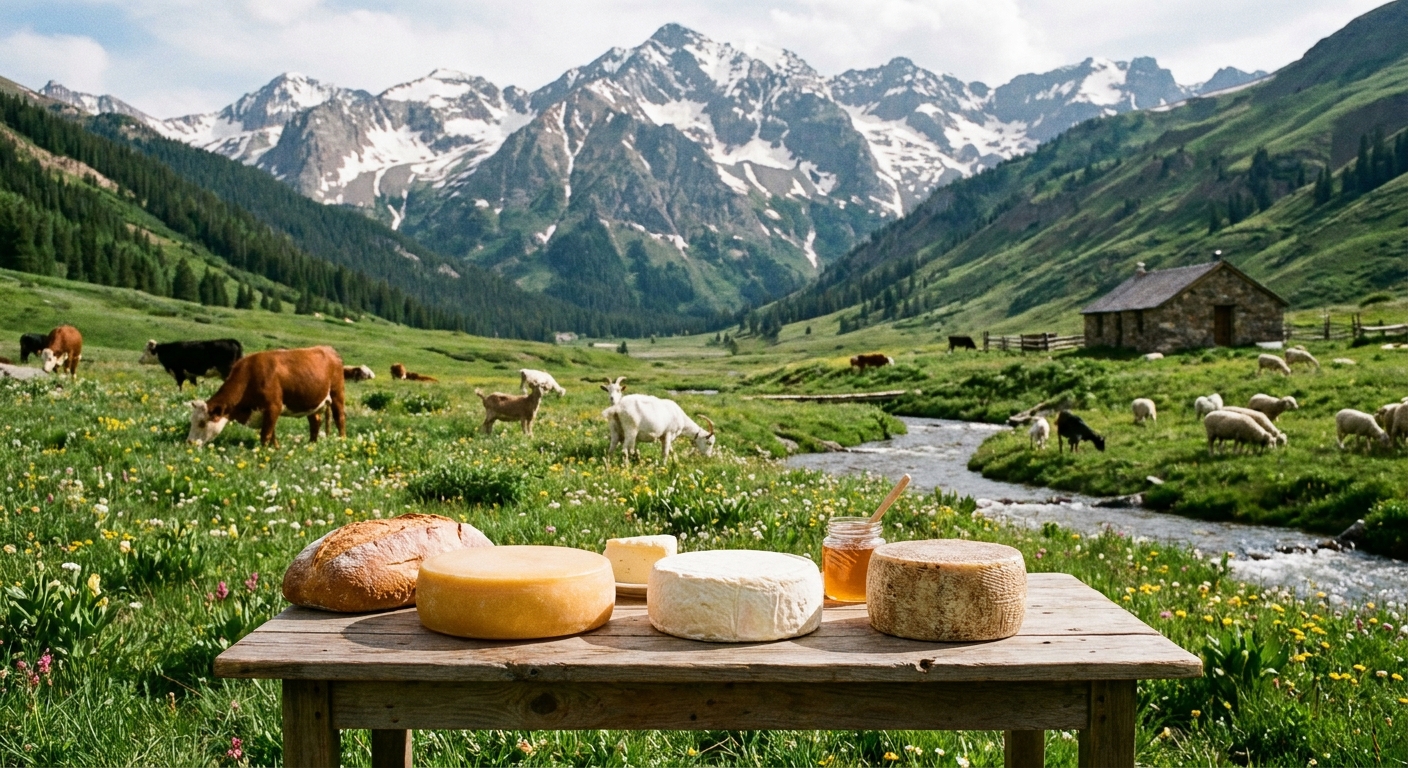
Colorado's High-Altitude Cheese Revolution: Where Mountain Air Meets Artisan Craft
From the mineral-rich waters of the Rockies to the unique challenges of high-altitude cheesemaking, Colorado has quietly become one of America's most innovative cheese regions.
Estimated Reading Time: 8 min
You might not think of Colorado as cheese country. After all, this is the land of craft beer and green chile, not aged Goudas and creamy Camemberts. But drive through the valleys around Fort Collins, Durango, or Longmont, and you'll discover something remarkable: a thriving artisan cheese scene that's producing some of the most awarded dairy products in the nation. What makes Colorado cheese special isn't just the skill of its makers, it's the unique terroir of the high country itself, where altitude, mineral-rich water, and alpine pastures create conditions unlike anywhere else in America.

The Science Behind the Summit: How Altitude Changes Everything
Making cheese at 5,000 feet isn't just a matter of adjusting recipes. The physics and biology of high-altitude production fundamentally alter every step of the process, from the composition of the milk to the behavior of the cultures.
Research shows that cows grazing at altitudes above 1,200 meters produce milk with higher concentrations of fat and protein, exactly what cheesemakers want. The trade-off? Lower lactose levels, which means the lactic acid bacteria that drive fermentation have less fuel to work with. This requires precise timing and temperature control to achieve the right acidity in the final product.
Then there's the atmospheric pressure. In Denver, water boils at 203°F instead of the standard 212°F. While cheesemakers rarely boil milk, this pressure difference affects moisture evaporation from curds and the development of those prized tyrosine crystals in aged varieties. The result is cheeses with more concentrated mineral profiles and unique textural characteristics.
Terroir Tales: The Grass-Fed Advantage
Colorado's high-mountain flora contributes another layer of complexity. Grass-fed herds grazing on alpine pastures produce milk rich in beta-carotene, which gives the cheese a natural golden hue, a visual marker of pasture-based health. The mineral-rich mountain spring water, loaded with magnesium, calcium, and potassium, acts as essential nutrients for starter cultures and contributes to the structural integrity of the curd.

MouCo Cheese Company: Bavarian Precision Meets Colorado Innovation
In Fort Collins, MouCo Cheese Company has been perfecting the art of soft-ripened cheese since 2001. Founded by Birgit Halbreiter, whose father was a professional cheesemaker in Bavaria, and Robert Poland, a former fermentation manager at New Belgium Brewing, MouCo represents the marriage of Old World technique and New World innovation.
Their approach is methodical. Using a High-Temperature Short-Time pasteurization system that recycles 70% of its heat, they process local Colorado milk through an eight-step production cycle that includes hand-measured cultures, custom curd-cutting harps, and German-imported breathable cheese paper for aging.
The results speak for themselves. Their ColoRouge, a washed-rind cheese with a striking red exterior, has taken first place at the American Cheese Society competition five times. Even more impressive, their Cheddar Cheese Curds shocked the industry by placing second at the 2023 ACS competition, a category traditionally dominated by Wisconsin producers.
Pro Pairing Tip
MouCo's Truffello, infused with real Italian black truffles, pairs beautifully with a crisp Riesling or a hoppy IPA. The earthy truffle notes complement both the wine's minerality and the beer's citrusy hop character.
Ingredients: Pasteurized cow's milk, cultures, rennet, salt. Contains milk.
James Ranch: Raw Milk Pioneers in the Animas Valley
Ten miles north of Durango, James Ranch operates as a 400-acre laboratory for regenerative agriculture and raw milk cheesemaking. The ranch, established by the James family in 1961, produces cheese only when their Jersey-cross cattle are on green grass, allowing the animals to rest during winter months.
This seasonal approach creates cheeses that truly reflect their terroir. Their Young Belford, aged 90 days, offers creamy mildness perfect for melting. The Reserve Belford, aged three years, develops notes of butterscotch and the satisfying crunch of amino acid crystals. Their Colorado Blue provides a smooth, natural-rind alternative to more aggressive blues, with hints of smoky mushroom and cream.
The ranch's commitment to raw milk isn't just philosophical, it's nutritional. By aging their cheeses for at least 60 days, they comply with federal safety regulations while preserving the natural enzymes and elevated levels of vitamins A and E found in grass-fed milk.
Terroir Tales: The Family Meeting
To maintain harmony across seven different agricultural enterprises, the James family holds quarterly meetings involving three generations. Each sibling manages a different aspect, from beef production to the on-site grill, under the philosophy: "Healthy Soil = Healthy Grass = Healthy Environment = Healthy Animals = Healthy Humans!"
Ingredients: Raw cow's milk, cultures, rennet, salt. Contains milk.
Haystack Mountain Creamery: Three Decades of Goat Cheese Excellence
Longmont's Haystack Mountain Creamery has been a Colorado institution since 1989, when founder Jim Schott started with five goats on six acres in Niwot. Today, under cheesemaker Jackie Chang's guidance, they've become the first goat dairy in the U.S. to receive "Certified Humane" status and one of the most awarded creameries in the nation.
What sets Haystack apart is their clean flavor profiles. Chang has mastered the art of eliminating the "goaty" aftertaste that can deter consumers, creating approachable cheeses that showcase the natural sweetness of goat milk. Their Boulder Chèvre launched the company, but it's varieties like Cashmere, a soft-ripened goat cheese that won first place at the 2019 American Cheese Society awards, that have cemented their reputation.
The operation has evolved beyond pure goat milk, partnering with Longmont Dairy to produce cow's milk varieties like Funkmeister, a washed-rind organic cheese that's become a staple in Denver specialty shops.
Pro Pairing Tip
Haystack's Snowdrop, a soft-ripened wheel with a delicate bloomy rind, pairs exceptionally well with local honey and toasted walnuts. The combination highlights the cheese's subtle tang while adding textural contrast.
Ingredients: Pasteurized goat's milk, cultures, rennet, salt. Contains milk.
Colorado Farmhouse Cheese Company: The Sheep Milk Frontier
The newest player in Colorado's cheese scene is also its most ambitious. Tim Veldhuizen, a former chef and restaurant owner with 30 years in Northern Colorado's culinary scene, launched Colorado Farmhouse Cheese Company in 2023 with a unique vision: to become the state's only dedicated sheep dairy.
Operating from a farm in Loveland where Veldhuizen hand-built the cheese cave, the company focuses on rare breed preservation. Their herd includes Dutch Belted cows, a breed with only about 350 individuals remaining in the United States. This diversity in milk sources, cows, goats, and sheep, allows for a varied production line that caters to high-end culinary markets.
While still scaling production, their Sharp Cheddar has already caught the attention of regional chefs, appearing on menus at establishments like Grand Elk Grille in Granby. The upcoming sheep's milk initiatives promise to fill a significant gap in the local market for Manchego and Pecorino-style cheeses.
Ingredients: Varies by cheese; cow's, goat's, or sheep's milk, cultures, rennet, salt. Contains milk.
The Cautionary Tale of Avalanche Cheese Company
Not every Colorado cheese story has a happy ending. Avalanche Cheese Company in Paonia, founded by Wendy Mitchell in 2008, produced world-class goat cheeses while maintaining the highest standards of animal welfare and employee compensation. Their Cabra Blanca, Goat Cheddar, and Midnight Blue won numerous awards from the American Cheese Society and Good Food Awards.
Despite critical acclaim and distribution in high-end venues like the St. Regis Aspen, Mitchell found that the economics "simply stopped adding up." The high costs of small-scale production, including trucking milk from farm to creamery, premium labor costs, and expensive packaging, eventually hit a price ceiling the market wouldn't support. When she raised prices to break even, she lost 75% of her associated business, leading to the creamery's closure in late 2017.
Mitchell's experience highlights the ongoing tension between consumers' desire for sustainable food and their willingness to pay the necessary premium. Her legacy continues through her Aspen businesses, Meat & Cheese Restaurant and Farm Shop and Hooch, which advocate for and sell other artisan cheeses.
Where to Find Colorado's Finest
The success of Colorado's artisan creameries depends on a specialized network of distributors and retailers who understand the nuances of high-altitude cheese. Cheese Importers of Longmont, operating since 1976, serves as the central hub, distributing roughly 700 varieties from their warehouse in a revived 1930s power station.
Locally, you'll find these cheeses at specialty shops throughout the Front Range and Western Slope. In Pagosa Springs, Murray's Cheese inside City Market offers a curated selection of Colorado artisan varieties alongside international classics. The knowledgeable staff can guide you through the unique characteristics of each producer and suggest pairings that highlight the terroir of the high country.
Pro Pairing Tip
For a true Colorado experience, pair James Ranch's Mature Belford with local honey from mountain wildflowers and a slice of Olathe sweet corn bread. The combination showcases the state's agricultural diversity while highlighting the cheese's nutty complexity.
The Future of High-Altitude Cheesemaking
Colorado's cheese industry represents a fascinating study in adaptation and innovation. The shift from traditional farmstead production toward strategic partnerships, as seen with Haystack Mountain and MouCo, suggests a path toward long-term sustainability. Meanwhile, the commitment to regenerative practices at James Ranch and the pioneering of sheep dairy at Colorado Farmhouse ensure the state continues pushing the boundaries of American cheesemaking.
The unique terroir of Colorado, defined by mineral-rich water, alpine flora, and the physics of high-altitude production, continues to express itself through the skill of its cheesemakers. As the industry matures, we're seeing greater integration of scientific precision with environmental stewardship, ensuring that the Mile High tradition remains both vital and profitable.
Whether you're a longtime resident or a visitor exploring the region, Colorado's artisan cheeses offer a delicious way to taste the terroir of the Rockies. Each wheel tells a story of altitude, adaptation, and the relentless pursuit of excellence that defines the best of American artisan food production.
Sources and Further Reading
- American Cheese Society - State of the U.S. Artisan/Specialty Cheese Industry Report
- National Center for Biotechnology Information - Impact of Altitude on Dairy Milk Composition
- MouCo Cheese Company - Fort Collins, Colorado
- James Ranch - Durango, Colorado
- Haystack Mountain Creamery - Longmont, Colorado