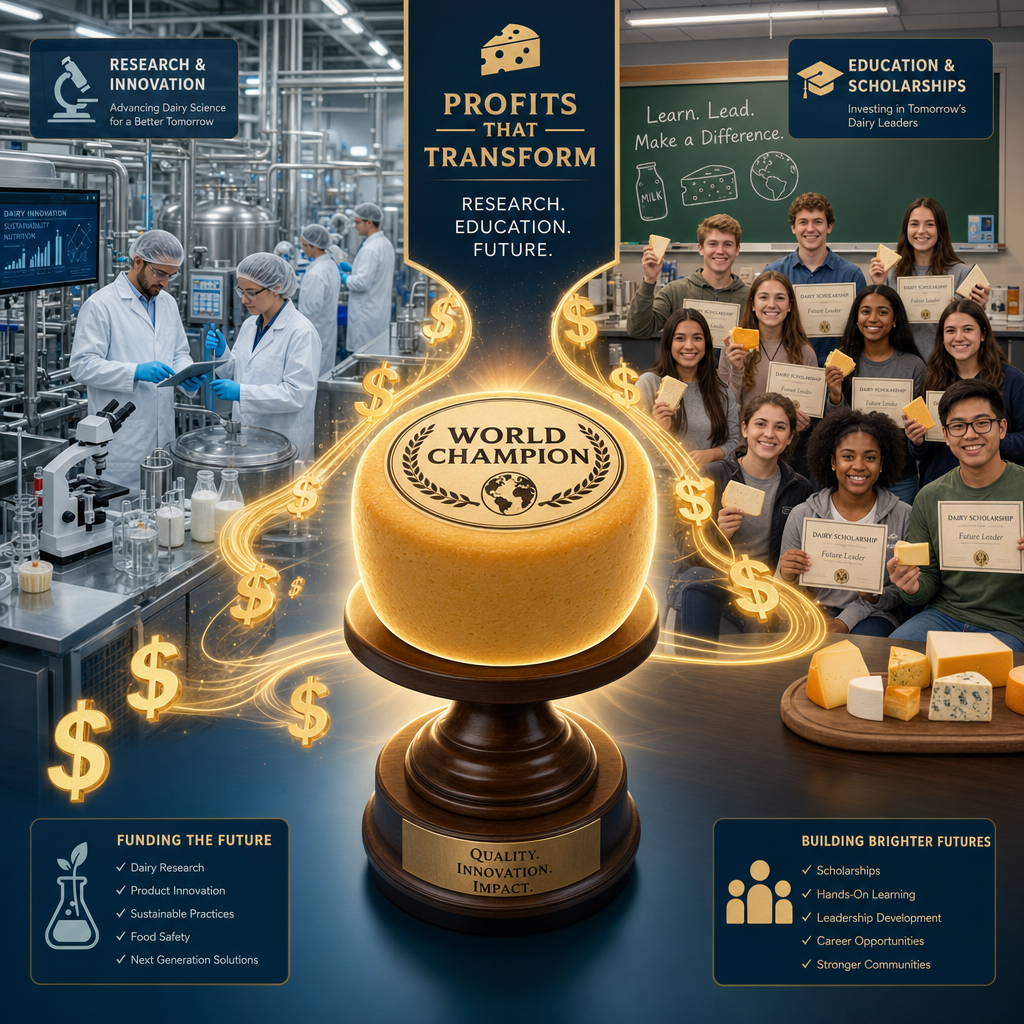
Why Companies Pay $1,000 Per Pound for Championship Cheese
The World Championship Cheese Contest auction isn't just about cheese, it's a strategic business investment that transforms dairy industry relationships and funds the next generation of cheesemakers.
Estimated Reading Time: 6 min
Every two years, something remarkable happens in Madison, Wisconsin. Technology companies, equipment manufacturers, and ingredient suppliers gather to bid hundreds, sometimes over a thousand, dollars per pound for cheese. Not just any cheese, mind you, but the technical masterpieces that emerge from the World Championship Cheese Contest. While you can walk into Murray's Cheese at City Market here in Pagosa Springs and buy excellent cheese for $15 to $30 per pound, these corporate bidders are playing an entirely different game.

The auction isn't really about the cheese at all. It's about relationships, reputation, and building the future of an industry that depends on technical precision and human expertise.
The Science Behind the Spectacle
The World Championship Cheese Contest, organized by the Wisconsin Cheese Makers Association since 1957, represents the pinnacle of dairy technical achievement. Unlike consumer awards that might consider packaging or marketing story, this competition uses a rigorous 100-point scoring system. Technical judges from around the world evaluate entries for specific defects in flavor, body, texture, salt, color, finish, and packaging.
When Beemster Royaal Grand Cru won the 2026 world championship, it wasn't because of clever branding. The 12-month aged hard cheese from the Netherlands earned its title through manufacturing precision that left judges with virtually nothing to critique. The difference between world champion and runner-up often comes down to fractions of points, in 2026, it was a mere 0.23 points that separated the winner from Switzerland's Appenzeller Purple Label.
This technical rigor is exactly why corporate bidders value these products so highly. When Custom Fabricating & Repair or ALPMA USA bids on a championship cheese, they're not buying food, they're buying proof that their equipment and expertise helped create something technically perfect.

Pro Pairing Tip
If you want to taste championship-level cheese without the auction prices, look for previous contest winners at Murray's Cheese. Many gold medal winners from past competitions are available at regular retail prices, giving you a chance to experience the technical excellence that drives these high-stakes auctions.
The Economics of Relationship Marketing
In the dairy equipment world, relationships span decades. When a creamery invests in a new packaging line from ALPMA or sanitary processing equipment from Custom Fabricating & Repair, they're making a multi-million-dollar commitment that requires ongoing service and support. These aren't impulse purchases, they're carefully considered partnerships.
When Nelson-Jameson or Hydrite Chemical places a record-breaking bid on cheese produced by one of their clients, it serves as a very public declaration of partnership. The winning bidder receives commemorative recognition and prominent coverage in trade publications like Cheese Market News. This earned media provides credibility that traditional advertising simply cannot match.
Consider the signaling theory at work: a company that can afford to bid $775 per pound for champion cheese (as T.C. Jacoby & Co. did in 2016 for Roth Grand Cru Surchoix) is demonstrating several key attributes to potential clients. They're financially stable, committed to quality, and positioned as industry leaders. For equipment buyers making seven-figure purchasing decisions, these signals matter enormously.
Terroir Tales: The 2016 Breakthrough
The 2016 auction marked a watershed moment when T.C. Jacoby's $775-per-pound bid for Roth Grand Cru Surchoix celebrated the first American world champion in a generation. The bid wasn't just about the cheese, it was about national pride and the validation of American cheesemaking technology. That single purchase generated more industry buzz than years of traditional marketing could have achieved.
Where the Money Really Goes
Since 1999, the Wisconsin Cheese Makers Association has invested over $1.84 million from auction proceeds into the industry's future. The allocation reveals the strategic thinking behind these luxury purchases:
Student Scholarships: The Myron P. "Mike" Dean & Supplier Scholarships now provide $5,000 per student (increased in 2025), while the Brian Eggebrecht Student Scholarship supports technical school students with $2,000 each. These programs ensure a pipeline of skilled workers who will operate the equipment these bidding companies manufacture.
Research Infrastructure: $100,000 has been allocated to the Center for Dairy Research at UW-Madison, while $90,000 supports the Grassland Dairy Center of Excellence at UW-River Falls. These institutions are where new cheese styles and processing technologies are developed and tested.
Professional Training: Ongoing operational funding supports WCMA training programs that keep the industry's technical standards high.
For equipment manufacturers, this creates a virtuous cycle. By funding education and research through auction bids, they're ensuring the future existence of their own customer base. A $5,000 scholarship investment today might yield a customer relationship worth millions over the next two decades.
The ROI of Luxury Cheese
Traditional marketing campaigns in the dairy industry typically show returns of 3:1 to 5:1. But auction bidding operates as a "force multiplier" for these efforts. Companies using integrated strategies, combining offline industry support like auction bidding with online presence, see 40-60% higher lead generation than those relying on traditional marketing alone.
The metrics that matter aren't typical retail calculations:
Customer Acquisition Cost: Face-to-face networking at events like CheeseExpo, anchored by auction participation, reduces sales cycle length for high-value machinery.
Customer Lifetime Value: Public support of a client's award-winning product through high bidding increases repeat business and long-term service contracts.
Workforce Pipeline: Funding scholarships ensures a supply of skilled operators familiar with the bidder's equipment.
When Westby Cooperative Creamery earned multiple top honors in 2026, including a second-place finish for its French onion dip with a score of 99.55, the cooperative announced a $14 million expansion project. The awards gave the board and lenders confidence to invest in long-term modernization. For the equipment suppliers who bid on Westby's products, that expansion represents potential sales worth far more than their auction investments.
What Drives the Highest Bids
Not all cheese styles command equal premiums. Aged Alpine styles and hard cheeses consistently dominate both the finalist lists and top auction bids. The 2026 world champion Beemster Royaal Grand Cru exemplifies this trend, a 12-month aged hard cheese that represents significant capital investment and technical complexity.
These styles command premiums because they require:
Inventory Carrying Costs: Cheeses aged for months or years represent substantial capital investment. Auction bidders recognize and support these long-term artisan projects.
Technical Complexity: Styles like Gruyère, Emmentaler, and aged Cheddar have narrow windows for perfection. The technical precision required resonates with equipment manufacturers who understand the challenges involved.
Market Growth: Emerging categories like goat and sheep milk cheeses represent the highest growth segments of the specialty market. Products like Midnight Moon and various chèvres from Cypress Grove have become auction staples, reflecting both technical innovation and consumer interest.
Pro Pairing Tip
When shopping for aged cheeses at Murray's Cheese, look for wheels with natural rinds and ask about aging time. The longer aging periods that drive auction premiums also create more complex flavors that pair beautifully with Pagosa Springs' craft beer scene.
The Ripple Effect for Makers
For creameries and cooperatives, contest success provides crucial pricing power in a commodity-driven market. A "World Champion" or "Best of Class" designation serves as technical validation, giving wholesale buyers confidence in product consistency and quality.
At the retail level, contest wins create a "halo effect" that extends beyond the winning product to the entire brand. Retail experts note that award-winning cheeses bring "excitement to the stores" and encourage consumers to try new products they might otherwise overlook. For smaller artisan producers who lack national marketing budgets, the contest provides invaluable exposure.
Emmi Roth's 2016 world championship win brought immediate national attention to their Fitchburg, Wisconsin facility, enabling them to leverage the victory for increased shelf space and consumer trial. The technical validation opened doors that traditional marketing approaches couldn't access.
The Future of Strategic Philanthropy
The cheese auction represents something unique in American business: a market where luxury pricing serves strategic philanthropy. The $300 to $1,000 per pound paid by technology firms aren't anomalies, they're calculated investments in brand authority, client retention, and workforce development.
As the dairy industry becomes increasingly automated and technically sophisticated, the need for skilled workers and ongoing research intensifies. The auction's funding model ensures that technical excellence and professional education continue driving the industry forward.
For those of us in Pagosa Springs who appreciate great cheese, the auction represents something profound about American craftsmanship and community investment. Every time you enjoy a piece of award-winning cheese from Murray's selection, you're tasting the result of this remarkable ecosystem where business strategy, technical excellence, and genuine philanthropy intersect.
The next time you see a $30-per-pound cheese and wonder about the price, remember that somewhere, a company paid thirty times that amount for a similar wheel. They weren't buying cheese, they were investing in the future of an industry that takes precision, partnership, and community seriously.
Sources and Further Reading
- Wisconsin Cheese Makers Association - Industry scholarships and auction proceeds
- World Championship Cheese Contest - Technical judging standards and competition results
- Cheese Market News - Industry analysis and auction coverage
- Center for Dairy Research, UW-Madison - Research and development initiatives
- Westby Cooperative Creamery - Case study in contest success and business expansion
