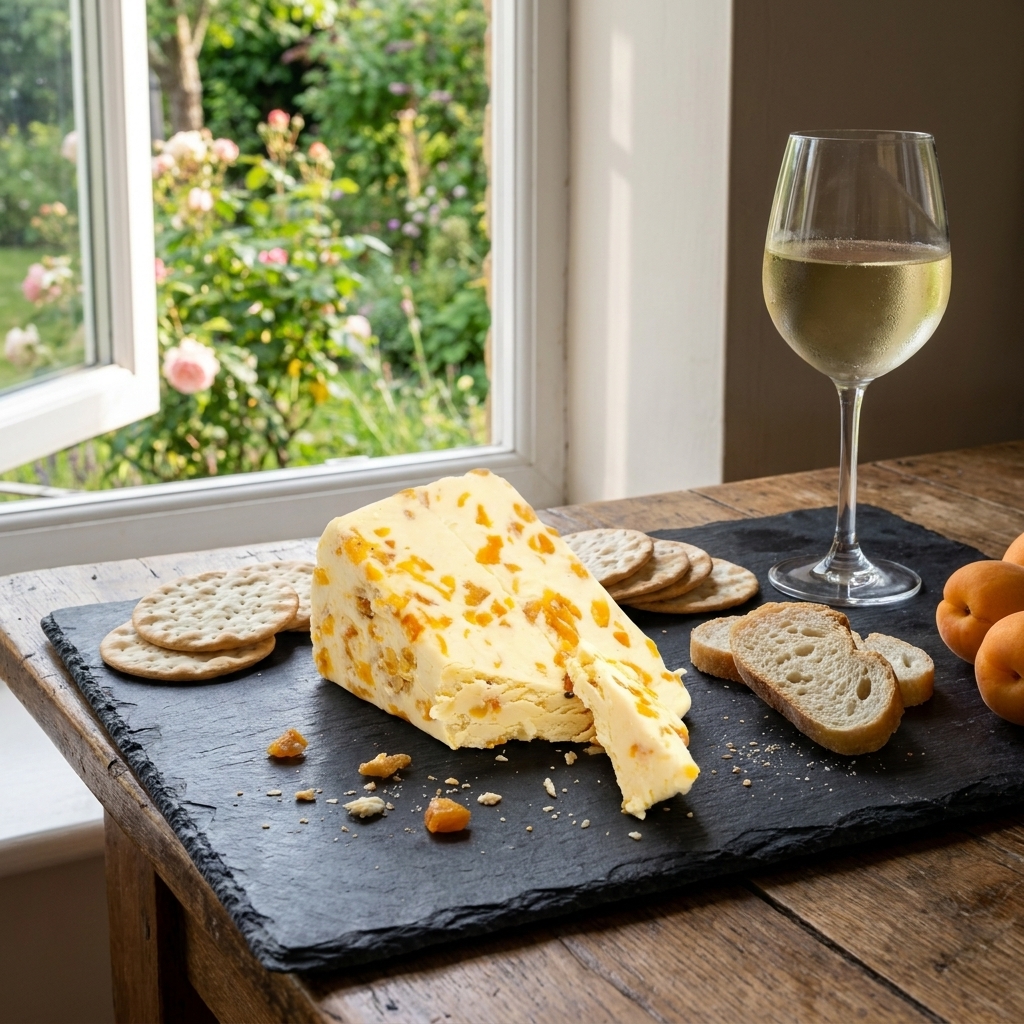
Meet the Stilton without the blue
Somerdale White Stilton with Apricot is a young, crumbly English cow's milk cheese blended with dried fruit. Its appeal is simple: bright dairy tang, sweet apricot and enough richness to make a small piece feel like dessert.
Despite the name, this is not a blue cheese. White Stilton is made without the added Penicillium roqueforti, the mold that gives Blue Stilton its blue veins and much of its bold flavor. It also skips the piercing used to encourage that mold's growth.
Think of it as a fruit-blended, unpressed cheese rather than a milder wedge of blue. It has its own purpose, and it is especially good when you want something sweet without committing to a slice of cake.

At the counter, say white STIL-tuhn with AY-pri-kaht by SUM-er-dayl. If you say APP-ri-kaht instead, nobody should withhold your cheese.
Three English counties, one protected name
White Stilton's home is England's East Midlands. Cheese bearing the protected Stilton name must be made in Derbyshire, Leicestershire or Nottinghamshire and meet defined production standards.
That protection is known as a Protected Designation of Origin, or PDO. In plain terms, the name ties a food to a place and a method. Stilton gained PDO recognition in 1996 and is also protected under the United Kingdom's geographical indications system.
Somerdale International is the exporter and distributor behind this apricot blend, not a reason to relocate Stilton's birthplace to Somerset. The company was founded in 1990 and is based in Wellington, Somerset. The White Stilton base comes from cheesemaking within the protected region.

Getting that cheese to an American counter takes refrigerated transport, import paperwork and careful handling. For shoppers, the useful distinction is between the company bringing a cheese to market and the dairy making it.
Terroir Tale: The village that cannot make its namesake
Stilton village is in Cambridgeshire, outside the permitted production area. A cheese made there cannot legally be sold under the protected Stilton name.
The village's coaching inns helped make the cheese famous among travelers on the Great North Road. Cooper Thornhill of the Bell Inn is closely associated with that 18th-century trade. The familiar origin story has some disputed details, but the central irony holds: Stilton became a famous place to buy the cheese, not part of today's authorized area for making it.
Milk, rennet and the ingredient label
The base cheese uses pasteurized cow's milk. No particular cattle breed is the defining feature of its identity. Place and production rules matter more here.
Pasteurization heats milk to reduce harmful microbes before cheesemaking begins. One common method heats it to at least 161 degrees Fahrenheit for 15 seconds. Pasteurized milk is required for Stilton, but pasteurization does not make the finished cheese immune to later contamination. Refrigeration still matters.
Starter cultures, the helpful bacteria used in cheesemaking, turn milk sugar into lactic acid. That acid helps create White Stilton's clean tang. Rennet then helps the milk set into curd, the solid portion that becomes cheese.
Somerdale's apricot blend uses microbial rennet, a nonanimal coagulant suitable for vegetarian cheesemaking. Vegetarian, yes. Vegan, no.
The blend contains dried apricots, and retail ingredient lists may also include fructose, rice flour, salt and sulfur dioxide. Fructose adds sweetness. Rice flour can help with handling the fruit, while sulfur dioxide helps preserve dried apricots and maintain their color.
Allergen check: This cheese contains milk. Check the package for sulfites, especially if you are sensitive to them, and use the current label to confirm ingredients and vegetarian status. Fruit-blended cheeses are not all formulated alike.
Nutritionally, treat this as a rich cheese with a sweet addition. It supplies protein, but also saturated fat, sodium and sugars. A roughly 1-ounce portion is a useful starting point for a mixed board. The package's Nutrition Facts panel is the best guide to the exact blend in your basket.
Young, moist and deliberately crumbly
White Stilton is generally ready after about three to four weeks, much sooner than Blue Stilton. That short maturation keeps the flavor fresh and tangy rather than deeply aged and pungent.
Its texture also reflects an important production choice: Stilton curds are not mechanically pressed. Whey, the liquid portion of milk, drains away naturally as the curds settle in molds.
The result is a cheese that holds together but breaks readily into flakes and small chunks. Depending on the classification system, you may see White Stilton described as semi-soft or semi-hard. At the table, moist and crumbly tells you more than either label.
Crumbly does not necessarily mean dry. A piece can fall apart under your fork, then soften into a creamy mouthful. The apricot pieces supply a different kind of resistance: a little sticky, a little chewy.
This is not a cheese to buy for a stretchy melt. Its strengths are crumbling, softening and bringing pockets of sweet-tart flavor to a dish.
What you will taste
Start with a small bite on its own. You should notice a clean, yogurt-like tang and mild milky richness. Then the apricot brings concentrated stone-fruit sweetness, sometimes with a light floral note.
There is no intended blue-cheese bite. Nor should there be a strong ammonia smell.
The balance matters. Too many sweet accompaniments can turn an interesting cheese into a rather sugary mouthful. A plain cracker often does more for it than a second spoonful of jam.
Pro Pairing Tip: Taste before you build
Try one bite plain, one with an unsalted cracker and one with a small piece of toasted walnut. That quick comparison tells you whether you prefer the cheese's fruit, tang or creamy finish. Build the rest of your plate around that preference.
Wine: Give the fruit a little room
Off-dry Riesling is my first pick. Off-dry means slightly sweet, not syrupy. Its lively acidity refreshes the palate, while peach and apricot notes can echo the fruit in the cheese.
A fruit-forward Zinfandel is another option, particularly if you prefer reds. Look for generous berry flavor rather than a heavily tannic, strongly oaked style. Sweet cheese can make a very dry wine seem sharper by comparison.
For an after-dinner plate, try a small pour of tawny port or a late-harvest dessert wine. Tawny port's nutty, dried-fruit character works especially well with walnuts alongside the cheese. Keep portions modest so the drink does not overwhelm the dairy tang.
Beer: Wheat styles make an easy match
A hefeweizen brings soft wheat flavor and often banana and clove aromas. A witbier usually leans toward citrus and spice. Either can give apricot a friendly setting without adding much bitterness.
Fruit beers can work, too, but sweetness and acidity vary widely. Taste before pouring for the whole table. A sharply sour fruit beer creates a very different pairing from a gently sweet fruit ale.
For a simpler match, choose a light lager. Its clean flavor and carbonation offer a refreshing contrast to the cheese's richness.
A strongly bitter IPA would not be my opening move. You can experiment, but this cheese generally rewards a lighter touch.
From a Pagosa cheese board to the kitchen
After a winter day near Wolf Creek, a small plate of this cheese, sliced pear and ginger cookies makes an easy finish to supper. During summer, it belongs in a cooler until serving, not loose in a daypack on a long hike.
To put together a balanced board:
- Start small. Set out about an ounce per person when other cheeses or desserts are available.
- Add something plain. Water crackers or thin baguette slices keep the sweetness in check.
- Choose one accent. Try ginger snaps for spice, toasted walnuts for crunch or fresh pear for a juicy contrast.
- Offer a savory neighbor. A mature cheddar gives guests a useful contrast without requiring another sweet spread.
- Serve in small batches. Refill the board from the refrigerator rather than leaving the whole wedge out.
For local shopping, ask at Murray's Cheese inside City Market in Pagosa Springs about Somerdale White Stilton with Apricot and current availability. A quick check is worthwhile if you are planning a particular board for visiting friends.
In the kitchen, fold small crumbles into scone dough for pockets of tangy cheese and fruit. Keep the pieces fairly small and use a reliable recipe, especially when baking at Pagosa's elevation.
The cheese can also fill chicken breasts or pork tenderloin. Expect it to soften rather than stretch. For an easier approach, serve a small crumble alongside the cooked meat. If you do stuff meat, use a food thermometer and bring the center of the stuffing to 165 degrees Fahrenheit.
Storage: White Stilton should stay white
Keep the cheese refrigerated at 40 degrees Fahrenheit or below, well wrapped or in a clean, covered container. Follow the package's storage directions and any instructions for use after opening.
A brief rest outside the refrigerator can soften its flavor and texture. About 20 minutes is often enough for a small serving. Count all time out of refrigeration, and discard perishable cheese left out longer than two hours, or one hour when temperatures exceed 90 degrees.
Normal features include ivory-colored cheese, orange apricot pieces, a crumbly body and a mild, tangy aroma. Warning signs include:
- Unexpected fuzzy mold, including blue-green, pink or black growth.
- A newly slimy surface.
- Strong yeasty, alcoholic, rotten or ammonia-like odors.
- Unusual package swelling.
Do not assume blue growth is acceptable because the label says Stilton. This is White Stilton. For this moist, fruit-blended cheese, discard the whole affected piece rather than trimming away mold.
Also remember that harmful bacteria do not always announce themselves through smell or appearance. Do not taste questionable cheese to test it. Sulfur dioxide in the fruit does not make the cheese shelf-stable.
Buy a manageable piece, keep it cold and give it a few simple partners. The apricot already brings plenty to the plate.
Sources and Further Reading
- Somerdale White Stilton Blends, Somerdale International.
- Good Labelling Practice for Stilton Cheese, Stilton Cheesemakers' Association.
- Curious Questions: Why Doesn't Stilton Cheese Come From Stilton?, Country Life.
- Somerdale White Stilton Apricot Cheese, Market Street.
- Molds on Food: Are They Dangerous?, U.S. Department of Agriculture, Food Safety and Inspection Service.