Estimated Reading Time: 7 min
Wisconsin roots, with an Italian accent
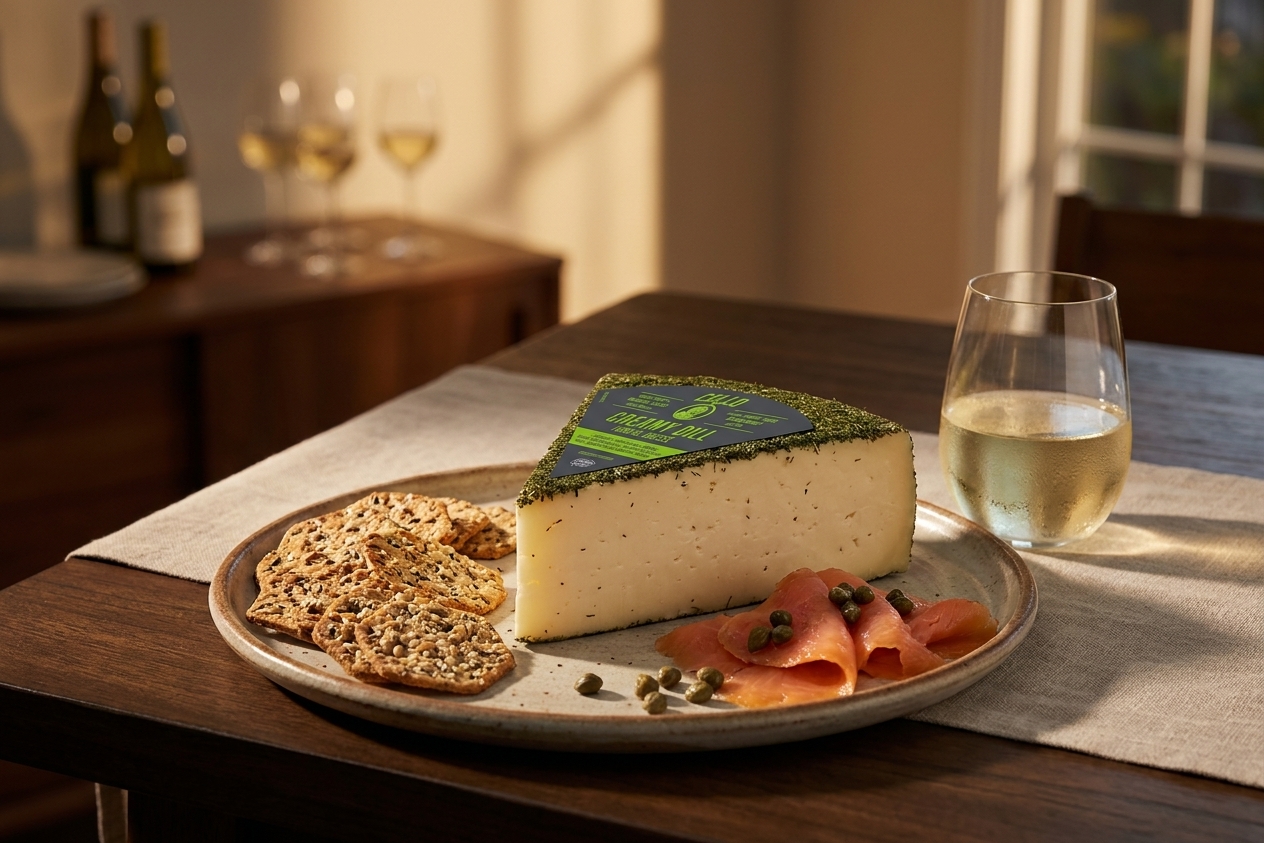
Cello Creamy Dill Rubbed Fontal comes from Lake Country Dairy in Turtle Lake, Wisconsin. The dairy is part of Schuman Cheese, a family-owned company with a long history in Italian-style cheesemaking.
Fontal belongs to the broad family of mild, supple cheeses inspired by European melting styles. It is not the same cheese as Fontina PDO from Italy’s Valle d’Aosta. That protected cheese must meet specific rules for its origin, raw milk and production. PDO means Protected Designation of Origin: The place and the method are part of the cheese’s identity.

Cello’s Wisconsin version takes a different path. It uses pasteurized cow’s milk and wears a hand-applied coating of dill, garlic, onion and spices. Think Italian-style foundations with an American herb-garden finish, not a replica of a cave-aged Alpine wheel.
Terroir Tales: A dairy with more than one specialty
Lake Country Dairy makes both Italian-style and Alpine-style cheeses. Its equipment includes copper kettles used for certain cheeses, including Copper Kettle Parmesan. That does not make this Fontal a copper-kettle cheese, but it gives you a sense of the dairy’s range. Dairy Foods named the facility its 2018 Plant of the Year.
What’s in the wedge?
The useful shorthand is aged, semi-soft, herb-rubbed cow’s milk cheese. It is also a melting cheese, which describes what it does in your kitchen rather than a separate milk or rind category.
Its key ingredients include cultured, pasteurized cow’s milk, salt, enzymes and a seasoning blend with dill weed, garlic, onion and spices.

- Milk type: Cow’s milk, not sheep’s or goat’s milk.
- Milk treatment: Pasteurized rather than raw.
- Coagulant: Microbial enzymes, which set the milk into curd without traditional animal rennet.
- Allergen: Milk. Pasteurization and aging do not make it suitable for someone with a milk allergy.
Microbial rennet generally fits vegetarian diets. If that distinction matters to your household, check the current package or ask the cheesemonger to confirm the enzyme information. The package is also the best place to check the full seasoning list and any additional allergen statements.
How to say it: CHEL-oh KREE-mee DIL RUBD FAHN-tuhl. No need to rehearse in the parking lot, but now you can order with confidence.
Pasteurization and aging: Two different jobs
Pasteurization heats milk to reduce harmful microbes. In high-temperature, short-time pasteurization, commonly called HTST, milk reaches at least 161 degrees Fahrenheit for 15 seconds. The process does not sterilize milk, and finished cheese still needs careful handling and refrigeration.
Starter cultures have another job. These useful bacteria turn milk sugar into lactic acid, helping shape the cheese’s flavor and structure. Rennet then helps form the curd, the soft gel that cheesemakers cut and drain.
Cello’s Fontal is aged for about 60 days. During that time, enzymes gradually break down proteins and contribute to flavor development. That protein breakdown is called proteolysis. The practical result is more interesting than the word: The cheese becomes supple and develops character beyond fresh milk.
Fat breakdown also contributes flavor during cheese ripening. Together, these changes help create Fontal’s mild, buttery and gently nutty profile without pushing it toward the sharpness of a long-aged cheddar.
Why semi-soft matters
Moisture helps determine whether cheese bends, spreads or breaks into crumbs. This Fontal retains enough water to stay smooth and pliable, with a little spring when you press it. Its fat contributes richness and a creamy feel.
That makes it easy to slice for sandwiches and useful for melting. It should yield under your teeth rather than crumble like aged Parmesan or run like a ripe Brie.
Do not confuse a creamy texture with cream cheese, though. This is a sliceable, aged cheese with a defined structure.
The same moisture that keeps it pleasant to eat also makes refrigeration important. It is a cheese for the cooler, not an all-afternoon ride in a warm car while you explore Pagosa Springs.
Taste the middle, then the edge
Start with a small piece from the center. Expect mild dairy sweetness, butter and a light nutty note, followed by a gentle tang.
Then try a piece with some herb-coated exterior. The dill adds green, grassy brightness, while garlic and onion bring a savory finish. You might notice the seasoning most clearly near the edge. That contrast is part of the pleasure.
The herb coating is intended to be eaten. Remove packaging, but there is no reason to trim away the seasoning just because it sits on the outside.
Dill’s aroma comes from a mix of fragrant compounds. One related bit of chemistry is especially neat: Carvone exists in mirror-image forms, one associated with caraway’s scent and the other with spearmint’s. A small change in molecular shape can make a big difference to your nose. The whole herb, however, smells of much more than one compound.
Build a board with crunch and restraint
This cheese already brings its own seasoning. It does not need five spicy spreads competing for attention.
For a simple board, choose one bread, one crisp vegetable and one salty or tart companion:
- Rye bread or seeded crackers: Their earthy flavors suit dill and onion. Caraway-studded rye is especially good if you enjoy a more assertive bite.
- Cucumber and tomatoes: Fresh, juicy produce lightens the rich cheese. In summer, this is an easy lunch rather than a production.
- Green apple: Thin slices add tartness and crunch.
- Smoked salmon: Dill and salmon make sense together, and a small slice of Fontal adds richness. Keep the portions modest because both bring plenty of flavor.
- Cornichons or pickled vegetables: A little acidity balances the buttery cheese.
- Prosciutto or mild salami: Choose restrained seasoning so the dill remains distinct.
Pro Pairing Tip: Taste before adding more salt
Smoked fish, cured meats, pickles and cheese can make a board quite salty. Include plain bread and fresh cucumber, and taste the full combination before reaching for salted nuts or another briny garnish.
For a local shopping stop, ask the staff at Murray’s Cheese inside City Market in Pagosa Springs whether Creamy Dill Rubbed Fontal is in stock. They can also help find a mild melting cheese if the exact wedge is unavailable.
Give it a turn in the skillet
My vote is for grilled cheese before an elaborate cheese board. Heat softens the Fontal, and the dill gives an ordinary sandwich enough character that you can skip a special sauce.
Try this straightforward method:
- Slice or grate the cheese while cold. It is easier to handle before it softens.
- Build a thin, even filling. Use rye or country bread and enough cheese to cover it without creating a thick mound.
- Butter the bread’s outer faces lightly. Cook in a skillet over medium-low heat.
- Cover briefly if needed. This helps warm the filling before the bread gets too dark.
- Rest, then cut. A short pause helps keep the molten center inside the sandwich rather than on your plate.
Good melting cheese still needs sensible heat. Too much heat can make cheese release oil or turn a sauce grainy. For white bean soup, add small amounts of grated Fontal over low heat and stir gently. Avoid a hard boil after adding it.
It also works with baked potatoes, vegetable panini and creamy baked pasta. After a cold day around Wolf Creek, a dill-cheese potato is a practical dinner, not merely a consolation prize for skipping a restaurant.
Wine: Start crisp, keep reds gentle
Sauvignon blanc is a natural first choice. Its bright acidity refreshes the palate, and grassy or citrus notes can sit comfortably beside dill. Choose a crisp bottle rather than a heavily oaked style.
Prefer red? Try a lighter pinot noir, with fresh red-fruit flavors and modest tannins. Serve it slightly cool. Big, heavily tannic reds can crowd this mild cheese and make the herb coating seem less balanced.
Nebbiolo is not automatically a gentle alternative. It can be quite tannic, so pinot noir is the easier starting point for this particular wedge.
Beer: Three styles worth trying
Pilsner: Crisp bitterness and lively bubbles provide a clean contrast to the buttery cheese. Herbal hop notes can complement the dill without overwhelming it.
Saison: A dry saison with peppery yeast notes makes an interesting match for the savory rub. Not every saison is sour, nor does it need to be for this pairing to work.
Hefeweizen: Its soft wheat character and banana-and-clove aromas offer a rounder contrast. Choose this if you prefer less bitterness than a pilsner usually delivers.
Pro Pairing Tip: Run a small taste test
Taste the cheese alone, take a sip, then try another bite. Does the dill still taste fresh? Does the drink feel refreshing? Those answers matter more than matching a list of aroma compounds.
Keep the herbs, watch for spoilage
Dried green herb flecks and a savory dill-and-garlic smell belong on this cheese. New fuzzy growth, a slimy cut surface or a strong rotten, rancid or unexpected ammonia-like odor do not.
Treat unexpected mold on this semi-soft cheese conservatively: Discard the piece rather than trying to rescue it by cutting around the patch. Do not taste questionable cheese to decide whether it is safe. Harmful microbes do not always change its smell or appearance.
A slightly dried edge is usually a quality issue, not proof of spoilage. Likewise, a little condensation alone does not establish that cheese has gone bad. Consider its storage history, package condition and any other changes.
Keep it refrigerated at 40 degrees Fahrenheit or below. After opening, wrap it snugly in cheese paper or fresh food-safe wrap and place it in a covered container. Follow package directions for storage and use.
For serving, take out only what you expect to eat and let it warm briefly. Limit unrefrigerated time to two hours, or one hour when temperatures exceed 90 degrees. Pack it with ice packs for a picnic by the San Juan River, and keep the cooler shaded.
Buy a manageable wedge, taste the center and edge, and save enough for one hot sandwich. That is a good way to get to know this cheese: a little comparison, a little crunch and a skillet close at hand.
Sources and Further Reading
- Creamy Dill Fontal Wheel Cello, Gourmet Foods International.
- Schuman Cheese’s Lake Country Dairy Plant Makes Italian-Style, Alpine Cheeses, Dairy Foods.
- Fontina PDO, Qualigeo, Fondazione Qualivita.
- Carvone, American Chemical Society.
- Molds on Food: Are They Dangerous?, U.S. Department of Agriculture, Food Safety and Inspection Service.