Estimated Reading Time: 8 min
Meet your everyday cheddar
Murray's Sharp White Cheddar is an American cow's milk cheese made in Wisconsin, with a firm body and a creamy, moderately tangy flavor. It belongs to the semi-hard, aged cheese family, but its most useful classification might be simpler: a cheese you will actually finish.
Typically aged three to five months, it has more bite than a mild cheddar without the brittle texture or forceful flavor of a much older block. Think sweet cream, a savory edge and a clean tang. Despite the word “sharp” on the label, this is an approachable cheddar, not a test of endurance.

Look for it at Murray's Cheese inside City Market in Pagosa Springs. Stock can vary, so ask at the counter if you do not see it.
And if you like a pronunciation guide: MUR-eez SHARP WYTE CHED-er. No elaborate rehearsal required.
Wisconsin cheese, English roots
Cheddar takes its name from the village of Cheddar in Somerset, England. The style traveled far beyond that village, and today the word generally describes a type of cheese rather than a guarantee of English origin.
Certain regional names have tighter rules. West Country Farmhouse Cheddar, for example, has protected designation of origin status tied to Somerset, Dorset, Devon and Cornwall, along with defined production requirements.

Murray's Sharp White Cheddar belongs to the American branch of that family. Its identity rests on cheddar-making methods and U.S. composition standards, not a British regional designation.
Terroir Tales: A different kind of regional character
Wisconsin's contribution is its long-established dairy and cheesemaking industry. A consistent grocery-counter cheddar serves a different purpose from a clothbound farmhouse wheel with pronounced seasonal variation. Neither needs to impersonate the other. For sandwiches and weeknight cooking, predictability is a real virtue.
What's in it: Milk, cultures and enzymes
This cheddar uses cultured pasteurized cow's milk, salt and coagulating enzymes. It contains milk, a major food allergen, and is not vegan.
“Cultured” means that cheesemakers add helpful bacteria that turn milk sugar, or lactose, into lactic acid. That acid helps shape the curd and gives the finished cheese part of its tang.
The enzymes perform a different job. Often called rennet, they help milk proteins join into a gel that holds fat and moisture. Cheesemakers then cut that gel into curds and separate it from the liquid whey.
Non-animal enzymes can come from microbial sources or fermentation-produced chymosin. Both offer alternatives to traditional calf rennet. For strict vegetarian shopping, check the current package or ask the cheesemonger to confirm the enzyme source. The ingredient word “enzymes” alone does not tell you where they came from.
Why white cheddar isn't necessarily sharper
Cow's milk naturally gives cheese an ivory to pale yellow color. Orange cheddar usually gets its stronger hue from annatto, a plant-derived coloring.
Murray's white cheddar skips that added orange color. That does not make white cheddar inherently sharper, healthier or more natural-tasting than orange cheddar. Age, cultures and cheesemaking choices matter far more than color when you take a bite.
Pasteurization: A safety step, not a flavor verdict
Pasteurization heats milk to reduce harmful microbes before cheesemaking. One common method holds milk at at least 161 degrees Fahrenheit for 15 seconds. Other approved time-and-temperature combinations also exist.
The process does not sterilize milk or make finished cheese immune to contamination. Clean handling and refrigeration still matter.
After pasteurization, added starter cultures guide acid development and help build flavor during aging. Pasteurized cheese can be flavorful and complex; raw milk is not a shortcut to better cheese.
U.S. rules generally require cheddar made from unpasteurized milk to age at least 60 days at a temperature of at least 35 degrees. That legal minimum should not be mistaken for a guarantee that aging eliminates every pathogen.
How cheddaring builds that firm bite
Cheddaring is the curd-handling process behind the name. In the traditional sequence, cheesemakers:
- Set and cut the milk. Cultures and rennet help form a gel, which is cut into curds.
- Cook and drain. Gentle heating and stirring help the curds release whey.
- Form, stack and turn slabs. Warm curds knit together, then are cut into slabs and repeatedly stacked. More whey drains as acidity develops and the curd structure changes.
- Mill and salt. The slabs are cut into smaller pieces. Salt adds flavor, draws out moisture and slows culture activity.
- Press and age. The salted curds become solid blocks that mature under controlled conditions.
Modern equipment can carry out parts of this sequence continuously. Block cheddar is commonly aged in sealed packaging, which limits moisture loss and avoids the development of a traditional clothbound rind.
The result is a dense, rindless cheese with very little waste. You are buying cheese, not an elaborate exterior.
What three to five months of aging delivers
Aging is active work, even when a cheese appears to be doing nothing. Enzymes slowly break down proteins and fats, changing both flavor and texture.
Proteolysis is the breakdown of proteins. In plain terms, it loosens the cheese's internal structure and helps create savory flavor. Lipolysis, the breakdown of fat, also contributes aroma, though cheddar generally has less of it than strongly flavored blue cheeses.
At three to five months, Murray's Sharp White Cheddar retains a cohesive, sliceable body. Expect a smooth bite rather than the pronounced crumbling or crunchy crystals associated with many long-aged cheddars.
“Sharp” is not a universal aging grade. One producer's sharp cheddar may taste milder than another's, so treat the word as a starting point, not a stopwatch.
Cheddar is usually low in lactose because much of the milk sugar leaves with the whey and cultures consume much of what remains. Still, tolerance varies. Low lactose does not mean safe for someone with a milk allergy, and a rounded “0 g sugars” label is not a promise of absolute zero lactose.
Moisture, fat and the nutrition label
Federal standards limit cheddar to 39% moisture and require at least 50% milkfat in its dry solids.
That second number can sound startling. It does not mean half the entire cheese is fat. It means fat accounts for at least half of what remains after the water is excluded.
Moisture influences firmness, shelf life and cooking behavior. Less available water, together with salt and acidity, helps limit microbial growth, but does not make cheddar shelf-stable.
A listed 1-ounce serving of Murray's Sharp White Cheddar provides about 110 calories, 9 grams of fat, 6 grams of saturated fat and 6 grams of protein. Cheese also supplies calcium. Check your package for the current nutrition values and serving size.
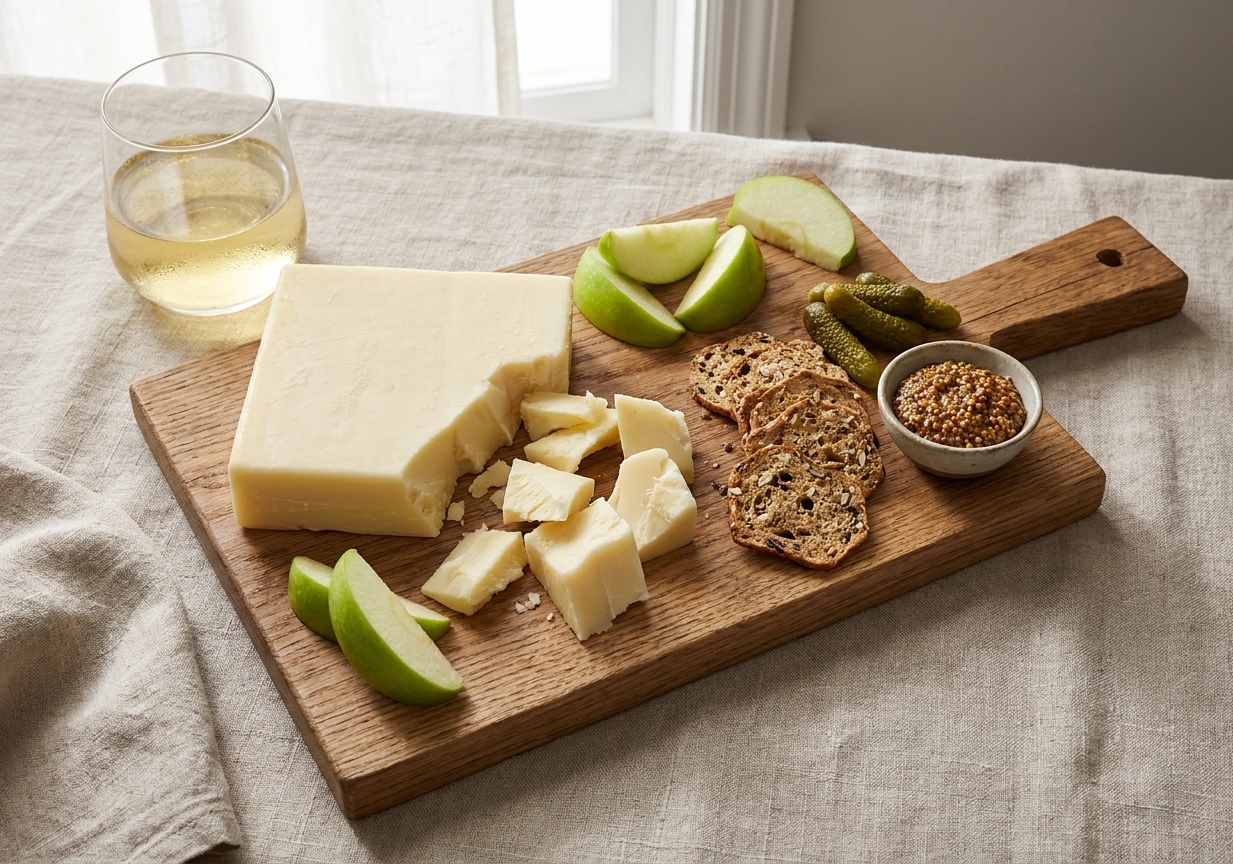
For a snack, an ounce alongside an apple and a few crackers is a useful starting portion. For a full board, remember that salami, salted nuts and crackers add sodium of their own.
Melt it gently, and it will repay you
This cheddar's smooth, firm texture makes it useful for burgers, grilled cheese and macaroni and cheese. But no cheddar has a magic exemption from overheating. Too much heat can tighten proteins and release fat, leaving a greasy or grainy result.
For a smoother sauce:
- Grate the cheese before you start cooking.
- Prepare a warm sauce base, such as a milk sauce thickened with a butter-and-flour roux.
- Reduce the heat or take the pan off the burner.
- Stir in small handfuls of cheese, letting each melt before adding more.
- Avoid boiling once the cheese is incorporated.
For grilled cheese after a cold day near Wolf Creek, use thin slices and medium-low heat. The bread should not reach dark brown while the center is still refrigerator-cold. A lid can help warm the filling before the crust overcooks.
Build a board with crunch and contrast
This is a creamy cheese, so give it something crisp to lean against.
A Granny Smith apple is an excellent first choice. Its tartness and crunch contrast with cheddar's salt and smooth texture. Add multigrain crackers or toasted sourdough, then choose a small spoonful of whole-grain mustard, fruit chutney or a few cornichons.
Genoa salami and prosciutto work well, too, though a board does not need both. One cured meat, one fruit and one sharp condiment will do more than a crowded collection of salty extras.
Pro Pairing Tip
Taste the cheddar by itself before adding mustard or chutney. Then build one bite at a time. You will notice whether an accompaniment brings out the cheese's sweetness or simply takes over.
For a summer picnic near the San Juan River, pack the cheese in a cooler with ice packs. Warm weather is not an invitation to let dairy spend the afternoon on a picnic table.
Wine: Choose balance over muscle
A lightly oaked Chardonnay can echo the cheese's creamy character. A crisp Sauvignon Blanc offers more contrast, while dry sparkling wine brings acidity and bubbles that make a rich bite feel less heavy.
Prefer red? Start with Merlot, a moderate Cabernet Sauvignon or a fruit-forward Shiraz. Cheese can soften the impression of wine's drying tannins, but a very powerful bottle may overwhelm this relatively young cheddar.
My first choice would be a balanced Chardonnay rather than the biggest red on the shelf. Let the cheese have a speaking part.
Beer: Brown ale earns its place
An IPA offers hop bitterness and citrus or pine aromas against the cheddar's richness. Choose a moderate version first; a very bitter double IPA can turn a friendly snack into a contest.
Brown ale is an especially comfortable match. Its toasted, nutty and caramel-like malt flavors suit the cheese's savory side. An Irish stout adds roast notes, while a lively saison brings bubbles and peppery or fruity yeast character.
Pro Pairing Tip
Try the same bite with brown ale, then IPA. One tends to complement the cheese; the other creates more contrast. Neither approach requires a chemistry lecture to enjoy.
Skipping alcohol? Sparkling water and a tart apple make a clean, simple pairing.
Keep it cold, and know when to let it go
Store the cheddar refrigerated at 40 degrees or below, well wrapped and protected from pooled moisture. Use clean utensils, reseal it after cutting and follow package guidance.
A creamy ivory color, firm body and pleasant tang are normal. Slime, unexpected pink or red discoloration, or a putrid, strongly rancid or unusual ammonia-like odor are reasons to discard it. Do not taste questionable cheese to test its safety.
White crystals can occur in cheddar and are not automatically spoilage. Fuzzy growth is different. Color alone cannot reliably identify a microbe.
USDA guidance allows a small mold spot on a solid block of hard cheese such as cheddar to be removed by cutting at least 1 inch around and below it, keeping the knife out of the mold. Rewrap the remaining cheese in clean packaging. If the piece is too small to leave that margin, discard it. Moldy shredded, sliced or crumbled cheese should be discarded, as should cheese with widespread growth or other spoilage signs.
As a conservative serving rule, refrigerate perishable food within two hours, or one hour when temperatures exceed 90 degrees. That matters in a warm vacation rental just as much as it does outdoors.
From a New York counter to a Pagosa kitchen
Murray's grew from a Greenwich Village cheese shop into a national specialty cheese retailer. Rob Kaufelt bought the business in 1991, helping expand its specialty focus. Its supermarket partnership with Kroger began in 2008, and Kroger acquired Murray's in 2017.
That history helps explain why you can browse a dedicated cheese counter during an ordinary grocery run in Pagosa Springs.
Pick up a small piece, taste it plain and put the rest to work. An apple at lunch, a grilled cheese at dinner, a few slices with brown ale later in the week. This cheddar's strength is not mystery. It is usefulness, with enough flavor to keep usefulness from being dull.
Sources and Further Reading
- Murray's Sharp White Cheddar Cheese, Fry's Food Stores, Kroger.
- 21 CFR Part 133: Cheeses and Related Cheese Products, U.S. Food and Drug Administration, Electronic Code of Federal Regulations.
- Casein Micelles; Whey Proteins; Enzymes, University of Guelph, Dairy Science and Technology eBook.
- Molds on Food: Are They Dangerous?, U.S. Department of Agriculture, Food Safety and Inspection Service.
- Kroger and Murray's Cheese Announce Merger, The Kroger Co.
