Estimated Reading Time: 7 min
A Wisconsin original with a place at the Pagosa table
Spring Green Colby Jack comes from Arena Cheese in Arena, Wisconsin, in the Wisconsin River Valley near Spring Green. That puts its roots firmly in American dairy country, among the rolling landscapes west of Madison.
Its two-tone appearance tells you what it is: orange Colby curds joined with creamy white Monterey Jack curds. These are combined before pressing, not melted together into a processed cheese product.

Colby itself dates to 1885, when Joseph F. Steinwand developed the style in Colby, Wisconsin. It shares cheddar’s general neighborhood on the cheese counter, but takes a different route through the vat. The result is usually milder, moister and more supple than an aged cheddar.
Wisconsin has formal cheese grading and labeling rules, but those are not the same as Europe’s protected-origin designations. The useful distinction for shoppers is simpler: Spring Green is a brand, Colby Jack is the cheese style, and Wisconsin is its home.
Terroir Tales: The marble came later
Arena Cheese traces its Colby Jack story to Harold Peterson and his family in 1979. The plant became known as the birthplace of Co-Jack, a name associated with the early marbled cheese. Today, Spring Green carries on that tradition under the widely used Colby Jack name.
The producer also has a connection to Wisconsin’s Master Cheesemaker program through Bill Hanson, whose certifications include Colby, Gouda and Colby-Jack. That matters because a mild cheese has little room to hide rough edges. With no strong rind or sharp finish doing the talking, balance and texture carry the bite.

What’s in it: Milk, cultures, enzymes and color
Spring Green Colby Jack is made from pasteurized cow’s milk. Its basic ingredient lineup includes milk, cheese cultures, salt, enzymes and annatto color.
Each has a job:
- Milk supplies the fat and protein that become the body of the cheese.
- Cultures are helpful bacteria that turn milk sugar into lactic acid and help build flavor.
- Rennet or coagulating enzymes help milk set into curd.
- Salt adds flavor and helps control moisture and microbial activity.
- Annatto gives the Colby portion its orange color.
Annatto comes from the seeds of the achiote tree. At the small amounts used in cheesemaking, it contributes color rather than a noticeable flavor. The orange pieces are not automatically sharper than the white ones, despite what your eyes may suggest.
Allergen note: This cheese contains milk. Pasteurization does not make it suitable for someone with a milk allergy. If you follow a vegetarian diet, check the current package or ask the producer to confirm the enzyme source; the word “enzymes” alone does not establish whether rennet is animal-derived or microbial.
Cow breed is not what defines Colby Jack. The milk’s balance of fat and protein, and the way the cheesemaker handles it, are more useful clues to its final character.
Pasteurization: A safety step, not a flavor verdict
Pasteurization heats milk to reduce disease-causing microbes. A common method, called high-temperature, short-time pasteurization, holds milk at 161 degrees Fahrenheit for at least 15 seconds, then cools it promptly.
That is different from sterilization. Pasteurized cheese still needs sound sanitation, careful handling and refrigeration. Nor does a long aging period guarantee that raw-milk cheese is free of pathogens.
For a young cheese such as Spring Green Colby Jack, pasteurized milk gives the cheesemaker a more controlled starting point. Selected cultures then guide fermentation and flavor development.
The washed-curd difference
Colby Jack is commonly described as a semi-soft, briefly ripened melting cheese. It is rindless and often sold in blocks or curved deli cuts from larger cylinders called longhorns.
Its most useful technical term is washed curd. That means water replaces some of the whey during cheesemaking. Whey is the liquid released as milk forms curds. Washing reduces the lactose, or milk sugar, available to the cultures, which helps limit acid development.
In plain English: less fuel for acid production helps keep the cheese gentle.
The process follows a broad sequence:
- Cultures and coagulating enzymes are added to prepared milk.
- The milk sets into a gel, which is cut into curds.
- The curds are stirred and warmed while whey drains away.
- Washing helps control lactose, acidity and moisture.
- The orange and white curds are combined, salted and pressed into their final shape.
Unlike cheddar, Colby does not go through the traditional cheddaring step of stacking and turning slabs of curd. That difference helps explain why the two styles do not feel the same in your mouth.
Young age, ample moisture, easy slices
Colby Jack is meant to be enjoyed young, generally after weeks to a few months rather than years. Its appeal is sweet dairy flavor and a yielding bite, not the sharpness or crystals that can develop in long-aged cheeses.
Moisture plays a large role. Federal standards allow a maximum moisture content of 40% for Colby and 44% for Monterey Jack. Those figures describe the individual styles, not a precise laboratory measurement for every package of marbled cheese.
The practical lesson is that this cheese retains enough water to stay pliable. Cheesemakers control that moisture through curd cutting, stirring, cooking, draining and pressing. The release of whey from curds is called syneresis, a formidable word for something you can picture as curds squeezing out liquid.
Too dry, and the cheese loses its soft bite. Too wet, and texture and keeping quality can suffer. The sweet spot takes more care than the casual snack suggests.
What you should taste and feel
Expect mild, buttery flavor with a little salt and a sweet-cream impression. It should feel smooth, moist and slightly springy, with enough body to slice cleanly.
Do not go looking for blue-cheese pungency or aged-cheddar bite. That is not the assignment.
For a simple tasting, cut a small piece straight from the refrigerator, then let a second piece stand briefly while you arrange a plate. Compare them. You may notice that the less-cold piece feels softer and offers a fuller dairy aroma.
Its mildness is a strength when other foods bring the fireworks. Chile, mustard, pickles and smoked meat can all take the lead without being crowded out.
A good melter, with one important condition
Spring Green Colby Jack works well in grilled cheese, quesadillas, burgers and macaroni and cheese. Its moisture, fat and protein balance favor a soft, cohesive melt.
But no cheese gets a free pass from overheating. Excessive heat can make Colby Jack release oil or turn tough, too.
For a better grilled cheese after a cold day around Pagosa Springs:
- Slice the cheese thinly or grate it so it heats evenly.
- Use moderate heat rather than blasting the skillet.
- Let the bread brown gradually while the cheese softens.
- Cover the pan briefly if the bread is ready before the center melts.
For a sauce, reduce the heat before adding grated cheese and stir in small handfuls. Avoid a hard boil after it goes in.
Pro Pairing Tip: Let mild cheese carry bold fillings
Try Colby Jack with roasted green chile in a quesadilla. The cheese supplies creamy texture while the chile supplies character. Add salsa at the table so you can adjust the heat without drowning the tortilla.
Build a board without making a project of it
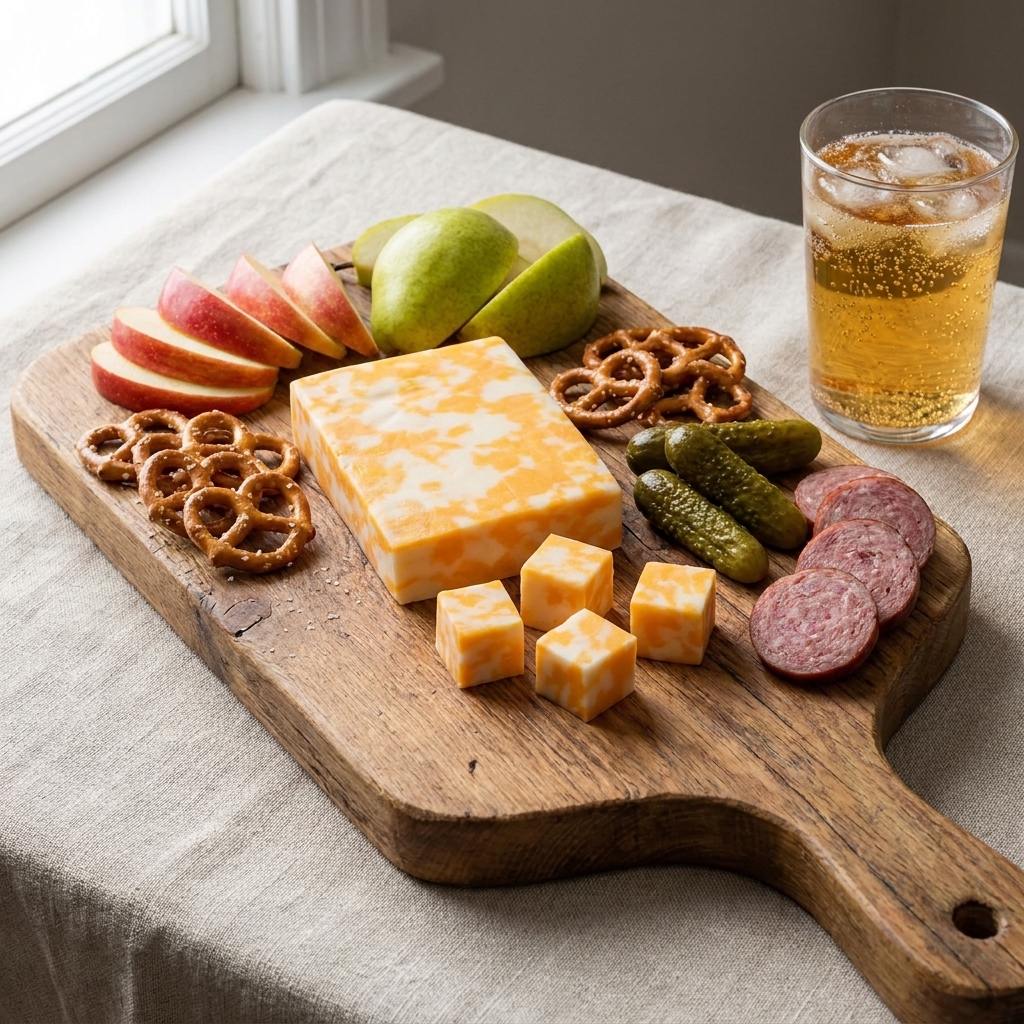
For a casual plate, pair slices with crisp apples or pears, pretzels and a few pickles. Add summer sausage or mild salami if you want something more substantial.
The contrasts do the work: juicy fruit against creamy cheese, crunchy pretzels against a supple bite, vinegar against richness. You do not need six jars of preserves.
At Murray’s Cheese inside City Market in Pagosa Springs, ask whether Spring Green Colby Jack is in stock and request a taste if sampling is available. A smaller piece is a sensible first purchase, especially if you are stocking a vacation rental rather than your home refrigerator.
Wine and cider: Keep the volume moderate
Choose drinks that leave room for the cheese’s quiet dairy flavor.
- Unoaked or lightly oaked chardonnay: A good choice when you want fruit and freshness without heavy oak dominating the plate.
- Pinot grigio: Its lighter body suits apples, crackers and a simple cheese snack.
- Sauvignon blanc: Bright acidity offers contrast, especially with a savory or vegetable-filled spread.
- Hard apple cider: Apple flavor and, in sparkling versions, bubbles make an easy match for the cheese’s salty, creamy side.
A powerful, tannic red may overwhelm this mild cheese, though pairing is not a rule book. If cabernet is what you enjoy, add a flavorful meat or another, more assertive cheese to the plate.
Beer: Crisp or gently malty
Pilsner and light lager are useful starting points. Their clean flavors and carbonation refresh the palate without competing hard with the cheese.
Amber ale offers a different kind of match, with toasted and caramel-like malt notes alongside the cheese’s mild sweetness. A hefeweizen can also work, bringing low hop bitterness and yeast-driven aromas such as banana and clove.
Pro Pairing Tip: Taste before you commit
Take a bite, sip the drink, then take another bite. Does the cheese still taste like something? Good. If the beverage wipes it out, try a lighter option. Sparkling water with apple slices on the plate makes a fine alcohol-free alternative.
Nutrition and portions
A typical 1-ounce serving provides about 110 calories, 9 grams of fat, 5 grams of saturated fat and 7 grams of protein. Sodium is roughly 160 to 170 milligrams, with about 200 milligrams of calcium. Check your package for its exact values.
That makes it a source of protein and calcium, but also a food worth portioning if you are watching sodium or saturated fat. Slice what you plan to eat and put the rest away. A cheese board is surprisingly good at making repeated small servings feel invisible.
Keep it cold, and know when to let it go
Store Colby Jack at 40 degrees Fahrenheit or below, well wrapped to limit drying and contact with other foods. Follow package directions and dates, and use clean utensils when cutting it.
A faint cultured-milk aroma can be normal. A few moisture droplets can result from condensation or whey release. Neither automatically means spoilage.
Warning signs include fuzzy growth, unexplained pink or dark discoloration, a slimy surface, swollen packaging, or a strong rotten or yeasty odor. This is not a mold-ripened cheese, so surface growth is not part of its intended character. Discard suspicious cheese rather than tasting it to investigate, especially if it is sliced or shredded.
Smell cannot detect every foodborne hazard. Keep served portions out for no more than two hours, or one hour when temperatures exceed 90 degrees. For a picnic near the San Juan River, use a cooler with ice packs. Sunshine is not refrigeration, even when the mountain breeze feels cool.
Say it, slice it, enjoy it
Pronunciation: KOHL-bee JAK.
Spring Green Colby Jack does not need to be the most forceful cheese on the board. Buy it for clean dairy flavor, a soft bite and useful melting ability. Pair it with something crisp, heat it gently, and let a well-made everyday cheese do its job.
Sources and Further Reading
- About Arena Cheese, Arena Cheese. Producer history and cheesemaking traditions.
- Arena Cheese’s Three Foundations, Arena Cheese. Plant history and cheesemaker profiles.
- Spring Green Colby Jack, Gourmet Foods International. Product information.
- Cheese Safety/Storage, University of Wisconsin-Madison Center for Dairy Research. Cheese handling and safety guidance.
- 21 CFR Part 133: Cheeses and Related Cheese Products, U.S. Food and Drug Administration, Electronic Code of Federal Regulations. Federal cheese standards.