Estimated Reading Time: 8 min
A Dutch farmstead cheese with three distinct personalities
Artikaas Hay There starts with a familiar pleasure: young Gouda that is sweet, buttery and easy to slice. Then it takes three different turns. Lavender and Thyme heads toward the herb garden, Walnut and Hazelnut brings crunch and a maple-like aroma, and Truffle leans into earthy, savory flavors.
All three are semi-hard, washed-curd cheeses made with cow’s milk. They mature for at least 60 days, so expect a supple cheese rather than the brittle texture and caramel depth of a long-aged Gouda.

For a Pagosa Springs supper after skiing or a summer board on the patio, that makes them useful cheeses to know. They offer plenty of flavor without requiring a dozen accompaniments. If you are shopping at Murray’s Cheese inside City Market, ask about current Artikaas selections. Stock can change, so check before planning a board around a particular flavor.
Terroir tales: Cheese from land that used to be sea
Hay There comes from the Van Blokland family’s farm in Biddinghuizen, in the Dutch province of Flevoland. Four generations of cheesemaking experience stand behind the family’s work, and milk comes from a single herd of about 170 cows.
The setting is unusual. The farm sits on the Flevopolder, land reclaimed from the former Zuiderzee during the 20th century. Its fertile sea-clay soils support the grasslands that feed the herd.
That is terroir in practical terms: the relationship among a place, its farming and its food. It does not mean you will taste seawater in the cheese. It means the story begins well before milk reaches the vat.
Dutch cheese labels also deserve a little care. Gouda Holland is a protected geographical indication, or PGI, with rules governing Dutch milk, production and maturation. Boerenkaas is a separate protected traditional designation for raw-milk farm cheese. Neither term should be treated as a synonym for every Gouda made on a Dutch farm.
The milk, the heat and the label
Hay There is sold in the United States as raw-milk Gouda, but its milk undergoes thermization. That distinction matters.
Thermization is a heat treatment milder than pasteurization. Common dairy processes use roughly 135 to 154 degrees Fahrenheit for a short time, though those figures describe the method generally, not a precise recipe for every wheel. The goal is to reduce unwanted microbes while retaining more of the milk’s native enzymes and bacteria.
Pasteurization uses validated combinations of time and temperature to destroy disease-causing organisms. Thermization is not a substitute for it.
The practical takeaway: Do not read the American raw-milk label as meaning the milk was never warmed. And do not read thermized as meaning pasteurized. European raw-milk definitions and American unpasteurized-cheese rules are not identical.
For Gouda made with unpasteurized milk, U.S. standards require at least 60 days of curing at no less than 35 degrees. That aging rule is not a guarantee that pathogens cannot survive. People who are pregnant, adults 65 and older, young children and those with weakened immune systems should choose pasteurized alternatives.
Ingredients: What to check before sharing
The base cheese uses cow’s milk and traditional animal rennet. Rennet is the enzyme preparation that turns liquid milk into curd. Because this one is animal-derived, Hay There is not suitable for vegetarians who avoid animal rennet.
The flavors add their own considerations:
- Lavender and Thyme: Contains lavender, thyme and rosemary.
- Walnut and Hazelnut: Contains both named tree nuts, plus fenugreek, a seed with a warm, maple-like aroma.
- Truffle: Contains Italian black summer truffle, or Tuber aestivum, and truffle flavoring. Its ingredient declaration also lists egg-derived lysozyme, used to help prevent certain bacterial spoilage defects.
All three contain milk. The nut version contains tree nuts, and the truffle version warrants special attention for anyone with an egg allergy. Read the label on the actual package, especially when buying a counter-cut wedge. Recipes and labeling can change.
Use separate knives and serving spaces when managing allergens. A nut-free cracker does not help much if it shares a knife with walnut cheese.
Why young Gouda tastes sweet and feels supple
Gouda’s defining technique is curd washing. After the milk sets and the curd is cut, the cheesemaker drains some whey and replaces it with water. This removes some lactose, the milk sugar that starter bacteria turn into acid.
Less available lactose generally means less acid development. The result is a mild cheese with a flexible texture rather than a sharp, crumbly one. Cultures and enzymes then develop flavor as it ages, including the creamy, buttery notes associated with young Gouda.
You may also encounter 48+ on Dutch Gouda labels. It means at least 48% fat in the dry matter, not 48% fat in the whole cheese. Water is excluded from that calculation. Young Gouda commonly has moisture content in the low-40% range, although moisture varies with the cheese and its age.
Cow’s milk fat also carries beta-carotene from feed, which contributes to the ivory-to-yellow color of many cow’s-milk cheeses.
In your mouth, Hay There should feel smooth, pliable and firm enough to slice. Do not expect the prominent crunchy crystals of a much older Gouda. In the walnut version, the satisfying crunch comes chiefly from the nuts.
Taste the three flavors side by side
Lavender and Thyme: More herb garden than perfume counter
The base is milky and buttery, with green, savory thyme notes and a floral lift from lavender. Rosemary adds another herbal layer. The small herb flecks make little difference to the smooth texture.
This is the one to try with a slice of ripe peach. If floral foods usually make you cautious, start with a small piece on plain bread. Give the cheese a fair audition before adding honey or jam.
Walnut and Hazelnut: Crunch with a maple-like twist
Walnuts and hazelnuts interrupt the soft cheese with a clear textural contrast. Fenugreek adds an aroma that can suggest maple syrup or toasted nuts, even though those impressions do not necessarily mean added sweetness.
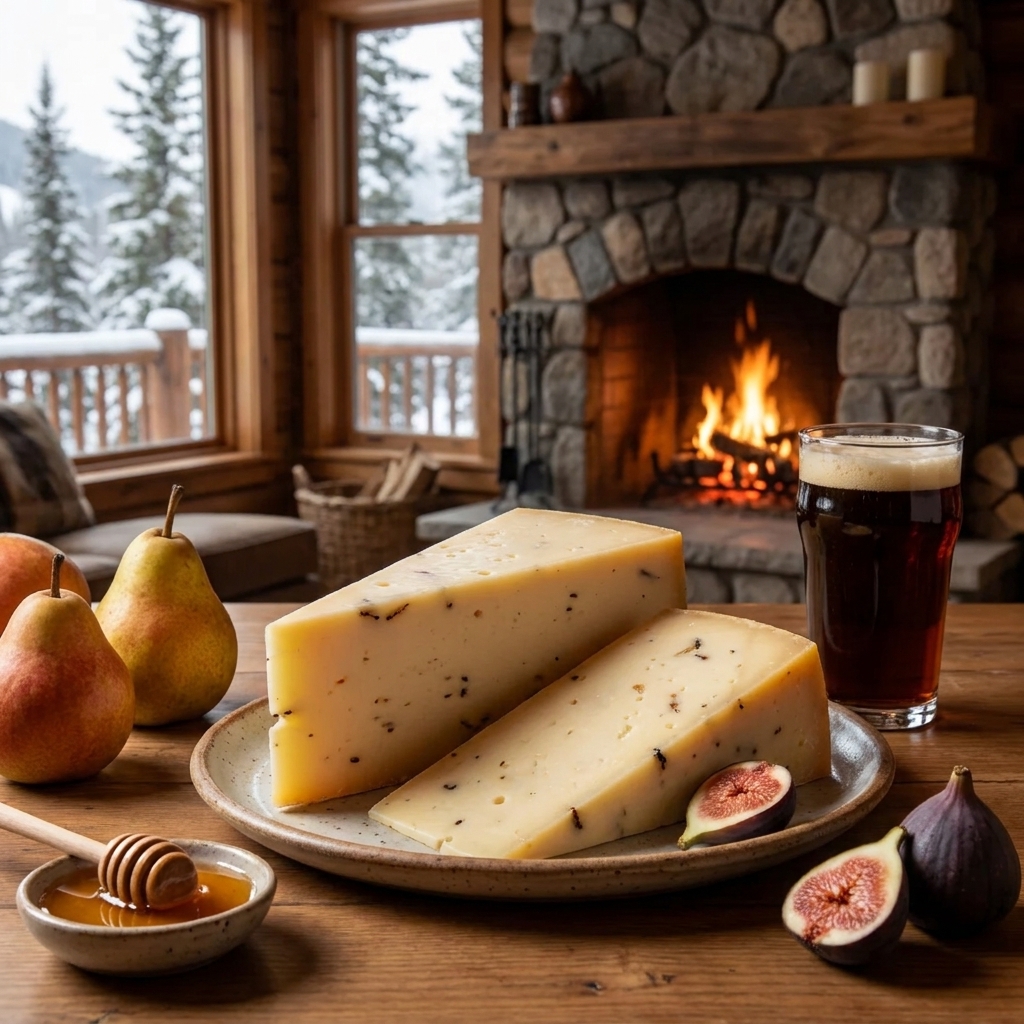
This is my first choice for an after-dinner plate. Pears, a few figs and a modest spoonful of honey are enough. More nuts are optional. The cheese has already handled that assignment.
Truffle: Earthy, savory and best used with restraint
Black summer truffle adds woodsy, mushroom-like aromas to the sweet dairy base. You might also notice a garlic-like pungency. Small truffle pieces add a little texture without making the cheese crunchy.
The recipe includes truffle flavoring as well as actual truffle, a useful distinction for shoppers comparing products. On a board, serve it last so its aroma does not crowd out the herbal cheese.
Wine pairings: Follow the added flavor
Young Gouda is accommodating, but these inclusions steer the pairing.
Lavender and Thyme: Start with dry sparkling wine, such as Crémant or Champagne. Bright acidity and bubbles refresh the palate between creamy bites. Dry rosé or a lighter Pinot Noir can also work without burying the herbs.
Walnut and Hazelnut: Tawny port and Madeira echo the nutty, dried-fruit side of the cheese. Oloroso sherry is another good match, especially if you want toasted-nut flavors without necessarily adding sweetness. Most traditional oloroso is dry, so check the bottle rather than assuming all fortified wines are sweet.
Truffle: Champagne with some age can bring toast and brioche notes that suit the earthy cheese. Nebbiolo is worth trying, particularly a bottle whose tannins have softened. A large, young red is not automatically the better partner.
Pro Pairing Tip
Taste the cheese first, sip the wine, then taste the cheese again. Look for a pairing that keeps both recognizable. If all you taste afterward is wine, choose something gentler.
Beer pairings: Give malt a chance
For Lavender and Thyme, try a saison. Its dry finish, lively carbonation and often peppery yeast character make sense alongside the herbs.
Walnut and Hazelnut welcomes brown ale, amber ale or oatmeal stout. Toasted malt flavors pick up the nuts and the cheese’s buttery side. A very bitter stout may be less friendly than a rounder, malt-led version.
With Truffle, start with bière de garde, a French farmhouse ale that often has a rounded malt character. A lightly smoked beer can also be interesting, but use a small pour first. Smoke and truffle can become a crowded conversation.
Strong hop bitterness is not my first choice for these cheeses, particularly the truffle version. Still, pairing is a tasting exercise, not a traffic code. If an IPA is your usual order, try a small bite before committing to the combination.
Put them to work in the kitchen
These young Goudas are good candidates for melting. Gentle heat helps keep the texture smooth; hard boiling can make a cheese sauce separate.
Try one of these straightforward uses:
- Herbed mashed potatoes: Fold grated Lavender and Thyme into hot mashed potatoes off the heat. Taste before adding more herbs or salt. Serve with roast chicken.
- Pear and nut-cheese toast: Layer thin slices of Walnut and Hazelnut over bread and pear. Broil until melted, watching closely. Add a little honey only if the pear needs help.
- Truffle macaroni and cheese: Make a mild cheese sauce, then replace part of the cheese with Truffle Gouda. Start modestly and taste. You want dinner, not a room freshener.
- A savory flatbread: Scatter Truffle Gouda over a plain base with mushrooms or a little cured meat. Avoid piling on so many toppings that the cheese disappears.
For a summer gathering in Pagosa, pair the herbal version with peaches, nectarines or plums. On a colder evening, the walnut cheese with pears and brown ale feels especially fitting. No elaborate board required.
Serving, storage and signs of trouble
Cut only what you expect to eat, remove any wax or nonedible coating, and let the portion lose its refrigerator chill briefly before serving. About 20 to 30 minutes is often enough for small pieces. Keep the rest refrigerated at 40 degrees or below.
Wrap cut cheese in cheese paper or parchment and place it in a covered container. Follow package storage instructions and use clean utensils. For a picnic along the San Juan River, bring an insulated cooler rather than relying on a cool mountain breeze.
Keep total time out of refrigeration under two hours, or one hour when temperatures exceed 90 degrees.
Dark truffle flecks, green herb fragments and brown nut pieces are expected. So is the truffle version’s earthy aroma. New fuzzy growth, slime, leaking liquid, unexpected swelling or a strongly rancid smell are not.
One cheesemaking defect called late blowing occurs when certain bacteria produce gas inside a wheel, causing swelling and irregular cracks. Egg lysozyme helps control some of the bacteria responsible. Shoppers do not need to diagnose the organism: Return or discard a suspicious product, and never taste it to test its safety. Harmful bacteria may cause no obvious smell or visible change.
A few details worth bringing to the table
Artikaas Hay There Truffle earned a silver medal at the 2025 World Cheese Awards in Bern, Switzerland. It is a pleasant conversation starter, though your own taste matters more than a medal.
Trained dogs help locate the Italian black summer truffles used in the cheese. The broader Artikaas production story also includes solar energy, heat recovery and reuse of water recovered during whey processing. Those efforts concern production practices, not a special health benefit in the wedge.
And how do you say Gouda? In the United States, GOO-duh and GOW-duh are both heard. Dutch pronunciation is closer to KHOW-dah, with a throaty initial sound that English does not reproduce neatly. Your cheese counter will understand you either way.
Start with the flavor that fits tonight’s meal. Buy a small wedge, taste it plain, then add one drink and one accompaniment. The best discovery may be as simple as realizing that your next grilled cheese needs a little thyme.
Sources and Further Reading
- Hay There product information, Artikaas: Producer information on flavors, ingredients and farm origins. https://www.artikaas.com/
- 21 CFR § 133.142, Gouda cheese, U.S. Food and Drug Administration, via eCFR: U.S. standards for Gouda, including curing requirements for unpasteurized-milk cheese. https://www.ecfr.gov/current/title-21/section-133.142
- Raw Milk Misconceptions and the Danger of Raw Milk Consumption, U.S. Food and Drug Administration: Guidance on unpasteurized dairy and food safety. https://www.fda.gov/food/buy-store-serve-safe-food/raw-milk-misconceptions-and-danger-raw-milk-consumption
- eAmbrosia geographical indications register, European Commission: Official records for protected food names, including Dutch cheese designations. https://ec.europa.eu/agriculture/eambrosia/geographical-indications-register/
- World Cheese Awards, Guild of Fine Food: Competition information and award resources. https://gff.co.uk/awards/world-cheese-awards/