Estimated Reading Time: 8 min
An Irish cheese with a sense of place
Claddagh-Bo with Irish Porter comes from County Limerick, Ireland, where the O'Doherty family makes cheese at Old Irish Creamery. The creamery occupies the former Effin Co-operative Creamery near Kilmallock, in the Ballyhoura area.
This is dairy country. Limerick forms part of the Golden Vale, a fertile region known for its pasture. Ireland's mild, wet climate supports a long grazing season, quite a contrast to the frozen ground and stored winter feed familiar to livestock owners around southwest Colorado.

Jim O'Doherty founded J.O.D. Foods, the business behind Old Irish Creamery, in 1992 after working as a cheesemaker and cheese grader. His family helped build a business known for flavored cheeses. With this one, the additions make sense: Irish cheddar and Irish beer have plenty to say to each other.
Terroir Tale: Pasture matters, but it is not a health promise
The cheese is made with milk from grass-fed cows. Fresh grass supplies beta-carotene, a pigment that can give cow's milk cheese a creamy yellow color. Feed also affects milk fat and, in turn, cheese flavor and texture.
Bord Bia, Ireland's food board, operates dairy assurance and grass-fed standards that help verify farming practices. Those programs are distinct from a protected geographical designation, such as Europe's PDO or PGI labels.
Studies comparing pasture-based and indoor feeding systems have found differences in milk and cheese fatty acids. That is useful agricultural science, not a reason to treat a wedge of cheddar as a supplement. Buy this cheese for its flavor.

Milk, rennet and the ingredient check
Claddagh-Bo with Irish Porter uses pasteurized cow's milk and vegetarian rennet. Rennet is the enzyme preparation that helps liquid milk form a gel, which is then cut into curds. Vegetarian rennet performs that job without traditional calf-derived rennet.
The main structural protein is casein. Think of it as the framework that holds the cheese's fat and moisture together. Rennet helps those proteins link up; cutting, draining and pressing turn the resulting curd into something you can slice.
Pasteurization heats milk to destroy disease-causing microbes. It also helps cheesemakers manage fermentation more consistently when they add starter cultures, the helpful bacteria that turn milk sugar into lactic acid. It does not sterilize cheese or remove the need for refrigeration.
Before serving, check the package:
- Milk: This cheese contains a major food allergen and is not vegan.
- Porter beer: Conventional porter contains barley, so do not assume this cheese is gluten-free. Anyone with celiac disease should check the full label and manufacturer guidance.
- Vegetarian suitability: The rennet is vegetarian, but strict dietary needs still warrant a look at the complete ingredient list.
- Alcohol avoidance: Do not assume beer-infused cheese is alcohol-free. Choose plain cheddar if that distinction matters to your guests.
Aged cheddar meets dark beer
The Claddagh-Bo range is built around cheddar matured for 12 months. That aging gives the cheese enough savory depth to hold its own against porter.
During maturation, enzymes break proteins into smaller pieces, including amino acids that contribute savory flavor. Fats also break down, adding aroma. The technical name for protein breakdown is proteolysis, but the practical result is easier to remember: less rubbery, more flavorful cheddar.
Traditional cheddar production includes a step called cheddaring. Drained curds form slabs that are stacked and turned as acidity develops. The slabs are then milled into smaller pieces before salting and pressing.
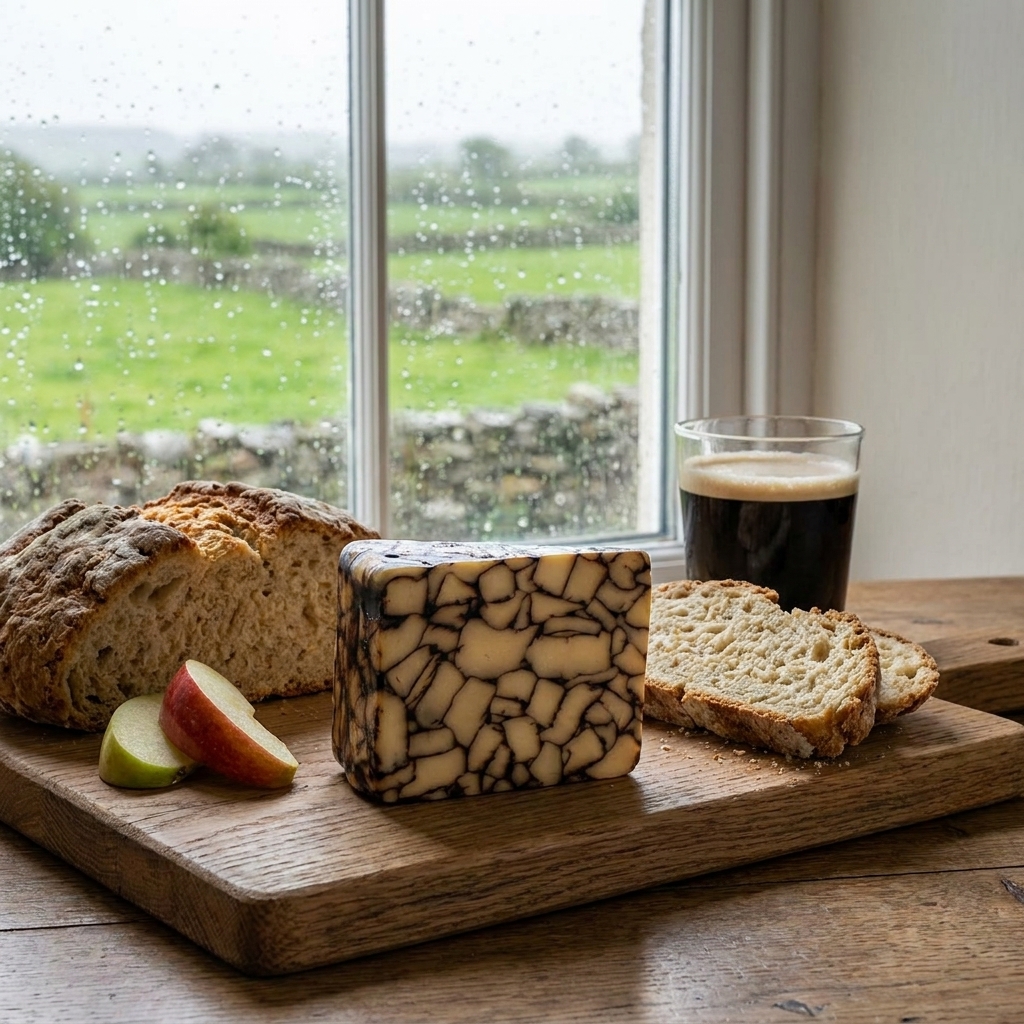
For the porter version, beer is incorporated into the curd before the final cheese is pressed. Its dark color outlines the lighter pieces, creating the mottled brown-and-gold interior. Those markings are beer, not blue-cheese mold.
Porter and stout are closely related dark beer styles, though the names are not interchangeable in every brewing context. Both can offer roasted malt flavors that work well with cheddar. Here, the porter supplies the signature dark seams and malty character.
What the bite tells you about moisture and texture
This is a firm cheddar, not a spreadable beer cheese. Expect slices that hold together, with some crumble when you break off a piece. The pale cheese feels smooth and rich; pieces may separate along the dark seams.
Its relatively low moisture helps explain that firm structure. During cheesemaking, curds release whey, the watery portion of milk. Cheesemakers call that release syneresis. Heat, acidity and pressing all help control how much moisture remains.
Moisture alone does not determine whether a cheese is safe. Acidity, salt, handling and storage matter, too. A firm wedge still belongs in the refrigerator.
Let a small portion sit out for about 30 minutes before tasting. As it loses its refrigerator chill, the fat softens and the aromas become easier to notice. You want supple cheese, not a warm, oily wedge beside the wood stove.
Taste it before you dress it up
Start with a plain bite. You should find cheddar's creamy tang and savory depth, followed by the porter's malt and roast. Depending on your palate, those darker notes may suggest toast, coffee, cocoa or caramel.
These are flavor associations, not a claim that the cheese contains chocolate or coffee. Nor does every bite need to deliver a full tasting-room vocabulary. If your first thought is “sharp cheddar with a pleasant malty finish,” you have understood the assignment.
Try a simple comparison:
- Taste a small piece of plain aged cheddar, if you have one.
- Taste the Claddagh-Bo on its own.
- Add a bite of bread, then a sip of your chosen drink.
- Notice whether the pairing makes the cheese seem sweeter, sharper or more bitter.
That last step is useful. A pairing should make you want another bite, not require an explanation for why it supposedly works.
Wine pairings: Fruit first, oak with care
Zinfandel or Primitivo is a sensible starting point. Ripe berry flavors contrast with salty cheddar, while spice can complement the roast. Choose a balanced bottle rather than the biggest, hottest wine on the shelf.
Rioja Reserva, usually based on Tempranillo, offers another route. Its fruit, developed savory notes and oak influence can sit comfortably beside aged cheese and malt.
Syrah or Shiraz works for drinkers who enjoy peppery, dark-fruited reds. Avoid assuming that more tannin means a better match. Strong tannins and roasted bitterness can feel harsh together.
Prefer white? Try a moderately oaked Chardonnay with enough acidity to keep the combination lively. Buttery flavors can echo the cheese, while gentle oak may complement its toasted notes.
Pro Pairing Tip
Pour a small taste before filling everyone's glass. If a wine makes the porter finish seem bitter, add plain bread and try a fruitier, less tannic option. There is no prize for defending an unhappy pairing.
Beer pairings: Follow the malt
My first choice is a dry Irish stout. Its roasted character echoes the cheese, while its relatively dry finish keeps the pairing from becoming too sweet. Guinness or Murphy's are familiar places to start.
A porter is the direct match, reinforcing the ingredient already in the cheese. Look for roast and malt balance rather than a heavily sweetened dessert beer.
An Irish red ale or brown ale makes a gentler companion. Toast and toffee notes support the cheddar without pushing the roast quite as hard.
For a nonalcoholic drink pairing, try sparkling apple cider or a balanced alcohol-free dark beer. Remember that a nonalcoholic beverage does not change the beer ingredient in the cheese itself.
Build a board, then put the leftovers to work
For a Pagosa Springs gathering after skiing, hiking or a soak, this cheese does not need an elaborate supporting cast. Its marbling already gives the board a focal point.
Set out a wedge with:
- Rustic bread or plain crackers.
- Toasted walnuts for crunch and a little pleasant bitterness.
- Dried cherries or fresh apple slices for sweet-tart contrast.
- Whole-grain mustard, served on the side.
- A modest portion of salami or prosciutto, if desired.
Keep the cured meat restrained. Cheese and charcuterie both bring salt and richness; fruit earns its place by giving your palate a break.
When shopping locally, ask at Murray's Cheese inside City Market about Claddagh-Bo with Irish Porter and current availability. Ask for a taste if samples are available. A small wedge is enough to decide whether you prefer it on a board or in dinner.
Pro Pairing Tip: Melt gently
Grate the cheese while cold, then use it in a grilled cheese sandwich, over a burger or as a finishing layer on shepherd's pie. For mashed potatoes, stir it in off the heat, a handful at a time.
Aged cheddar can release oil under high heat. Gentle heating is more useful than expecting a long, stretchy melt like mozzarella. Taste before adding more salt, and remember that the dark marbling will be less distinct once melted.
Storage and spoilage: Know the difference
Remove any wax before eating. Wrap a cut wedge in cheese paper or parchment, then place it in a covered container or loosely closed food-storage bag. Refrigerate at 40 F or below and follow the package's storage instructions.
Pagosa's dry air can toughen exposed edges quickly, especially on a board near a heater. Cut only what you expect to serve, and replenish from the refrigerator. For picnics or a drive to a vacation rental, use a cooler with ice packs.
Refrigerate perishable food within two hours, or within one hour when temperatures exceed 90 F. Serving a small portion at a time makes that easier.
Watch for these changes:
- New fuzzy growth: The porter's flat, embedded seams are normal. New surface fuzz is not.
- Slime or a strong, unpleasant odor: Discard the cheese. Do not taste it to investigate.
- Dry, hard edges: These usually signal quality loss rather than spoilage by themselves.
USDA guidance allows a small mold spot on a block of hard cheese to be removed by cutting at least 1 inch around and below it, keeping the knife out of the mold. Discard moldy shredded, crumbled or sliced cheese. If a wedge is too small to leave that margin, or the changes extend beyond an isolated spot, throw it out.
The name, the family and the journey
Say it “Clad-uh Bow,” with the last word rhyming with “go.” Claddagh is associated with the Irish word for shore and Galway's historic fishing community; bó means cow in Irish. The name connects coastal heritage with dairying.
Somerdale International brings the Claddagh-Bo range to export markets. Barber's, the long-established English cheddar maker, acquired Somerdale in 2023, adding another chapter to the cheese's route from an Irish creamery to overseas counters.
The original aged cheddar in the range is known for wax in the colors of the Irish flag. The porter version makes its strongest impression inside the wedge. Serve it at St. Patrick's Day if you like, but there is no need to wait for March. A cold Pagosa evening, good bread and a small glass of stout are reason enough.
Sources and Further Reading
- Old Irish Creamery: Our Producers, Taste Ballyhoura.
- Irish Claddagh Bó Range, Somerdale International.
- Buyer Guide: Grass Fed Dairy from Ireland, Bord Bia.
- Cheese: Dairy Processing Handbook, Tetra Pak.
- Molds on Food: Are They Dangerous?, USDA Food Safety and Inspection Service.
