Estimated Reading Time: 8 min
A Colorado cheese with European roots
Truffello comes from MouCo Cheese Company in Fort Collins, Colorado. It belongs to the Camembert family of styles: small, soft-ripened cheeses with a pale, edible rind and an interior that grows creamier as it ages. Italian black truffles give this version its woodsy character.
That makes it a Colorado specialty with a European accent, not a French cheese wearing a different label. Camembert de Normandie has a protected French designation tied to its place and production rules. Truffello follows its own path, using local cow's milk and European cheesemaking skills on the Front Range.

Say the name truh-FELL-oh. No need to rehearse it in the grocery aisle.
Terroir Tales: From beer to bloomy rinds
MouCo was founded in 2001 by Birgit Halbreiter and Robert Poland. Halbreiter grew up around cheesemaking in Bavaria and trained at Germany's Käserei Champignon. Poland brought fermentation experience from New Belgium Brewing.
Their backgrounds make a useful match. Beer and cheese require different methods, but both reward close attention to cultures, temperature and time. At MouCo, that shared skill set helped European soft-cheese traditions take root in Colorado.
What's inside: Milk, truffles and traditional rennet
Truffello starts with locally sourced, pasteurized cow's milk. Its mellow dairy flavor gives the truffles room to speak without making the cheese taste like a seasoning delivery system.

MouCo collects milk from a nearby dairy, keeping the trip to the creamery short. The milk undergoes quality checks before processing. For the shopper, local sourcing is the useful point. A Colorado address alone does not tell you how cows are fed or guarantee a particular flavor.
The cheese contains real Italian black truffle pieces, visible as dark flecks within the pale interior. MouCo emphasizes those truffles rather than synthetic truffle oil.
Ingredient and dietary essentials:
- Milk: Pasteurized cow's milk. Contains the milk allergen.
- Rennet: Traditional animal rennet, specifically veal rennet. Truffello is not vegetarian.
- Other key components: Cheese cultures, salt and black truffles.
- Rind: The intended white bloomy rind is edible.
Rennet is the set of enzymes that helps milk form a curd. Its small quantity does not change the vegetarian question. If you are shopping for guests with allergies or other dietary needs, read the current package label rather than relying on a cheese's appearance.
How milk becomes a soft, truffle-flecked wheel
MouCo uses high-temperature, short-time pasteurization. A standard treatment heats milk to at least 161 degrees Fahrenheit for 15 seconds. Pasteurization reduces harmful microbes, but it does not make the finished cheese immune to contamination or poor storage.
After pasteurization and an overnight rest, the milk receives cultures and rennet. The cultures turn milk sugar into lactic acid; the rennet helps create a gel-like curd. Cheesemakers cut that curd, let whey drain away and transfer it into forms.
Whey is the liquid released as curds come together. How much drains away helps determine whether a cheese becomes firm and sliceable or stays soft and moist.
The wheels are turned for even drainage, salted and moved to aging racks. Surface cultures then develop the white bloom that gives Truffello its rind.
This is a high-moisture, soft-ripened cheese, not a hard grating cheese. Its retained moisture helps support that tender texture. The rind's enzymes gradually break down proteins beneath the surface, softening the wheel from the outside toward the center.
What all those cheese terms mean
Several labels can describe Truffello without contradicting one another:
- Soft-ripened: Its texture changes as ripening works inward from the surface.
- Bloomy rind: It develops a soft, white coat of beneficial surface mold.
- Camembert-style: Its format and ripening method resemble Camembert.
- Semi-soft: A useful description of its firmer, younger texture, though a ripe wheel can become much softer.
- Truffle cheese: Truffle pieces are part of the cheese, not just a topping.
- American specialty cheese: It is made in Colorado, with a distinct identity of its own.
One more term worth keeping: paste. In cheese talk, it means the interior. Nothing to do with glue, despite how firmly some of us become attached to a favorite wheel.
Choose the age, choose the experience
Truffello is not a fixed-texture food. Two wheels tasted at different ages can feel surprisingly different.
MouCo's package dating system, called the D8Code, helps shoppers follow the cheese through young, middle and mature stages. Use those dates as a guide to style, alongside storage directions and package condition. Ripening is not a stopwatch.
Young: Roughly the first three weeks
Expect a firmer, sliceable paste, sometimes with a slightly chalky center. The flavor leans bright and tangy, with truffle notes playing against fresh dairy acidity.
Choose this stage if you want tidy portions for a board. It is also useful when you prefer a lighter touch of earthiness.
Soft and layered: About three to seven weeks
The paste relaxes, buttery flavors become more pronounced and the truffle character feels more integrated. You may see a soft band just beneath the rind. That is the creamline, where ripening is most visible.
For my money, this middle stage offers the best balance: enough structure to serve neatly, enough softness to feel generous.
Fully mature: Around seven to eight weeks and beyond
A mature wheel can become very supple and slump when cut. Earthy, savory and nutty notes grow more assertive. A spoon may be more useful than a knife.
Older is not automatically better. If you prefer tang and a clean slice, there is no prize for waiting until the cheese spreads itself.
Taste the rind, then the center
Take one small bite of the interior on its own, then another with a little rind. You should notice how the components fit together.
The paste brings butter and cream. Black truffles add a woodsy aroma and earthy depth. The rind contributes a mushroom-like note, linking the two.
As the wheel ages, enzymes break down proteins and fats. Those changes help explain why the cheese becomes softer and develops more savory flavor. Umami, often used to describe mature cheese, means savory depth, the sort you might recognize in mushrooms or broth.
Texture matters just as much. A younger core offers a gentle crumble; the middle stage feels smooth and yielding. A fully ripe wheel can flow. Those visible black truffle flecks are ingredients, not evidence of mold growing inside the cheese.
Wine pairings: Start with bubbles or Pinot Noir
Prosecco and brut rosé are sensible first choices. Their acidity and fizz provide a fresh contrast to the creamy paste. A dry rosé sparkler also brings light berry flavors that sit well beside the truffle's earthiness.
Prefer red? Try Pinot Noir, especially a lighter-bodied bottle with fresh acidity and modest tannins. Earthy examples from Burgundy or Oregon's Willamette Valley can echo the cheese's mushroom and woodland notes.
I would save a heavily tannic Cabernet Sauvignon for another cheese. Strong tannins and a bloomy rind can make a pairing taste bitter or metallic, though individual bottles vary.
Pro Pairing Tip
Taste the cheese first, sip the wine, then take another bite. If the truffle disappears or the rind turns bitter, switch drinks. A pairing should improve your snack, not become homework.
Beer pairings: A good excuse for porter
MouCo recommends Odell Brewing Co.'s Cutthroat Porter, along with stouts. Roasted malt flavors bring coffee, cocoa and toast notes that complement Truffello's earthy side.
A balanced porter is my first pick for a cold Pagosa evening. It offers depth without necessarily overwhelming the cheese. With stout, be cautious about very sweet or heavily flavored versions. Dessert additions can crowd out the truffle.
Double IPAs are more adventurous. Piney hops might suit a mature wheel, but strong bitterness can dominate a younger one. If you enjoy that contrast, try a small taste before committing your whole board to it.
Build a board, or make a simple supper
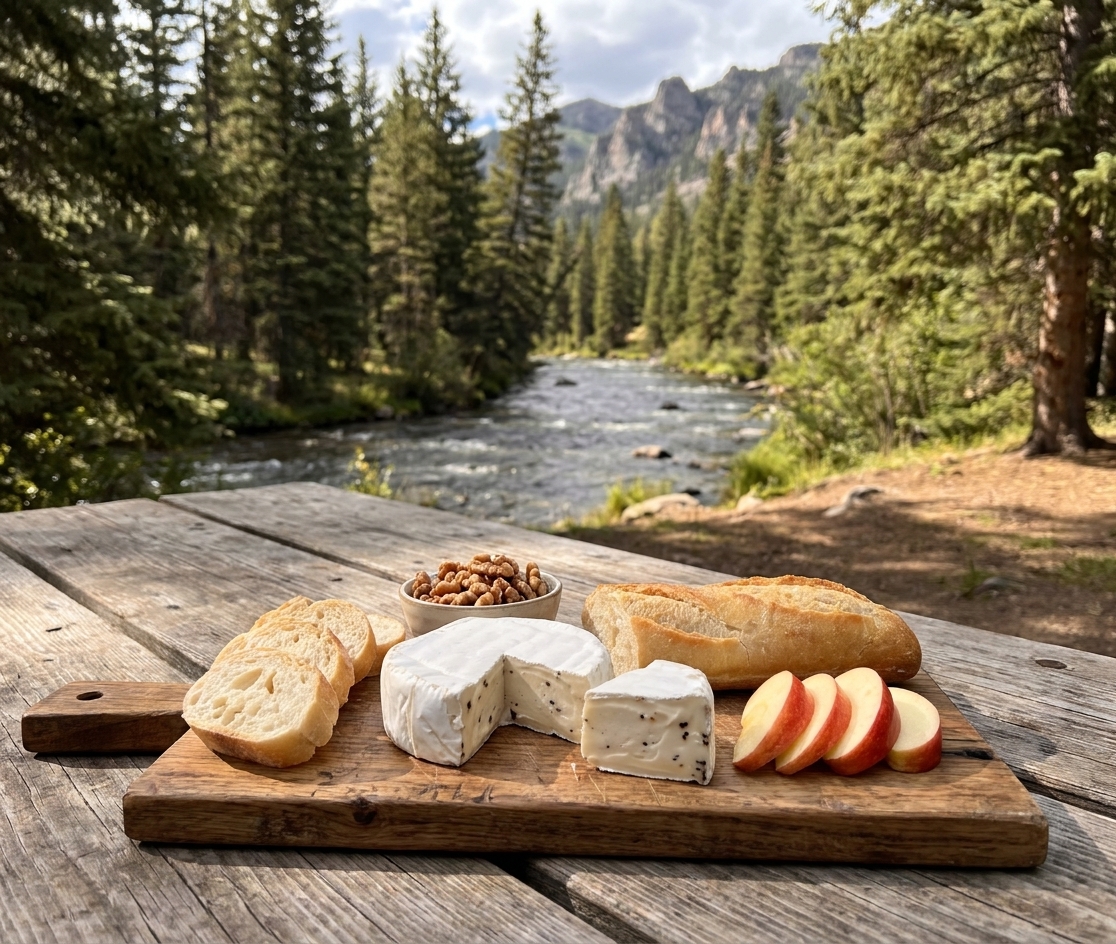
You do not need a dozen accompaniments. Start with crusty bread, crisp apple slices and a few toasted walnuts or almonds. The bread carries the soft paste, while fruit and nuts bring crunch.
Fresh figs offer a gentler, sweeter pairing. A little honey can work, too, but use restraint. Truffello already has plenty to say.
Salame adds salt and chew. Dark chocolate is worth trying as a separate bite rather than piled onto the cheese. Neither is essential.
For a warm dish, let Truffello soften over hot toast, tuck a small amount into a savory sandwich or pair it with peaches in a tartlet. MouCo's recipe ideas also explore stuffed French toast and crisp fried Camembert-style bites with tart fruit dips.
Gentle heat is usually enough. Long, aggressive cooking can release fat and send those fragrant truffle aromas into the kitchen rather than onto your fork.
A simple serving plan
- Check the package dates and choose the ripeness you like.
- Set out only the portion you expect to eat.
- Let it lose its refrigerator chill for about 20 to 30 minutes.
- Serve with bread and one crisp or tart accompaniment.
- Refrigerate the remainder promptly.
In Pagosa Springs, ask about Truffello at Murray's Cheese inside City Market. Selection can change, so check availability before planning a board around it. Visitors heading back to a rental cabin should bring a cooler, especially during summer errands.
Keep it ripe, not neglected
MouCo uses breathable cheese paper that allows gas exchange while helping protect the wheel. Keep the original wrapping when practical, and store the cheese refrigerated at 40 degrees Fahrenheit or below. Avoid crushing a soft wheel under other groceries.
A mild ammonia note can occur in an aging bloomy-rind cheese and may fade after unwrapping. That smell alone does not establish safety. A strong, persistent ammonia odor is a reason to reject an overripe wheel, not a challenge to your cheese-loving credentials.
Watch for these distinctions:
- Soft or flowing paste: Can be normal ripening.
- A detached, sliding rind: Can be a ripening defect. It is not, by itself, a reliable safety test.
- Unexpected pink, green or black surface growth: Discard the cheese. Do not confuse truffle pieces in the paste with new growth on the rind.
- Unusual slime or rancid odors: Discard it.
Do not trim unwanted mold from a soft cheese and eat the rest. Contamination may extend beyond what you can see. Harmful bacteria also may cause no obvious change in smell or appearance.
Keep total room-temperature time under two hours, or one hour when the temperature exceeds 90 degrees. That matters on a sunny picnic table as much as in a parked car.
A small wheel with a worthwhile story
Truffello earned second-place finishes at the 2024 American Cheese Society competition and the 2013 United States Championship Cheese Contest. Those honors are a useful introduction, but the real test is simpler: Do you like what happens when buttery cheese meets earthy truffle?
Buy a wheel at the stage you enjoy. Give it good bread, a little time out of the fridge and a drink that leaves room for its flavor. That is plenty, whether you have spent the day skiing, walking along the San Juan River or simply getting dinner together.
Sources and Further Reading
- MouCo Truffello, MouCo Cheese Company. Product details, ripening guidance, pairings and awards.
- How We Do It, MouCo Cheese Company. Milk handling, pasteurization and cheesemaking.
- Are MouCo cheeses vegetarian? What rennet do you use?, MouCo Cheese Company. Rennet and dietary information.
- European Cheesemaking Flourishes at MouCo in Colorado, The Cheese Professor. Producer history and regional context.
- Quantitative Assessment of the Risk of Listeriosis From Soft-Ripened Cheese, U.S. Food and Drug Administration and Health Canada. Food safety considerations for soft-ripened cheeses.