Estimated Reading Time: 7 min
A Colorado cheese with its own sense of place
Rocking W makes Tomato Basil Jack in Olathe, in the Uncompahgre Valley on Colorado’s Western Slope. It is an American cheese with a familiar Italian flavor combination: mellow Jack threaded with tomato and basil.
For Pagosa Springs shoppers, that makes it a regional choice rather than a cheese made down the street. There is value in that distinction. Buying Colorado cheese can support agriculture elsewhere in the state while giving your lunch a little more character.

Rocking W is a farmstead operation. That term means the cheese is made on the farm with milk from the farmer’s own herd. Artisan refers to the craft of making cheese, often by hand in small batches. The two terms overlap, but they are not interchangeable.
The practical benefit of this setup is a short path from milking to cheesemaking. Rocking W processes its milk within 24 hours of milking, keeping those two parts of the operation closely connected.
Terroir Tales: From dairy farm to cheese vat
The Webb family’s dairy was established in 1965 by Robert and Charlotte Webb. In 2008, Caryn Webb Gibson and her husband, John, opened the cheese plant, adding cheesemaking to the family’s agricultural work.
That is a useful way to understand terroir, a French word for the influence of place on food. Here, start with the farm, its animals and the people making the cheese. You do not need to claim you can taste mountain sunshine to appreciate the connection.

What goes into Tomato Basil Jack?
The foundation is cow’s milk from Rocking W’s Holstein herd. The cheese uses pasteurized milk, with tomato and basil providing its signature flavor.
Holsteins are the familiar black-and-white dairy cows known for producing generous amounts of milk. Breed is part of the story, but feed, herd care and cheesemaking choices also shape the finished cheese. No single breed guarantees a better melt or a richer flavor.
Ingredient and dietary check: Expect a milk-based cheese with tomato, basil, cultures, salt and coagulating enzymes. Read the current package for the complete ingredient list and any added ingredients in the seasonings.
Allergen: Contains milk. Pasteurization does not remove milk allergens, and this is not a dairy-free food.
Rennet: Rennet is the enzyme preparation that helps milk set into curd. Microbial rennet comes from microorganisms rather than an animal’s stomach and can suit vegetarian diets. If that distinction matters to you, confirm the enzyme type on the current package or with Rocking W. The word enzymes alone does not identify its origin.
How milk becomes a sliceable, melting cheese
Tomato Basil Jack belongs to the flavored Jack family. Think of it as a pliable, semi-firm cheese: substantial enough to cube, soft enough to bend in a thin slice and well suited to melting.
The basic process explains much of its appeal:
- Pasteurize the milk. This heat treatment reduces harmful microbes before cheesemaking begins. Common methods use 161 degrees Fahrenheit for 15 seconds or 145 degrees for 30 minutes. Those are standard methods, not a description of a particular Rocking W vat.
- Add cultures and rennet. Cultures turn some milk sugar into lactic acid. Rennet helps the milk proteins form a gel that traps fat and water.
- Cut, stir and gently warm the curds. These steps help release whey, the liquid portion of milk. This gentle curd heating serves a different purpose from pasteurization.
- Drain, season and press. The curds come together into a cheese that can be sliced, with the tomato and basil distributed through it.
- Allow the cheese to mature. As proteins break down during aging, the texture and flavor change.
Some Jack recipes include a curd-washing step. Replacing part of the whey with water removes some lactose, or milk sugar, which can help keep the cheese mild. Stirred-curd and washed-curd describe production methods, not flavors you need to memorize before ordering a sandwich.
Moisture and aging, without the math headache
The federal standard for Monterey Jack sets a maximum moisture content of 44%. That is a limit for the style, not a measurement of every flavored Jack on the shelf.
Water helps make cheese supple, but moisture alone does not determine texture. Acidity, fat and the structure of the milk proteins matter, too.
This is a cheese to enjoy for youthful creaminess and lively seasoning, rather than the dry bite of a long-aged grating cheese. Young Jack commonly matures over weeks to a few months. Follow the package date and storage instructions rather than treating an aging period as permission to keep an opened block for months.
What you will taste and feel
The appeal is contrast, not force. The Jack base brings mild milk flavor and a buttery impression. Sun-dried tomato adds concentrated sweetness, tang and savory depth. Basil supplies the green, herbal lift.
That savory quality is often called umami. It is the mouth-filling depth you find in foods such as tomatoes, mushrooms and aged cheese. Here, tomato gives a mild cheese more substance without turning it sharp.
Look for red tomato pieces and green herb flecks against a pale, creamy background. The cheese should feel smooth and pliable, though a slice may break around a larger tomato piece. That is different from a block that has dried into hard, cracked edges.
Taste a small piece on its own before adding crackers or wine. Then let another piece lose its refrigerator chill for about 20 minutes and try again. You may notice more aroma and a softer feel.
Pronunciation: tuh-MAY-toh BAY-zuhl JAK by ROK-ing DUB-uhl-yoo.
Wine pairings: Let the basil lead
My first choice would be Sauvignon Blanc. Its bright acidity and herbal notes make a useful match for both the creamy cheese and the basil. It is especially appealing with a summer lunch on the patio.
Other good directions include:
- Dry rosé: Fresh fruit and crisp acidity work well with tomato without weighing down the cheese.
- Pinot Noir: Choose a lighter, supple bottle if you prefer red wine. Heavy tannins can crowd out a mild Jack.
- Chardonnay: A lightly oaked version can echo the cheese’s creamy side. A heavily oaked bottle may become the only thing you taste.
Pro Pairing Tip
Try the cheese first, take a sip, then taste the cheese again. Does the basil still come through? If the drink erases it, choose something lighter. Pairing should make lunch better, not turn it into an exam.
Beer pairings: Keep bitterness in check
A wheat beer, including a hefeweizen, is an easy starting point. Its lively carbonation and gentle grain character suit the cheese, while clove-like notes can play nicely with basil.
A balanced pale ale offers a different route. Herbal or citrusy hops can complement the seasoning, provided bitterness stays in the background. Wheat IPAs vary widely, so choose by flavor rather than the style name alone.
For a maltier match, try an amber ale. Its toasted, lightly caramel-like notes make sense beside concentrated tomato and browned bread.
Not drinking alcohol? Sparkling water with lemon is a clean, simple companion.
Put it to work in the kitchen
This cheese earns its refrigerator space by bringing its own seasoning. You can make something satisfying without assembling half the spice cupboard.
For a grilled cheese after a cold day near Wolf Creek, keep the method simple:
- Grate the cold cheese or cut it into thin, even slices.
- Lightly butter the outside of two bread slices.
- Add a modest layer of cheese. An overstuffed sandwich often browns before its center melts.
- Cook over medium-low heat, turning once. Cover briefly if the filling needs help warming through.
- Rest for a minute before cutting.
Jack generally melts readily, but no cheese is immune to overheating. Too much heat can make fat separate. Gentle heat is your friend in a sandwich, sauce or pan of macaroni and cheese.
Other useful pairings include a burger, hot tomato soup or cold pasta salad. For pasta salad, cool the pasta before adding cheese cubes so they keep their shape.
On a board, serve it with crusty bread, water crackers, olives, cherry tomatoes and mild cured meat. Resist adding pesto to everything. The basil already has a job.
When shopping in Pagosa Springs, ask at Murray’s Cheese inside City Market about current Rocking W availability. Check before planning a menu around a specific flavor.
Storage and spoilage: Know what belongs
Keep the cheese refrigerated at 40 degrees Fahrenheit or below. After opening, wrap it well or place it in a clean, closed food-storage container. Use a clean knife each time, and follow the package’s guidance.
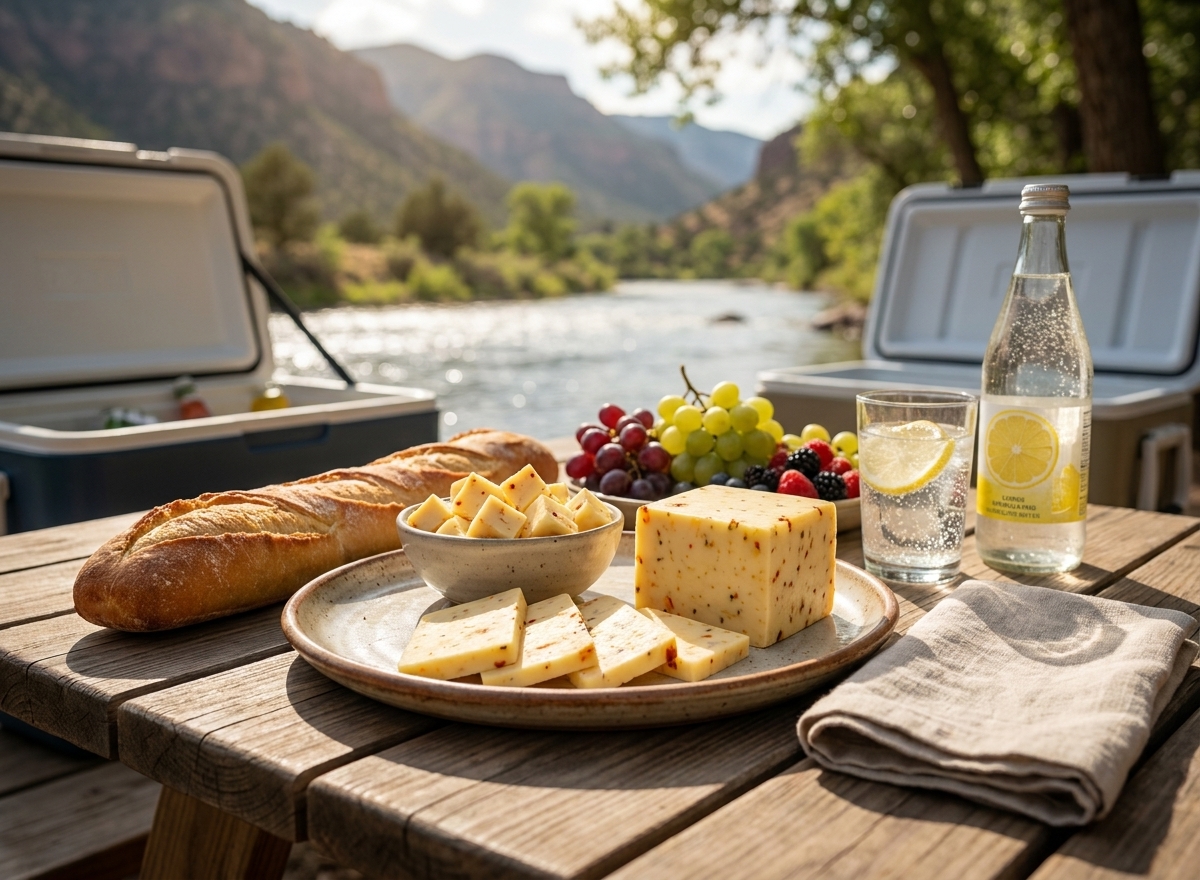
For a picnic near the San Juan River, carry it in an insulated cooler with ice packs. Perishable food should not sit out for more than two hours, or one hour when the temperature is above 90 degrees.
Red or green flecks embedded in the cheese belong there. Slight color staining immediately around those pieces can happen. A little liquid inside a package does not, by itself, prove spoilage, but it does not establish safety either.
Discard cheese with unexpected fuzzy growth, a slimy surface, an unpleasant rancid or putrid smell, or unexplained package swelling. For this moist, flavored cheese, discarding a moldy piece is the cautious choice rather than trying to salvage it by trimming.
Do not taste suspicious cheese to test it. Harmful microbes do not always announce themselves with a smell.
An American original, comfortably at home in Colorado
Monterey Jack’s history is rooted in California, with early cheesemaking associated with Spanish missions and later commercial success tied to businessman David Jacks. Rocking W’s version brings that American tradition into a Colorado farmstead setting, with tomato and basil doing the flavor work.
It is not a cheese that needs ceremony. Start with a slice, a piece of bread and something crisp to drink. Then save enough for tomorrow’s grilled cheese.
Sources and Further Reading
- About Us, Rocking W Cheese. Family and farm history.
- Rocking W Tomato Basil Jack Cheese, Gourmet Foods International. Product information.
- Farmstead and Artisan Cheesemaking, Penn State Extension. Farmstead terminology and cheesemaking context.
- 21 CFR 133.153: Monterey Cheese and Monterey Jack Cheese, Electronic Code of Federal Regulations, U.S. Food and Drug Administration. Federal identity standard.
- Molds on Food: Are They Dangerous?, USDA Food Safety and Inspection Service. Mold and food-handling guidance.