Estimated Reading Time: 8 min
English roots, with a geographic twist
Long Clawson Cotswold is an English cheese made with Double Gloucester, onions and chives. Its name points toward the Cotswold Hills of southwestern England, but the dairy is based in Leicestershire, in the East Midlands. The name and the production address tell different parts of the story.
Gloucester cheesemaking belongs to England's long dairy tradition. Double Gloucester developed a reputation as a substantial cheese that could travel to market. Today, it can be made outside Gloucestershire, unlike Single Gloucester, which has Protected Designation of Origin status and specific regional production rules.
Long Clawson takes that portable tradition a step further. It turns a mellow territorial cheese, meaning a style tied historically to a particular region, into something with the seasoning already tucked inside.
What's in the wedge?
The essentials are straightforward:
- Milk: Pasteurized cow's milk.
- Rennet: Microbial rennet, making the cheese suitable for vegetarians.
- Flavorings: Onion and chives.
- Color: Annatto, a plant-derived coloring that gives the cheese its golden-orange shade.
- Other cheesemaking ingredients: Starter cultures and salt.
- Main allergen: Milk. This is neither dairy-free nor vegan.
Rennet is the enzyme that helps milk set into curd. Microbial versions provide a nonanimal alternative to traditional calf rennet. Starter cultures are helpful bacteria that turn milk sugar into lactic acid and help develop flavor.
Check the current package for the complete ingredient list and any additional allergen statements, particularly if you are serving someone with a food allergy.

Terroir Tale: The cow behind the older tradition
Gloucester cheeses have historic ties to the Gloucester breed of cattle, which came close to disappearing as British dairy farming shifted toward higher-yielding animals. Conservation efforts have helped preserve the breed.
That heritage matters, but it does not make today's Long Clawson Cotswold a rare-breed cheese. Its identity rests on its Double Gloucester base and onion-and-chive blend, not an exclusive Gloucester-cow milk supply.
Pasteurized milk, explained without the lab coat
Pasteurization uses controlled heat to reduce harmful microbes in milk. A common commercial method, called high-temperature, short-time pasteurization, heats milk to at least 161 F for 15 seconds.
It is not sterilization, and it does not make finished cheese immune to contamination. Clean equipment, properly handled herbs, acid development, salt and refrigeration all matter, too.
Cow's milk supplies both the fat that gives Cotswold its richness and the proteins that hold the cheese together. One important protein group is casein. During cheesemaking, those proteins form a network that traps fat and moisture. Think of it as the framework that keeps your slice from becoming a pile of buttered onions.
Age, moisture and what “semi-hard” means
Cotswold is generally a relatively young cheese. Commonly described maturation periods run about four to 12 weeks, often around three months. Exact timing can vary by product and production method, so treat that as a guide rather than a promise for every wedge.
Affinage is the cheesemaker's term for aging and caring for cheese as it ripens. In Cotswold, the aim is a mellow, savory base that lets the onion and chives remain distinct. More age is not automatically better. This is not a cheese you buy for the dry texture or crystals of a long-aged cheddar.
Its useful shopping categories are semi-hard, flavored or blended, pasteurized cow's milk cheese and English territorial-style cheese. You may also hear it called pub cheese. Here, that means a savory cheese suited to bread and a pint, not necessarily a spread in a tub.
Moisture helps explain its behavior. Double Gloucester commonly falls around 38% to 43% moisture, though that is not a guaranteed specification for a particular Cotswold wedge. The practical result is a cheese firm enough to slice but still supple enough to melt.
You may also encounter fat in dry matter, or FDM. That measures fat as a share of everything left after the water is removed. It is not the same as the fat percentage of the cheese you eat. For everyday meal planning, the nutrition label is more useful: A listed 1-ounce serving of Long Clawson Cotswold contains about 9 grams of fat.
What it tastes and feels like
The first impression is usually buttery and mellow, with a mild, cheddar-like tang. Then the onion arrives: savory, a little sweet and quite unmistakable. Chives add a greener, lightly grassy note.
It is assertive without relying on the sharpness of an aged cheddar. If you like cheese-and-onion sandwiches, the appeal requires very little explanation.
The texture is dense, smooth and semi-firm, with some crumbling when cut. The onion and herb pieces interrupt the creamy paste with small bits of chew. Expect an orange interior dotted with green chives and pale onion pieces, not a perfectly uniform block.
Annatto supplies the orange color. It does not mean the cheese is sharper, older or more heavily seasoned than a pale cheese.
Try a three-bite tasting
- Start plain. Let a small portion sit out for about 20 to 30 minutes, then taste it without crackers or condiments.
- Add plain bread. Notice how the onion becomes part of a fuller, sandwich-like flavor.
- Take a sip. Try brown ale, dry cider or your chosen wine, then taste the cheese again.
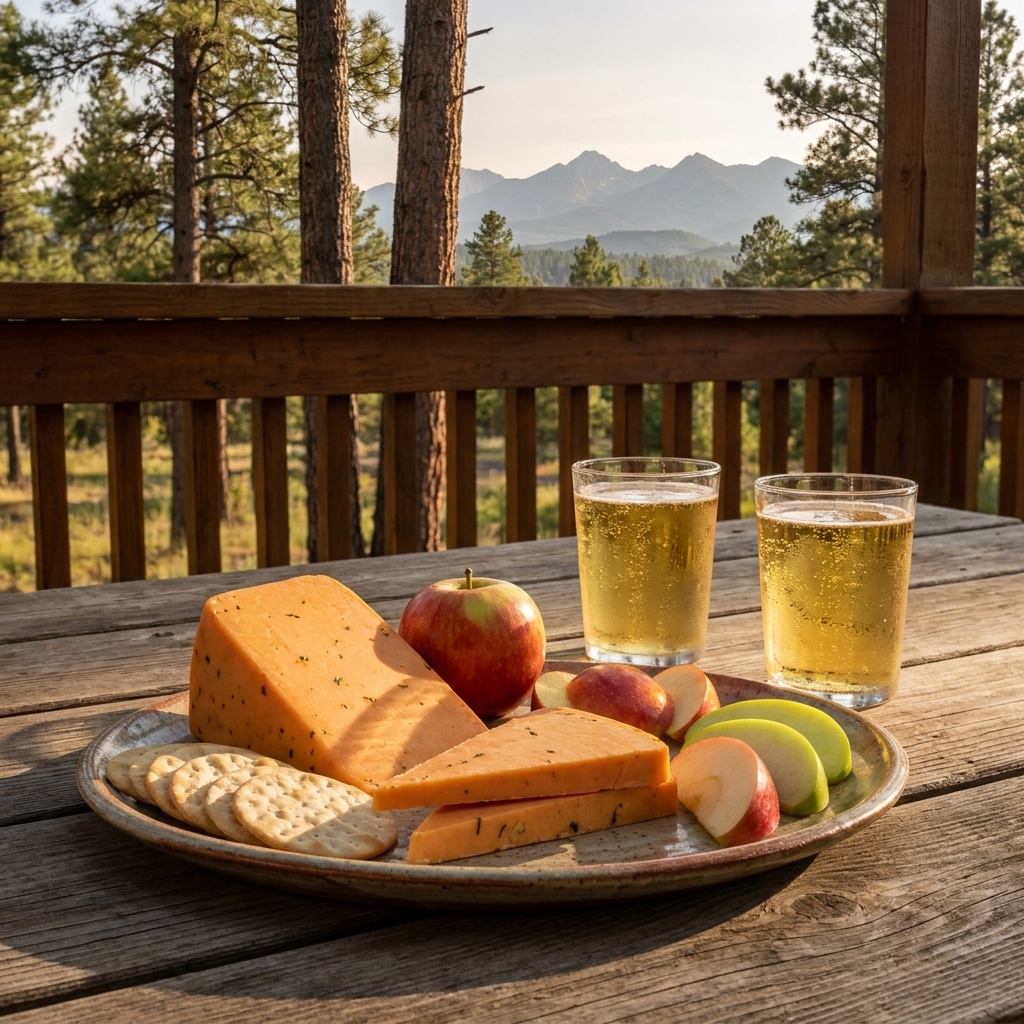
Serving only a small portion also helps keep the rest cold, a useful habit for summer porch meals in Pagosa Springs.
Wine: Favor fruit and freshness
Onion-forward cheese can be awkward with a heavily tannic red or a wine dominated by oak. Neither is forbidden, but I would start elsewhere.
- Lightly oaked Chardonnay: Look for apple or pear flavors, some freshness and a restrained creamy note. A wine that has undergone malolactic fermentation, a process that softens acidity, can echo the cheese's buttery character.
- Fruit-forward Zinfandel: A softer example with plum, blackberry and pepper can hold its own against the onion. Zinfandel varies widely, so avoid assuming every bottle will be low in tannin or gentle in alcohol.
- Slightly off-dry Gewürztraminer: Its floral, spicy fruit and touch of sweetness can offer the same sort of sweet-savory contrast you get from chutney.
Pro Pairing Tip
Taste the cheese before pouring everyone a full glass. If a wine seems harsh or bitter alongside it, switch to a fresher white or cider rather than trying to rescue the match with more condiments.
Beer and cider: The easygoing choices
English brown ale is my first pick. Its toasted bread, caramel and nutty malt notes suit the cheese's buttery base and savory onion. The bubbles refresh the mouth between bites.
An English bitter or ESB offers another good direction. Earthy hop notes play well with chives, while bitterness balances the richness. Despite its name, an English bitter need not taste as aggressively hoppy as a modern American IPA.
Then there is dry cider. Not beer, of course, but too good a companion to leave out. Crisp apple flavors bring brightness, and the fruit works naturally with cheese and onion. For a nonalcoholic option, try sparkling apple juice diluted with sparkling water if you prefer less sweetness.
After a cold day outside in Pagosa, bread, Cotswold and a brown ale make a convincing case for staying in.
Put it to work at dinner
Cotswold earns its refrigerator space because it brings both cheese and seasoning to a dish. It melts readily, but gentle heat is still your friend. Like other natural cheeses, it can release oil when overheated.
For a ham baguette: Layer thin slices with ham on crusty bread. Add a little mustard if you like, but taste first. The cheese already supplies plenty of onion flavor.
For burgers: Add a thin slice near the end of cooking, cover briefly and let residual heat finish the melt. Go easy on raw onion until you know how much bite you want.
For baked potatoes: Split a hot potato, loosen the center with a fork and fold in grated Cotswold. Add black pepper. Sour cream is optional, not an obligation.
For chili: Scatter a modest handful over the bowl just before serving. The cheese adds richness and a savory finish without requiring another pot or sauce.
Pro Pairing Tip: Build a smaller board
Set out Cotswold with plain crackers or crusty bread, apple slices and a spoonful of chutney. Add ham if you want a more substantial meal. Skip the onion jam at first; doubling down can bury the cheese's gentler dairy flavors.
For residents planning dinner or visitors stocking a vacation rental, ask at Murray's Cheese inside City Market in Pagosa Springs about Cotswold and current availability. Requesting a small piece is a sensible way to try it before committing to a larger wedge.
Storage and spoilage: Know normal from questionable
Keep Cotswold refrigerated at 40 F or below. After opening, wrap it in cheese paper or parchment and place it in a covered container or loosely closed food-storage bag. Follow package directions and use a clean knife each time.
For a picnic, carry it in a cooler with ice packs. As a general food-safety rule, do not leave perishable food unrefrigerated for more than two hours, or one hour when temperatures exceed 90 F.
The green chive flecks belong there. New fuzzy growth does not.
Watch for these warning signs:
- Unexpected swelling in a sealed package.
- A slimy surface.
- A putrid, strongly sour, yeasty or ammonia-like odor that differs from its normal onion aroma.
- New fuzzy spots or unusual pink or black growth.
Light can fade annatto and can sometimes cause pinkish discoloration. But you cannot reliably decide that a pink patch is harmless just by looking at it. Do not taste suspicious cheese to test its safety; return it or discard it if there is doubt.
USDA guidance allows mold to be cut away from some hard cheeses with a margin of at least 1 inch around and below the spot. That is not a blanket rule for every cheese. With a small, semi-hard blended wedge, discarding a moldy piece is the more cautious household choice. Discard moldy shredded or crumbled cheese.
Also remember that harmful microbes do not always announce themselves through smell or appearance. Good storage matters even when a wedge looks fine.
A modern cheese with an older family tree
Long Clawson Dairy was founded in 1911 and is closely associated with Stilton. Its flavored-cheese range brought another side of British cheesemaking to the table, including the Cotswold blend associated with the early 1970s.
So the base style is historic; the onion-and-chive combination is comparatively modern. That is part of its charm. It takes a familiar cheese and gives it a practical, immediately recognizable twist.
Double Gloucester also has a more unruly claim to fame: It is the cheese associated with the annual Cooper's Hill cheese-rolling event in Gloucestershire. Participants chase a wheel down a steep hill. Enjoying its Cotswold cousin on toast is considerably easier on the knees.
How to ask for it
Say KAHTS-wohld. And Gloucester, if you are discussing the base cheese, is GLOSS-ter.
Start with a small wedge, a baked potato and something crisp to drink. Cotswold does not need an elaborate occasion. It is particularly good at making an ordinary supper feel thought through.
Sources and Further Reading
- Long Clawson Cotswold Half Wheel, Gourmet Foods International. Product and nutrition details.
- Long Clawson Cotswold Cheese, Gourmet Dash. Cheese characteristics and serving suggestions.
- About Us, Clawson Farms. Dairy history and cheesemaking background.
- Single Gloucester PDO, Academy of Cheese. Regional identity and protected status.
- Molds on Food: Are They Dangerous?, USDA Food Safety and Inspection Service. Guidance on mold and safe food handling.