Estimated Reading Time: 7 min
What Is Pumpkin Spice BellaVitano?
Sartori Pumpkin Spice BellaVitano is an aged Wisconsin cow's milk cheese with a warm spice coating. Its appeal rests on a useful contrast: The outside suggests the baking cupboard, while the inside delivers nutty, buttery, savory cheese.
BellaVitano is an American original, not a blend of finished cheddar and Parmesan. Those familiar cheeses offer a helpful way to describe it, though. Think of cheddar's rich dairy flavor meeting the savory depth and small crunchy crystals you might find in an aged Italian cheese.

For your cheese board, classify it as firm to hard, aged and spice-rubbed. It is not a soft, mold-ripened cheese, and the spice coating does not make it a washed-rind cheese. That last term describes cheeses whose surfaces are treated during ripening, often with brine, to encourage particular microbes.
Wisconsin Roots, With an Italian Family Connection
Sartori's story began in Wisconsin in 1939, with Italian immigrant Paolo Sartori. The company built its reputation on Italian-style cheesemaking before branching into distinctive American creations. BellaVitano arrived in 2008.
The milk comes from regional family farms. That connection matters: Reliable milk quality and close working relationships between farmers and cheesemakers help support consistent cheese.
Wisconsin's cool climate, dairy farms and long-established cheesemaking culture form the setting. Still, a wedge's flavor cannot be neatly traced to one soil type or a particular pasture plant. Feed, milk handling, cultures and aging all contribute.

Terroir Tales: A Master Is More Than a Job Title
Wisconsin's Master Cheesemaker Program recognizes advanced skill in specific cheese varieties. Candidates need substantial licensed cheesemaking experience before entering its multiyear course of study and evaluation. Sartori's team includes certified masters, among them Pam Hodgson.
The program is a professional credential, not a geographic designation equivalent to Europe's protected cheese names. Its value is the depth of practical training behind it. Less romance than a castle on a label, perhaps, but considerably more useful in the vat.
Ingredients, Milk and Rennet: What to Know
The main ingredient is pasteurized cow's milk, with cheese cultures, salt, enzymes and the seasonal spice treatment completing the picture. Check the package for the full ingredient list, especially if you need to avoid a particular spice or additive.
Sartori uses microbial rennet, a milk-setting enzyme made with the help of microorganisms rather than obtained from an animal's stomach. That makes BellaVitano suitable for vegetarians who eat dairy. It is not vegan.
Allergen alert: This is a milk product. Aging does not remove milk proteins, so it is not suitable for someone with a milk allergy. Aged cheeses often contain little lactose, but lactose intolerance and milk allergy are different issues. Follow the package's dietary claims rather than assuming every aged cheese is completely lactose-free.
Sartori also describes its farm milk as coming from cows not treated with rBST, a supplemental growth hormone. That is a farming practice claim, not evidence that other milk is unsafe.
What Pasteurization Actually Does
Pasteurization heats milk to reduce harmful microbes. A common dairy method uses at least 161 degrees Fahrenheit for 15 seconds, although other approved time-and-temperature combinations exist.
It does not make milk sterile or cheese immune to contamination. Cheesemakers add selected cultures to guide fermentation, and safe handling still matters after production. For you, the practical point is simple: Pasteurized cheese still belongs in the refrigerator.
How Aging Builds Flavor and Crunch
BellaVitano develops its character through months of maturation before its flavored finish becomes part of the experience. During aging, enzymes break milk proteins into smaller pieces, including amino acids that contribute savory flavor. Changes in milk fat also help build aroma.
Two useful terms, minus the chemistry exam:
- Proteolysis: The breakdown of proteins during ripening, which changes flavor and texture.
- Lipolysis: The breakdown of fats, which can contribute distinctive aromas and flavors.
Moisture matters, too. Compared with a fresh cheese, a firm aged cheese holds less water and has a denser structure. Cheesemakers control moisture through cutting, stirring, heating and pressing the curd, the milk solids that become cheese.
Curd washing is another moisture-and-acidity management technique used in some cheese styles. Replacing some whey with water removes part of the milk sugar available to the cultures. It is different from washing a rind.
For serving purposes, you do not need a laboratory moisture percentage. Expect a wedge firm enough to shave, grate or cut into small pieces, with a texture that softens as you chew.
The Flavor: Pie Aromas, Cheese Priorities
The spice coating brings the warm character associated with cinnamon, nutmeg and clove. Those aromas can suggest pumpkin pie or a cinnamon roll, but the cheese itself stays on the savory side.
Inside, look for sweet cream, roasted nuts and a buttery finish, balanced by salt and aged-cheese depth. Here, “sweet” describes an impression, not necessarily added sugar. Milk fat helps carry many spice aromas, which is one reason the coating and cheese can feel integrated rather than like two separate snacks.
The edible coating delivers the strongest spice hit. Taste a piece from the center first, then another with some exterior attached. You might notice how much of the seasonal character lives at the edge.
Texture adds another layer: firm and close-knit at first, then creamy, with occasional tiny crunches. Aged cheeses can develop crystals of compounds such as calcium lactate or the amino acid tyrosine. Those crystals are not sugar, even when they feel a little like it between your teeth.
A Simple Three-Step Tasting
- Cut only what you plan to serve. Small wedges or thin shards make the spice easy to judge without overwhelming a bite.
- Let that portion lose its refrigerator chill. About 30 minutes is a useful starting point in a cool room. Keep the rest refrigerated.
- Taste plain before adding accompaniments. Start with the center, try the coated edge, then add an apple slice or cracker.
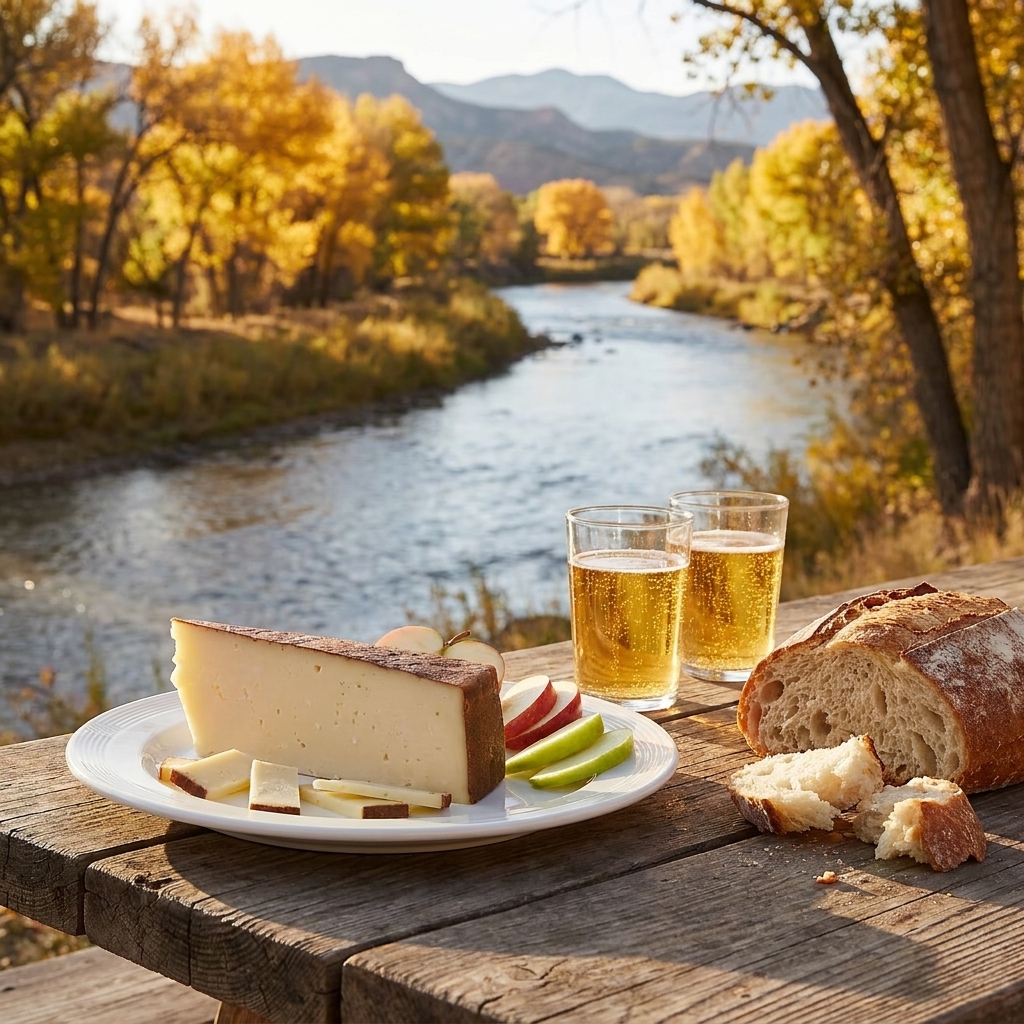
After a cool-weather walk along the San Juan River, this is a pleasantly low-effort snack. No oven, no elaborate board and no need to buy six kinds of jam.
Pro Pairing Tip: Keep the first bite simple. If you start with sweet preserves and a strongly flavored cracker, you will mostly taste the preserves and cracker.
Wine: Fruit and Freshness Before Power
A lightly oaked Chardonnay is a sensible place to start. Its rounded texture and gentle oak notes can echo the cheese's butter and baking spice. Choose one with enough freshness that the combination does not feel heavy.
Pinot Noir offers a lighter red option, with fruit that can complement the nutty interior without burying the spice coating. A soft, fruit-forward Merlot can work for similar reasons.
Cabernet Sauvignon is a bolder choice. Some bottles will overpower the cheese, particularly when young and strongly tannic. If Cabernet is already open, try a small taste rather than treating the pairing as a rule.
For an aromatic white, consider off-dry Riesling or Gewürztraminer. A little sweetness can connect fruit flavors with the spice aroma. Riesling's acidity provides welcome contrast to the rich cheese.
Beer, Cider and an Alcohol-Free Option
A porter or stout can bring coffee, cocoa and toasted malt notes alongside the buttery cheese. Avoid assuming that stronger is better. A very bitter roast character may crowd out the nutmeg and clove.
An amber lager is an easygoing choice, with toasted bread flavors and a crisp finish. Hefeweizen, a German-style wheat beer, can contribute yeast-derived clove and banana notes that make an interesting match with the coating.
An IPA takes the pairing in a sharper direction. Citrus and hop bitterness create contrast, but aggressive bitterness is not everyone's friend alongside baking spice. Try amber lager first if you want the safer bet.
Then there is apple cider. Dry or gently sweet hard cider brings a familiar apple-and-spice combination. Sparkling nonalcoholic apple cider works, too; choose a less-sweet version when possible.
Pro Pairing Tip: Pair by intensity. A modestly spiced bite needs a drink that leaves room for the cheese, not a contest between the loudest flavors on the table.
Build a Board, Then Put the Leftovers to Work
For a small board, start with sliced apples or pears, plain crackers and toasted pecans. Add dates, raisins or a little dried pineapple if you enjoy a sweeter contrast. Keep nuts separate when serving guests with allergies.
Apple butter and pumpkin butter are natural companions, but use a light hand. A thin smear is plenty. Briny green olives, crusty bread and mild cured meats bring the board back toward savory territory.
In the kitchen, treat this as a finishing cheese before making it the main ingredient:
- Shave it over roasted butternut squash just before serving.
- Stir a small amount into risotto off the heat, then taste before adding salt.
- Scatter fine shavings over squash soup.
- Combine it with a milder melting cheese in a grilled sandwich.
Gentle heat is your friend. Like other aged cheeses, it can release fat or become grainy if overheated. The spice coating can also become more prominent in a hot dish, so add gradually.
If you are shopping in Pagosa Springs, ask at Murray's Cheese inside City Market about seasonal Sartori selections. Check current availability before planning a gathering around this particular wedge.
Storage, Crystals and When to Let It Go
Keep the cheese refrigerated at 40 degrees Fahrenheit or below. Leave unopened packages sealed and follow their storage directions. After opening, protect the cut face with cheese paper or parchment, then place the wedge in a food-storage container or bag to limit drying.
For a picnic or the drive back to a rental, use a cooler with ice packs. Refrigerate perishable food within two hours, or one hour when temperatures exceed 90 degrees.
The brown spice coating is intentional. Small hard white specks may be aging crystals, but appearance or a finger rub alone cannot prove that an unfamiliar patch is harmless. New fuzz, slime or a pronounced off odor warrants attention. Do not taste questionable cheese to test its safety.
USDA guidance allows mold to be cut from a solid hard cheese by removing at least 1 inch around and below the affected spot, keeping the knife out of the mold. That advice does not apply to shredded, sliced or crumbled cheese. With a small wedge, there may not be enough cheese to trim safely. When in doubt, discard it.
Spice oils can show antimicrobial effects in laboratory settings, but a spice coating is not a food-safety shield. It does not replace refrigeration or extend the package's storage guidance.
Freezing may reduce texture quality, making the cheese more crumbly after thawing. For the best board experience, buy an amount you can enjoy refrigerated.
Say It, Slice It, Share It
The name is pronounced PUHMP-kin spahys BEHL-uh-vee-TAH-noh, by sar-TOR-ee.
Give it a fair first taste without honey, jam or a speech about pumpkin spice. A thin piece, a slice of crisp apple and a quiet minute will tell you more. The seasonal coating is the invitation. The aged cheese has to earn the second bite.
Sources and Further Reading
- Sartori BellaVitano, Wisconsin Cheese, Dairy Farmers of Wisconsin. Style, character and pairing ideas.
- Our Heritage, Sartori Cheese. Company history and cheesemaking development.
- All About Wisconsin's Master Cheesemaker Program, Wisconsin Cheese, Dairy Farmers of Wisconsin. Certification and training.
- Curd Is the Word: Storage & Enjoyment Best Practices, Sartori Cheese. Care and serving guidance.
- Molds on Food: Are They Dangerous?, USDA Food Safety and Inspection Service. Mold identification limits and safe handling.