Estimated Reading Time: 7 min
An American cheddar with an everyday job
Murray’s Mild Yellow Cheddar is an American cow’s milk cheese built for sandwiches, snacks and warm, comforting meals. It belongs to the semi-hard family, which puts it between soft cheeses such as Brie and firm grating cheeses such as Parmesan. It is ripened, not fresh, even though its flavor stays gentle.
Murray’s began as a cheese shop in New York City’s Greenwich Village. Its expansion through Kroger brought specialty cheese counters into grocery stores, making a cheese-and-apple supper a little easier to assemble alongside the week’s groceries.

In Pagosa Springs, check Murray’s Cheese inside City Market for this cheddar and other options. Stock can change, so ask at the counter if you have a particular block in mind.
One distinction matters: Murray’s Mild Yellow Cheddar and Murray’s New York State Yellow Cheddar aged six months are separate offerings. The latter comes from Adams, New York. Don’t assume that its origin or aging time applies to every Murray’s yellow cheddar. The package is your best guide to the specific cheese you’re buying.
Milk, cultures and the ingredients worth checking
This mild cheddar starts with pasteurized cow’s milk. Starter cultures, which are helpful bacteria, turn milk sugar into lactic acid. That acid helps shape the cheese’s flavor and structure. Rennet then helps the milk set into curd, and salt contributes flavor while helping control moisture and microbial activity.
Ingredient check: Expect cultured pasteurized milk, salt, coagulating enzymes and annatto coloring. Milk is the key allergen. Always read the current package if you have an allergy or dietary restriction.
Rennet is an enzyme preparation that coagulates milk. It can come from animal sources, microbes or fermentation processes. For vegetarian shoppers, the important distinction is not whether a label says “enzymes,” but whether the manufacturer identifies those enzymes as nonanimal. Look for an explicit vegetarian designation or ask the cheesemonger to confirm the current product specification.
A 1-ounce serving of Murray’s Mild Yellow Cheddar has about 110 calories, 9 grams of fat, 6 grams of saturated fat and 6 grams of protein. It also supplies roughly 200 milligrams of calcium and 190 milligrams of sodium. Check your package for the current numbers. Cheese brings useful nutrients, but its saturated fat and sodium still deserve a place in your portion decisions.
Pasteurization: A safety step, not a flavor shortcut
Pasteurization heats milk to reduce harmful microbes before cheesemaking begins. One common method heats milk to at least 161 degrees Fahrenheit for 15 seconds. Other approved time-and-temperature combinations also exist; that standard example does not identify the exact equipment or process used for a particular block.
For cheddar made from unpasteurized milk, the federal standard requires curing for at least 60 days at a temperature of at least 35 degrees. That does not mean aging makes every raw-milk cheese risk-free. Nor does pasteurization make finished cheese immune to later contamination.
For you, the practical point is simple: This is a pasteurized-milk cheese, and it still needs clean handling and refrigeration.
How curds become cheddar
Cheddar takes its name from an English village, but its defining production step has traveled widely. Traditional cheddaring turns loose curds into a dense, cohesive cheese through a sequence of draining, stacking and pressing.
The basic process looks like this:
- Set the milk. Cultures and rennet help create a gel-like curd.
- Cut and drain. Cutting releases whey, the watery portion of milk.
- Cheddar the curd. Curds knit into slabs that are stacked and turned as acidity develops and more whey drains.
- Mill and salt. The slabs are cut into smaller pieces and salted.
- Press and ripen. The curds become blocks, then mature under controlled conditions.
Modern plants can mechanize these steps. Scale alone does not tell you whether a cheese will taste good, and a specialty-shop label does not necessarily mean a block was handmade on a small farm.
What age and moisture actually change
Mild cheddar sits at the younger end of the cheddar range. Its maturation is generally measured in weeks or a few months rather than years. “Mild,” however, is not a precise aging guarantee. For an exact age, look for a stated maturation period on the label.
As cheddar ripens, enzymes break down proteins and fats. Those changes help develop deeper flavor and alter texture. Young cheddar tends to remain supple and cohesive; older cheddar often becomes more crumbly and more intense.
Moisture matters, too. Under the U.S. standard of identity, cheddar may contain no more than 39% moisture and must have at least 50% milkfat in its solids.
That last phrase needs translating. Milkfat in the solids measures fat after excluding water. It does not mean half the whole block is fat.
Young cheddar often retains enough moisture to feel yielding rather than brittle. But water is only part of the story. Acidity, calcium balance and protein breakdown also affect how cheese slices, stretches and melts.
Taste it before you put it in a sandwich
Take one small bite plain. You’re looking for a gentle dairy sweetness, buttery richness and a light tang, with possible hints of nuts or grass. Those subtler notes should be quiet. This is not a cheese that needs to announce itself from across the table.
The texture should be smooth and cohesive, with a little resistance under your teeth. “Fudgy” is a useful description of that dense, yielding feel, not a suggestion that it tastes like dessert.
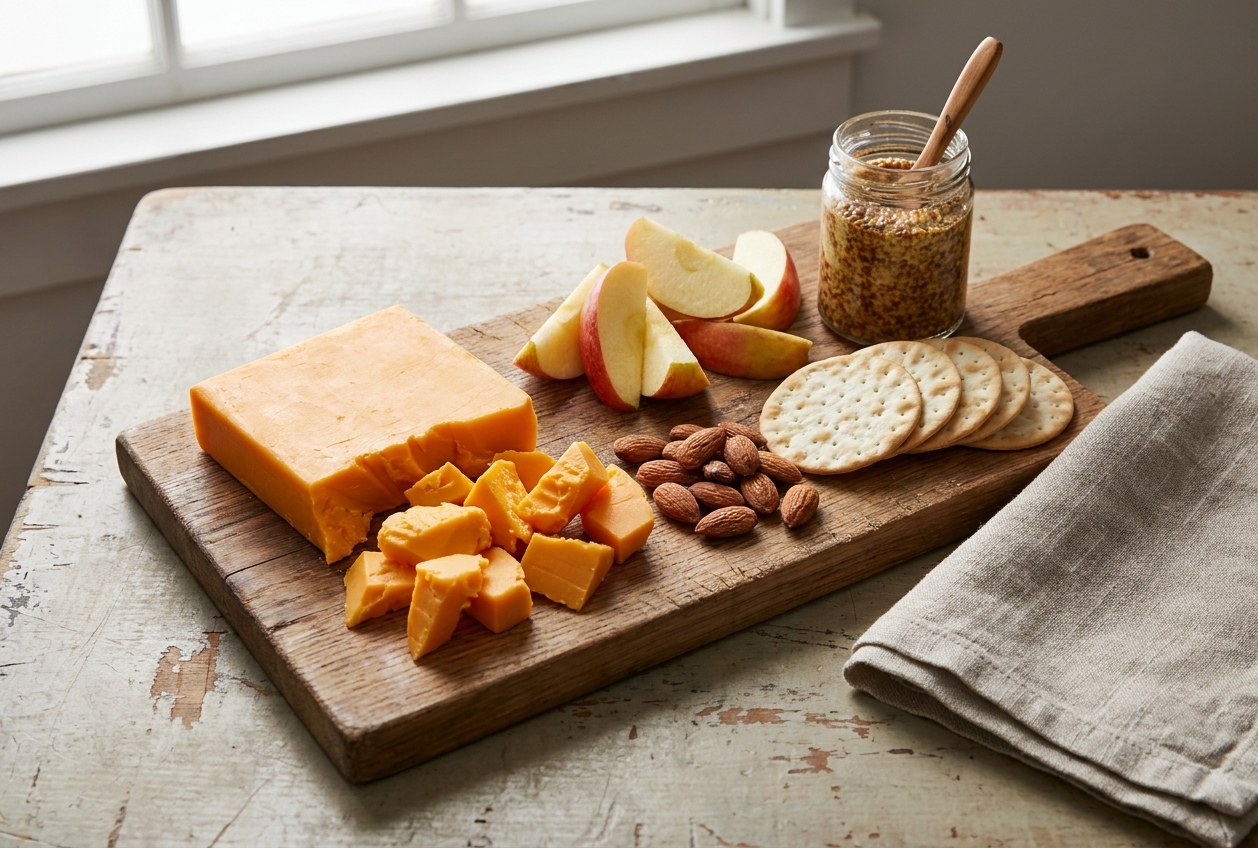
For a quick tasting, let a small portion lose its refrigerator chill while you slice an apple and set out crackers. Keep the rest refrigerated. Taste the cheese alone, then with apple, then with a dab of mustard. You’ll notice how much its mild flavor changes with the company it keeps.
Why the cheese is yellow
Yellow cheddar usually gets its warm color from annatto, a plant-derived coloring made from the seeds of the achiote tree, Bixa orellana.
The tradition has roots in efforts to give cheese a consistent golden appearance. Milk from cows eating fresh grass can carry more beta carotene, which contributes a natural yellow tint. Added coloring helped smooth out seasonal differences and, over time, became part of cheddar’s familiar look.
Annatto contains pigments called bixin and norbixin. Water-dispersible norbixin preparations are widely used in cheesemaking, where the pigment associates with milk proteins.
The useful takeaway: Color does not measure sharpness. A deep yellow cheddar can be mild, and a pale cheddar can be fiercely aged. Choose by style and age, not by shade.
Melt it gently, and it will repay you
Mild cheddar is a sensible choice for grilled cheese, burgers and macaroni and cheese. Its gentle flavor also makes it a useful base when you want another ingredient, such as green chile or mustard, to remain noticeable.
But no natural cheddar is guaranteed never to separate. Too much heat can still squeeze out fat and tighten proteins. Smooth melting depends on the cheese, the recipe and your technique.
For a dependable cheddar sauce:
- Grate the cheese first. Small pieces melt faster and more evenly.
- Prepare the sauce base. A milk sauce thickened with a butter-and-flour roux helps keep the finished sauce stable.
- Lower or turn off the heat. Add cheese to a hot base, not a rolling boil.
- Stir in small handfuls. Let each addition melt before adding more.
- Adjust gently. Use a little warm milk to loosen the sauce if needed.
For grilled cheese, use thin slices or grated cheddar and moderate heat. After a cold day around Pagosa, patience at the skillet is worth it: You want the center melted before the bread turns too dark.
Pro Pairing Tip: Blend mild cheddar with a smaller amount of sharp cheddar when you want more flavor without giving up the younger cheese’s easygoing character. You still need gentle heat.
Build a board with contrast
Mild cheddar benefits from something crisp, something tart and something with a little bite. You do not need six jars and a decorative arrangement of rosemary.
Try these combinations:
- Tart apples: Granny Smith provides a clear contrast; Honeycrisp adds a sweeter crunch.
- Apple butter or fig jam: Use a thin smear to echo the cheese’s sweetness without burying it.
- Cranberry-orange preserves: A bright option when you want more tartness.
- Whole-grain mustard: Especially good in a cheddar sandwich or alongside plain crackers.
- Toasted almonds: Their crunch contrasts with the smooth cheese. Keep nut allergies in mind when sharing.
For a summer picnic, pack cheese in a cooler with ice packs. A shaded spot beside the river is pleasant, but it is not refrigeration.
Wine and beer that let mild cheddar speak
Start with lighter wines rather than the biggest bottle on the shelf. Pinot Grigio and Sauvignon Blanc offer refreshing acidity. A lightly oaked or unoaked Chardonnay can work well, too. Buttery Chardonnay styles may echo the cheese’s richness, though oak level alone does not determine that buttery character.
Dry rosé brings fruit without much weight. For red wine, try Pinot Noir or Beaujolais. A tannic Cabernet Sauvignon is not forbidden; it simply risks becoming the only thing you taste.
Beer is an equally friendly partner. Lager and pilsner keep the pairing crisp, while a restrained pale ale adds hop bitterness. A moderately bitter IPA can work, but a forceful double IPA may overwhelm this cheese.
A lighter porter offers a different direction, with roasted flavors alongside the cheddar’s dairy sweetness.
Pro Pairing Tip: Taste the cheese first, then sip. If the next bite seems flavorless, choose a less intense drink. For an alcohol-free option, try sparkling water with apple slices on the side.
Know what belongs on the block and what does not
Keep cheddar refrigerated at 40 degrees or below, wrapped well and protected from contamination. Follow package storage instructions. Once opened, use a clean knife and rewrap the remaining block promptly.
Discard cheese with unexplained swollen packaging, a slimy surface, widespread mold or a strongly unpleasant, rancid odor. Do not taste suspicious cheese to test its safety. Smell and appearance also cannot detect every foodborne hazard.
Small, hard white crystals can be harmless calcium lactate, formed when calcium and lactic acid combine. Pale seams where curds joined can also be a texture or appearance issue rather than spoilage. Neither should be confused with fuzzy growth. If you cannot confidently tell the difference, do not guess.
USDA guidance allows an isolated mold spot on a solid block of hard cheese such as cheddar to be removed by cutting at least 1 inch around and below it, keeping the knife out of the mold. Rewrap in fresh material. If the block is too small to leave that margin, discard it. Discard moldy shredded, crumbled or sliced cheese rather than trying to salvage it.
At the table or on a picnic, follow the two-hour rule for perishable food, reduced to one hour when temperatures exceed 90 degrees.
Say it, slice it, enjoy it
Pronunciation: MUR-eez myld YEL-oh CHED-er.
Mild cheddar does not need an elaborate defense. It needs a decent apple, a carefully cooked sandwich or a sauce that never reaches a hard boil. Buy a small block, taste it plain and give it a useful job. Sometimes the cheese you reach for most often is the one that gets the least fuss.
Sources and Further Reading
- Murray’s Mild Yellow Cheddar Cheese Block, Kroger.
- 21 CFR § 133.113: Cheddar Cheese, Legal Information Institute, Cornell Law School.
- Cheese Melt and Stretch, Cheese Science Toolkit.
- Molds on Food: Are They Dangerous?, USDA Food Safety and Inspection Service.
- How Does Annatto Change Cheese?, culture: the word on cheese.