Estimated Reading Time: 8 min
A Swiss wheel with a clear identity
Murray’s Cave Aged Gruyère comes from Switzerland, not from Murray’s aging caves in New York. It begins at one Swiss village dairy, then finishes aging in a facility built into natural sandstone cliffs. Murray’s does not publicly name its dairy partner or cave operator.
That Swiss origin matters. The cheese carries the Le Gruyère AOP designation, a protected name tied to rules for milk, production and aging. AOP stands for Appellation d’Origine Protégée, or protected designation of origin.

The main production area covers western Swiss cantons including Fribourg, Vaud, Neuchâtel and Jura, plus designated areas of Bern. Certain historic dairies outside that core area also qualify. All Le Gruyère AOP ripening takes place in Switzerland.
In the United States, however, the word “gruyere” alone does not guarantee Swiss origin. A federal appeals court affirmed in 2023 that the term is generic under U.S. trademark law. If you want this particular tradition, look for Le Gruyère AOP and the country of origin, not just a familiar name.
The milk: Local farms, grass and winter hay
This is an all-cow’s-milk cheese made with raw, unpasteurized milk. Murray’s describes the milk as non-GMO and silage-free.
For standard Le Gruyère AOP, farms supply their assigned dairy from within a maximum radius of 20 kilometers, about 12 miles. Milk is generally delivered twice daily, keeping the trip from milking to cheesemaking short.

The cows’ menu is closely controlled: fresh pasture in summer, dry hay in winter and no silage, which is fermented stored forage. That restriction helps reduce the risk of certain bacterial defects during long aging. It is a practical rule, not just a pastoral selling point.
No single cattle breed defines the cheese. Western Swiss dairy herds include Holstein, Red Holstein, Swiss Fleckvieh, Simmental and Montbéliarde cattle. The shared standards matter more than a claim that every wheel comes from one picturesque breed.
Ingredients and dietary notes
The essentials are raw cow’s milk, starter cultures, salt and traditional animal rennet. Rennet helps turn liquid milk into curd; this cheese uses calf rennet, so it is not vegetarian.
Milk is the key allergen. Mature Le Gruyère AOP is naturally very low in lactose, commonly described as lactose-free at less than 0.1 gram per 100 grams. That does not make it safe for someone with a milk allergy. The cheese itself is naturally gluten-free, though crackers, beer and other accompaniments may not be.
Raw milk, cooked curds: Both can be true
“Raw milk” does not mean the cheese never encounters heat.
The milk is not pasteurized before cheesemaking. After cultures and rennet form a curd, the cheesemaker cuts it into small grains and heats the curd-and-whey mixture to about 129 to 138 degrees Fahrenheit. This cooking step helps drive out whey. The curds are then pressed into large wheels.
That makes Gruyère a cooked-curd, pressed cheese. It is also an Alpine-style hard cheese and a washed-rind cheese. Those terms describe different parts of the same process, not competing identities.
Curd cooking is not equivalent to pasteurization. If you are pregnant, immunocompromised or otherwise at higher risk from foodborne illness, choose a pasteurized alternative in line with public health guidance.
What 10 months in a cave accomplishes
Murray’s ages this Gruyère for 10 months, reaching the starting point of the commonly used Réserve maturity category. Le Gruyère AOP requires at least five months of maturation, so this wheel has extra time to develop depth.
During aging, the wheels are turned and rubbed with brine. That care supports the rind’s community of microbes, sometimes called the morge, which helps shape the cheese’s aroma. Affinage is simply the skilled work of aging cheese.
Robots handle much of the heavy lifting, flipping and washing in the Swiss sandstone facility. A wheel weighs roughly 73 to 80 pounds. Even the most devoted cheesemonger has a back to protect.
Time also changes the interior. Enzymes break down proteins, flavor grows more complex and moisture slowly escapes. The result is firm but still supple, rather than dry and brittle.
Moisture, fat and the reason it slices so well
Le Gruyère AOP standards set moisture at 34.5% to 36.9% when batches are evaluated. That is enough water to keep the cheese pliable, but little enough to give it a dense, compact body.
You may also see a fat figure of 49% to 53%. That means fat in dry matter, the share of fat after water is excluded. It does not mean half the wedge in your hand is fat. The corresponding total-fat range is roughly 31% to 35%.
For your kitchen, the useful distinction is simpler: This is a hard cheese that can still bend a little, slice neatly and melt well. “Hard” does not have to mean “bring a chisel.”
Taste first, then look for the small details
Expect toasted hazelnut, browned butter and a savory depth that recalls beef broth. There is dairy sweetness underneath, with a light oniony note toward the rind. “Beefy” describes the flavor, not an added meat ingredient.
Try a bite from the center, then one closer to the rind. You might notice a more earthy, pungent edge in the second piece. The microbes near the surface work in different conditions from those inside the wheel, so flavor is not identical from rind to center.
Protein breakdown releases savory compounds, including glutamate. Other ripening reactions create buttery, fruity, nutty and sulfur-rich aromas. You do not need to memorize the chemistry to recognize the result: a cheese that tastes like more than salt and cream.
The interior should be ivory-colored, dense and slightly yielding. Small, hard crystals may add a faint crunch as the cheese matures. These are not the same as fuzzy mold.
And do not expect cartoon-sized Swiss-cheese holes. Gruyère usually has few holes or none. Large eyes are more closely associated with Emmentaler.
Build a board without burying the cheese
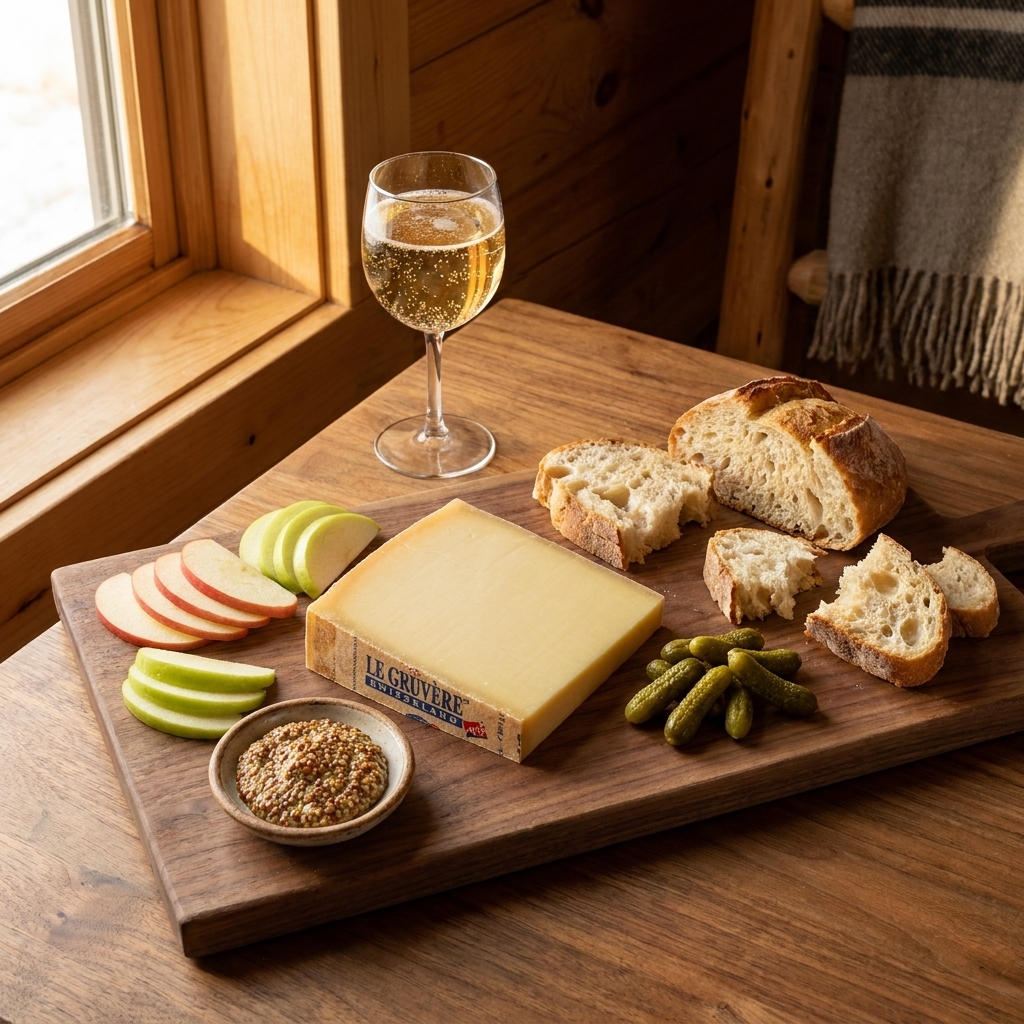
For a relaxed evening in Pagosa Springs, this wedge needs fewer companions than you might think. An apple, good bread and something pickled can do the job.
- Take out only what you plan to serve. Let it warm for about 30 to 60 minutes so the aroma opens up.
- Cut into small sticks or thin slices. Pieces about ¼ to ½ inch thick are easy to eat and let you appreciate the texture.
- Add something crisp and tart. Apple or pear slices, cornichons and a dab of mustard balance the richness.
- Choose one nutty or savory extra. Roasted pistachios, walnuts, onion confit, prosciutto or peppery beef salami all make sense.
- Leave some space on the plate. The cheese should not have to compete with six jams.
Pistachio cream is a particularly good sweet-savory partner. Onion confit takes a different route, echoing the cheese’s mild onion note. Use either sparingly.
For picnic season, carry the cheese in a cooler rather than letting it warm throughout the drive or hike. Keep total unrefrigerated time under two hours, or one hour when temperatures exceed 90 degrees.
At Murray’s Cheese inside City Market in Pagosa Springs, ask whether Cave Aged Gruyère is in stock and request a piece sized for your plans. A smaller wedge you finish while fresh beats an ambitious purchase forgotten behind the mustard.
Melt it gently, especially after a cold day outside
After a day at Wolf Creek or a chilly walk along the San Juan River, Gruyère earns its place in dinner. It brings depth to French onion soup, potato gratin, quiche, croque monsieur and grilled cheese.
It melts well, but it is not immune to bad treatment. High heat can still make cheese release fat or become grainy.
For a smoother result:
- Grate it while cold, when it is easier to handle.
- Use gentle heat and add it gradually to sauces.
- Avoid boiling once the cheese is incorporated.
- Follow a tested fondue recipe, including its wine and starch proportions.
For classic Swiss moitié-moitié, meaning “half-and-half,” combine Gruyère with Vacherin Fribourgeois. Dry white wine contributes flavor and acidity; starch helps keep the mixture together.
My vote for a low-effort supper? Gruyère grilled cheese with tomato soup. Toast the bread slowly enough that the middle melts before the outside burns.
Wine: Start with freshness, not muscle
A dry white with good acidity is the easiest place to start. Swiss Chasselas, including Fendant from Valais, is a traditional choice. Savoie whites such as Apremont or Chignin offer another Alpine match.
More familiar options include dry Riesling, Grüner Veltliner and unoaked or lightly oaked Chardonnay. Champagne or Crémant brings bubbles and a refreshing contrast to the cheese’s rich texture.
For a more adventurous pairing, try an oxidative Jura wine such as Vin Jaune. Its walnut-like character can echo the cheese’s toasted notes, though that distinctive style is not everyone’s weeknight pour.
Prefer red? Choose Pinot Noir or lightly chilled Beaujolais. Their fruit and generally lighter tannins leave room for the cheese. A heavily oaked, powerful red would not be my first choice for a plain wedge.
Pro Pairing Tip
Taste the cheese alone, sip the drink, then try them together. You are looking for a pairing that keeps both flavors clear. If the wine overwhelms the cheese, switch to something lighter rather than adding more toppings.
Beer and cider deserve equal billing
A classic saison is a strong match. Its dry finish, lively bubbles and peppery notes play well with Gruyère’s rich body and faint rind funk. Saison Dupont is a useful style reference.
Amber and brown ales take a toastier route, echoing hazelnut and browned butter through their malt flavors. A malty bock can work well, too.
Belgian dubbels bring dark-bread and dried-fruit notes; tripels offer a brighter, spicy contrast. Pour these stronger beers in small amounts so they do not dominate.
Sparkling hard cider is another easy choice, especially alongside apple slices. For a nonalcoholic option, try sparkling apple cider or plain sparkling water with the board.
Keep it fresh, and know when to let it go
Wrap the wedge in cheese paper or parchment, then place it in a loosely closed bag or container in the refrigerator. Keep the refrigerator at 40 degrees or below. Rewrap after cutting, and avoid freezing cheese intended for a board because thawing can damage its texture.
A tan-brown rind, mild earthy aroma and hard white crystals can be normal. A slimy cut face, rotten smell, widespread mold or strong ammonia throughout the interior is reason to discard the piece. Appearance and smell alone cannot guarantee food safety.
For an isolated mold spot on a solid block of hard cheese, USDA guidance allows trimming at least 1 inch around and below the mold. Keep the knife out of the mold itself, then use fresh wrapping. If the wedge is too small to leave that margin, discard it.
Do not apply that rescue method to shredded, crumbled or sliced cheese. Discard those if mold appears. Do not sniff visibly moldy food, and clean the storage area afterward.
Terroir Tales: A very old cheese with modern helpers
Cheesemaking in Switzerland’s La Gruyère region appears in written records dating to 1115. A roughly 77-pound wheel takes about 400 liters of milk, or 106 gallons. Large wheels were a useful way to preserve a substantial supply of milk long before household refrigeration.
Traditional copper vats remain part of Gruyère’s identity, while modern cave equipment handles strenuous aging tasks. Wheel markings and casein labels provide traceability through dairy numbers and production details.
That mix of old methods and new tools is more interesting than a tidy tale about tradition standing still. Good cheese has always required both skill and practical decisions.
Order it with confidence
Say groo-YAIR, with the stress on the second syllable. The Swiss-French vowel is a little different, but you do not need an accent lesson to buy dinner.
Start with a small wedge. Taste it plain before melting any of it. Then decide whether the rest belongs beside a crisp cider or on tonight’s soup. Either way, give those 10 months of aging a moment of your attention.
Sources and Further Reading
- Murray’s Cave Aged Gruyère, Murray’s Cheese. Product identity, aging and tasting notes.
- Le Gruyère AOP: Cahier des charges, Swiss Federal Office for Agriculture. Official production and aging specifications, in French.
- Le Gruyère AOP, Switzerland Cheese Marketing. Cheese characteristics and dietary information, in French.
- Molds on Food: Are They Dangerous?, USDA Food Safety and Inspection Service. Safe handling and the hard-cheese trimming rule.
- Interprofession du Gruyère v. U.S. Dairy Export Council, U.S. Court of Appeals for the Fourth Circuit, via Justia. The 2023 decision on the U.S. use of “gruyere.”